

THE VICAR
Even if he weren’t a deacon at St. Patrick’s Church on Bridge Avenue, Franklin-Clinton Block Club president Bill Merriman would be held in saintly regard by his neighbors. He’s a former mailman with the U.S. Postal Service and the owner of multiple homes on Church Avenue between West 29th and West 32nd. For years, Merriman has charged low rents to his tenants (which include the annual crop of Jesuit volunteers) to preserve and protect what has long been considered a core value on Cleveland’s near west side: diversity.
Merriman is a short, bespectacled, older man who walks with a slight forward hunch and is rarely seen without a beatific smile. His goodness and humility would be ripe for parody if they weren’t so sincere. But they are.
On the morning of Nov. 2, 2015, Merriman sat patiently at the Board of Zoning Appeals on the fifth floor of City Hall. He was there to offer a voice of dissent on a variance that would allow the owners of the Schaefer Printing Building on Detroit and West 28th Street to convert the second and third floors into apartment units without on-site parking. The zoning code requires eight parking spaces, but none were shown in the plan.
The owner of the Schaefer Printing Building is, for the moment, Bob Schaefer, but will soon be Graham Veysey and Marika Shioiri-Clark, the married co-developers and christeners of Hingetown. Veysey and Shioiri-Clark told me later that the variance was essentially a technicality. People park in the gravel lot adjacent to the Schaefer Building all the time, they said. The lot is even rented out on weekends to Bounce Nightclub. The city just doesn’t recognize it as a parking lot.
“We’re excited about redeveloping the whole property,” Veysey told BZA chair Carol Johnson at the meeting. “In addition to the lot, looking at those mixed-use plans and having a ton of … having a long runway in order to figure out what are the needs of the community.”

Some members of the Franklin Clinton block club — Bill Merriman, in any case — are worried that the variance is not a technicality at all. Once it’s in place (and it’s granted in perpetuity), Veysey and Shioiri-Clark will have license to develop the lot however they please. That could mean more bars, more restaurants, more apartments. It certainly won’t be a parking lot for long. And though Veysey and Shioiri-Clark have insisted that they won’t do anything without a “robust community process,” some are yet to be persuaded. (The fact that Veysey wasn’t keen on voluntarily postponing the variance request, or making a presentation to the block club, were interpreted as stormy portents.)
“I feel humbled in the shadow of something great coming in,” said Merriman, after both Veysey and Shioiri-Clark had spoken. “It’s with great trepidation that I present my case before you, Madame Chairman. I’m requesting a postponement and I’m suggesting that an unfavorable decision would be appealed, the reason being that the request for a zoning variance is being presented by the Schaefer Printing Company. Yet we’re hearing a case not from the owner, but from a developer who probably has had more favorable coverage in the Plain Dealer and Vanity Fair and elsewhere than anyone I can think of, maybe even more than [councilman Joe Cimperman] — I feel like I’m a devil’s advocate, perhaps.
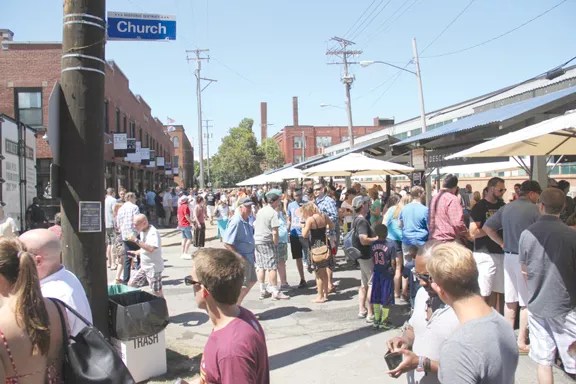
“But in light of that, if I can only suggest that as an adjacent property owner (we live on Church Avenue adjacent to Transformer Station, Tea Revival, to a variety of successful businesses that have graced the neighborhood over the past few years because of Marika Clark and Graham Veysey, there’s absolutely no doubt), but part of the package of this entertainment or gathering space, like a piazza in Florence or something like that … is that it has its challenges. I think the challenges should be heard by the board this morning.
“The harm that we expect is because my wife has dementia, and there are others in the neighborhood who are challenged by the crush of hundreds and sometimes thousands of people who come into the neighborhood to celebrate and to enjoy good food and good wine and beer and fine music. But what has happened, occasionally — and these are extreme instances — my wife has cringed at 9 and 10 o’clock at night wondering what has happened to her life as the music pounds through our 6-inch insulated walls and double-pane glass, as the entertainment district celebrates and draws in so many people from around the area, and enlivens the imaginations of people about life in Cleveland …”
“Mr. Merriman, I have to stop you,” Johnson interjected. “We’re discussing the fact that they’re going to change it to residential. Two floors of residences only. There’s no entertainment, there’s no bar here. There’s no restaurant here, there’s nothing.”
“I hear you, ma’am,” Merriman responded. “And I’m only speaking for myself, not as a representative of the block club, but this is an entertainment district of which this is going to be a key component. I anticipate that this is going to be developed as well as they’ve developed the Striebinger Block on West 29th Street. And questions have not been answered in terms of how to deal with the huge crush of crowds and loud, amplified music at 9 and 10 o’clock at night.”
“That’s something you’ll have to discuss with them,” Johnson said. “And if there is a development project, maybe in the spring, we’ll see it. You’ll certainly get a notice and come back again to make your comments. But what we’re okaying today is putting in residences. That’s it. Six residences. And that’s all.”
“Yes ma’am. But again — and I hate to use this word — this is a Trojan Horse. This is the beginning of something that is even more than we currently have, even more of a challenge to the residential community that has not had these basic questions answered. The developer and his business partner have great things in store for all of us, but it needs to fit into the larger context of what’s happening to a neighborhood that is no longer residential. And as such I offer my objection.”
Ben Trimble, director of real estate and planning for Ohio City Inc., chimed in to register support for the variance on behalf of the CDC.
“I think Mr. Merriman is expressing some trepidation by the community because they haven’t heard a full plan for this building. But I think it’s the case that there just isn’t one yet,” he said. “We realize that there are a lot of unanswered questions, but there’s a lot of work to be done before we come back.”
“Really I think the unanswered questions are ones we’re still trying to figure out ourselves,” Veysey said in conclusion. “But the six apartments, that’s the thing we know can give us the runway in order to look at how to responsibly redevelop, with immense community input.”
THE POWER COUPLE
“We’ve got to get these apartments done,” Graham Veysey is saying, walking the length of the Schaefer Building’s third floor. “Right now, there’s not a lot of there there.”

He’s not kidding. The empty second and third floors look like something out of Saw. They’re dusty and dark and littered with printing company antiques: typewriters and boxes of metal letterpress type. But when complete, with new windows and snappy interiors, these six units figure to be hot commodities. Among other assets, they’re exactly one mile from Public Square, less than a mile from the Happy Dog, and a short walk to the Market District. It’s on the near-westside’s proverbial hinge.
“Then the lot,” says Graham, “which is an exciting opportunity, we’ll be able to dive deep into ‘What is that?’ And it’ll also be right around the time that Rick Foran and Chris Smythe’s [West 25th Street Lofts] project is coming on board.”
Graham and Marika walk to the roof of the building that will soon be theirs, both jacketed against the November wind. Marika carries a Mason jar with a coffee-cup lid. Graham gazes out and down. In every direction, he can point to an imminent residential project cropping up on this, the north end of Ohio City.
“You’ve got 83 units there,” Graham says, gesturing to the forthcoming lofts on Church Avenue between West 25th and West 28th. “You’ve got 250 units right there.”
“Snavely,” Marika elaborates, referencing Peter Snavely’s Chagrin Falls-based construction company. They’re set to break ground in early 2016 on their ‘superblock’ on the northwest corner of West 25th and Detroit — currently a vacant lot — which is also the proposed new site for the Music Settlement. “Thirty or 40 will be affordable units, above Massimo da Milano [across the street].”
“Then you’ve got Mariner’s Watch,” says Graham, pointing west on Detroit. “Which is 64 units. And that’s fully occupied. Then on the other side of that, you’ve got the Vintage Project, which is the Marous Brothers — the actual brothers. They’re building a six-story building with 60-plus units.”
“It’s the old Club Cleveland,” says Marika.
And directly across Detroit, of course, is the Federal Knitting Mills Building, 66 “authentically redeveloped,” “industrial-chic” lofts, which have been on-line and in-demand for years.
“When you add all those up,” says Graham, “it’s more than 500. There’s no place in Cleveland, other than the downtown core and University Circle, that’s seen the urban density that we’re seeing in this immediate area.”
Graham is quick to point out, however, that almost all of these properties are redevelopments of vacant buildings or lots. They fit into Ohio City Inc.’s strategic plan to prevent the further cannibalization of the interior neighborhood’s historic housing stock. There’s plenty of room for growth, academics and developers say, and Veysey and Shioiri-Clark are eager to continue being a part of it. But they’re also particular about the way they present themselves, anxious to be viewed not as real estate developers or gentrifiers, but as “responsible redevelopers” and “community builders.”
Iterations of Graham and Marika’s story have been repeated — to the extent that Hingetown’s story has been repeated — in the pages of local and national publications. It goes something like this: A boomeranger and a frisbee — Graham, a University School alum, is originally from Shaker Heights; Marika’s from Berkeley, California — both of them young, white, college-educated and terribly fashionable, have created a trendy sub-neighborhood out of thin air. (Correction: Marika is half Japanese and a Japanese citizen). And, go figure, their hearts seem to be in the vicinity of the right place. They don’t just want profits, they want to establish roots. Since the arrival of their projects, the prostitutes and drug traffickers who had imperiled the local environs are no more, and the businesses and the residents and the weekend tourists are all more or less equally pleased about the spirit of collaboration and innovation that now abides. And have we mentioned the amenities?
Graham, targeted by a realtor for his “OHCITY” license plates, bought the old firehouse on the corner of Church and West 29th Street four years ago and converted it to a live-work space. Rising Star Coffee and Urban Orchid are now anchor retail tenants on the first floor. Graham’s video production company and Marika’s design studio are on the second.
Then, with backing from Fred Bidwell — the modern art collector and force behind Transformer Station, soon to be a Hingetown resident himself — Graham and Marika bought the Striebinger Block building on Detroit and West 29th.
“The building was about to go into foreclosure,” Marika told me. “It was owned by this predatory lending company in L.A. and if we hadn’t bought it, I’m positive they would’ve torn it down and turned it into a Wendy’s or something.”
With vision and elbow grease, Graham and Marika physically renovated the building and secured tenants that jibed with the vibe: Harness Cycle, Beet Jar, Tea Revival, Jukebox Tavern. Dean Rufus’ House of Fun, a longtime tenant, is still going strong.
In short order, they beefed up the intersection’s “programmatic side” — Ohio City Stages, the Cleveland Museum of Art’s weekly summer concert series; the Hingetown Hoedown, a bluegrass music festival; the Hingetown Hygge; and the Cleveland Flea’s Sunday Market — and solidified the Hingetown brand: logo, signage, website, the whole deal. There was vibrancy in the air.
“It’s one of the things we’ve talked about from the beginning,” Marika said. “How to responsibly redevelop by filling in the missing teeth between these pockets of vibrancy [West Side Market, Gordon Square, etc.], to kind of knit together a larger, more vibrant near-westside.”
The headlines have practically written themselves: “Can One Young Guy Lift Cleveland Out of its Misery (No, Not LeBron James)”; “How One Young Couple Turned a Toxic Corner of Cleveland into a Development Hotbed”; “How One Young Couple Led the Renaissance of a Cleveland Neighborhood”; “Welcome to Newly Revitalized Hingetown, Cleveland’s Latest Hot Spot.” (It’s the favorable coverage that Bill Merriman was alluding to.)
But Graham told me in our first phone conversation that he’s been uneasy with the some of the coverage, and of being painted as a sort of savior.
“I didn’t write those headlines,” he said. “And there’s an element of trying to get people to click. I shouldn’t be blamed for what an objective editor or digital editor puts in a headline. I mean, have you ever had a headline written by any of your subjects?”
No indeed.
Graham said that any good piece of journalism about Hingetown should strive to be a “holistic narrative” that talks about “the Bill Merrimans,” and, among other things, the residents of Lakeview Terrace public housing on the other side of Detroit Avenue.
“All I can do is talk about my first-hand accounts and celebrate the social justice history of this community,” Graham said. He referenced his and Marika’s work with Station Hope and Cleveland Public Theatre (where they are both board members), and said that when he speaks with reporters, he often tries to talk about poverty issues and urban policy — Graham was, in fact, recently appointed to Policy Matters Ohio’s board of directors — but that reporters, almost without fail, end up writing stories about him and Marika instead.
“I don’t know if it’s better to just not call attention to what I think is a beautiful thing [Hingetown], this amazing collaboration, or stay silent. But I don’t write any of these articles.”
THE ANTAGONIST
Graham Veysey certainly did not write “My Issue with Hingetown,” a harshly worded screed written by neighborhood resident Ben Hess in the aftermath of the Vanity Fair piece.
“Graham Veysey is a pompous piece of shit,” Hess wrote (not what you’d call burying his lede), “and any lasting impact he’s had on the Ohio City area is far more toxic than anything that was happening on West 29th before he branded it ‘Hingetown.'”
Hess has lived next door to Bill Merriman on Church Avenue for most of his life. He’s 24 now — a Benedictine alum who spent time at both Ohio University and Cleveland State — and works at the Capitol Theatre in Gordon Square. While he cares deeply about the neighborhood in which he lives, you wouldn’t confuse him for a neighborhood spokesman. He told me over coffee that he’s never been particularly active with or vocal about community issues. Still, he said, the sentiments expressed in his blog post had been simmering for some time, and the Vanity Fair coverage, (and the Plain Dealer’s coverage of the coverage), was “the straw that broke the camel’s back.” He said that whether or not Graham claimed to be seeking credit for the neighborhood, the unmistakable impression from the articles was that it’s credit he was owed.
“Graham is so far up his own ass that he can’t even fathom the idea that maybe there was a thriving, inclusive community that has existed on the near-westside of Cleveland long before he was born, and that his ideals help no one outside of his elitist posse,” Hess wrote in the post. “Graham, in action, is building barriers and lengthening the divide between classes in a city that is far too segregated as is, and is shutting down anyone and everyone working to ensure people of all different backgrounds can live peacefully together.”
Hess acknowledged that his post was hostile, and that the name-calling was a “low blow” (though he rolled his eyes at Graham, in an email, calling him a “cyber bully”). He even published a sanitized “Radio Edit” when he learned his post was being widely shared, and recognized that the language discredited the contents for a lot of readers. But he stood by the aggression in principle:
“When [Graham] insults my neighborhood and the people I love,” he wrote, “all that I have left to do is stoop to his low; to sling insults.” (FWIW: It was Fred Bidwell, not Veysey, to whom the “nowhere, toxic corner” quote was attributed in Vanity Fair).
For his part, Graham sees little profit in talking about what Hess wrote, classifying the post as angry, hurtful, cyber- bullying, “with about as much value as a reader comment on Scene or Cleveland.com.”
That said, both parties are trying to meet. Their schedules have been uncooperative thus far, and even if they do get together, neither seems to be anticipating an especially productive conversation about the future of the neighborhood.
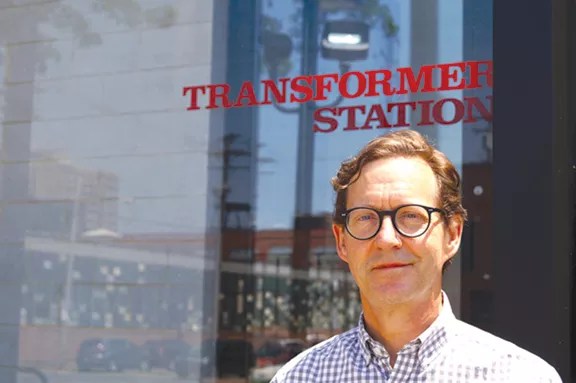
“Other than the language, the one big criticism I got was that people thought I had an issue with wealthy people coming into the neighborhood in general,” Hess told me. “That’s not my issue. Nor is my issue with the business owners. I really like Rising Star in particular. One of the things I really like about the community is that it’s diverse. I like the idea of poor people living in harmony next to middle-class people and rich people. My issue is with people who use money and influence to build up the barriers and make a bigger divide.
“At best,” Hess said, “there’s just a lack of consideration for people who don’t fit into their bracket.”
Graham and Marika both feel that Hess’s view occupies a radical fringe and said that depicting Hess as representative of a larger groundswell would be journalistically irresponsible. But nonetheless, several people responded positively to Hess’ posts. On Facebook and in informal conversations, Hess was lauded for speaking out. A few told me that though they weren’t personally offended (or affected) by Hingetown’s developments, they found the idea of an intersection masquerading as a neighborhood — and the “place-making” rhetoric — pretty ridiculous. (See also: “SoLo.”)
Graham was hurt and saddened by the post, and anyone who’s been targeted by vindictive online commentary can sympathize. But he interpreted the blog post as a baseless personal attack, suggesting that the accusations were neither grounded in fact nor in “any of the realities that [he’d] seen.”
“I just wanna get this right,” Graham told me. “I care passionately about the work that’s being done here, and I want to make sure there’s fairness in how that’s reflected.”
That’s a desire Graham and Ben are likely to share.
THE ACADEMIC
Turning, then, to a more holistic narrative, and the idea of responsible redevelopment that can benefit the whole community: Here’s what Richey Piiparinen, the region’s go-to expert for population dynamics and demographic research, had to say:
“You can’t manufacture economic restructuring through lifestyle amenities.”
Piiparinen said that Cleveland, where only 16 percent of the population is college educated, has plenty of room for the type of development we’re seeing in Ohio City, but that policy makers need to get ahead of market forces if they want to plan for good neighborhoods.
And the key to good neighborhoods, Piiparinen said without equivocation, is “diverse demographic makeup, not only racially but in terms of household formation. Anything that goes away from catering to one type of person. And that type of person, in America’s urban revitalization, has been young, white, college-educated, and largely from the suburbs. So anything that creates the amenities much broader than the classic creative-class-ification model, which consists of microbreweries, bike paths and art galleries.”
Piiparinen said he doesn’t blame Veysey and Shioiri-Clark for bringing precisely that type of development to Ohio City — “Four years ago,” the Vanity Fair piece began, “Graham Veysey and Marika Shioiri-Clark set out to develop and cultivate their ideal neighborhood.” He said that this problem is much bigger than Cleveland, and that it’s probably academics and policy makers, not developers, who should be responsible for ensuring the growth of equitable communities.
“[Graham and Marika] are making money. And they’re in the wrong business if they’re not trying to make money off of real estate,” he said.
But if it is indeed “responsible redevelopment” they’re after, Piiparinen wasn’t convinced that Hingetown will have positive effects on the residents in Lakeview Terrace or the neighborhood’s poor and minority populations.
“There’s an isolation of psychogeography,” he explained. “When you’re building amenities largely for white suburbanites, are you going to feel welcome as a minority going into these places? You’re not. So when they say, ‘What are the things that people want?,’ it sounds simple; but the playbook of urban regeneration has been creative-class-ification, and that has created huge divisions. So pivoting away from that, and developing neighborhoods for people, instead of for a demographic, is hugely important.”
Piiparinen’s No. 1 prescription? Affordable housing. He said that Cleveland is a long, long way off from places like Brooklyn or San Francisco, where residents get priced out of rental units. The bigger problem is that as a newer neighborhood gentrifies, it becomes exclusionary, and low- and even middle-income people don’t get access to an area “thick with opportunity and amenities.”
So the big issue that policymakers need to think about is the diversity of the housing stock.
“Are we just gonna build one- and two-bedroom luxury condos?” Piiparinen asked. “Or are we going to capture the fact that millennials are going to want kids just like every other generation? Are there going to be single-family homes? And is there the land to build single-family homes? And is there a concerted effort to do so?” (Graham, in follow-up correspondence, said one policy he thought was worth exploring in Cleveland was Philadelpia’s program of tax abatement for longtime homeowners). (Correction: Graham first mentioned this program at an in-person meeting at the Firehouse. He sent Scene information about it, by email, three days later).
From a demographic standpoint, Piiparinen saw one clear positive:
“Cleveland needs circulation; it needs demographic dynamism. So one of the really good things about these projects [like Hingetown] is you get a lot of outsiders, people who may have been living on the coasts who come in largely for job reasons and who want to live in products that they’re used to. It helps to change this kind of insular, parochial mentality that we’ve had.
“One way to look at this is that rising conflict [between old neighbors and new developers] might actually be a metric of success, like the tension is actually a good thing. It’s something that we’ve been missing for a long time.”
Graham and Marika, in a quiet moment back at the Firehouse, admitted that there’s always tension as neighborhoods evolve.
“I think it’s a balance, right?” said Marika. “Is it better to have a neighborhood with a large number of abandoned parking lots and places where there’s trash and nobody gives a shit about it? I think that there are places like the Bay Area and Brooklyn where there really is a scary level of homogeneity, where every single place is a very expensive restaurant. But the situation here is so far from that. And of course this is an important conversation. We need to be smart about directing the changes in this neighborhood. But we have no intention of skirting the block club or anything like that.”
“We’re really excited to meaningfully engage.” said Graham. “It’s a necessary dialogue.”
THE NEIGHBORS
At a community meeting at Franklin Circle Community Church one evening in early November, residents gathered for this sort of meaningful engagement. Matt Hils, a principal from Behnke Landscape Architects, presented a conceptual framework, commissioned by the Snavely Group, for streetscape improvements in the area surrounding the new residential development on Detroit and West 25th. The presentation focused primarily on safety and connectivity, and during a lively Q&A, that’s what residents sank their teeth into first.
Ohio City Inc.’s Kerry McCormack and Destinee Henton (community outreach and affairs, respectively), marshaled comments from a diverse pool of congregants. Bill Merriman was there. When called upon, he said that the Snavely Group might consider a comfort station on the corner of West 25th and Detroit. It’s the second busiest RTA hub in Cleveland, and an important intersection for commuting cyclists as well. Mayor Jackson’s chief of staff Ken Silliman was in attendance. Graham and Marika were there too, listening intently.
Residents were curious about green space, about public art, about the mechanisms for safe crosswalks, about traffic patterns for the student dropoff at the proposed new location for the Music Settlement (on the first floor of the Snavely development), about the long-term sustainability of infrastructure, and about the trajectory of development — “I think having stores that are more neighborhood feeling and not just, you know, 10 more restaurants, would be great,” said one recent Kent State alum, to applause.
Mike Fiala, a longtime Ohio City resident, asked Ryan Nagel, the Snavely rep, about what sort of subsidies the project stood to receive from the city. Nagel responded that they’d applied for typical tax abatements.
“And how much are you charging for the apartments?” Fiala asked.
“For the 194 units, they’ll be consistent with Mariner’s Watch, about $2 per square foot.”
“What’s that,” asked Fiala.
“So for a one-bedroom, 750-foot apartment, you’re at $2 per square foot, so that’d be $1,500,” said Nagel, who remained even-tempered throughout the Q&A. “We also will have some studios, the first studios on the near-westside, between 500 and 600 square feet, and those will run $900 to $1,000.”
“If I can just make the comment,” said Fiala. “I’m stunned, that in Ohio City, we are subsidizing $1,500 apartments. You could say that this market doesn’t need that anymore. It would be sensible to rethink how we’re doing that.”
Another resident piggy backed. “You’ve touched on diversity and being welcoming to all, and yet the proportion here is 194 units compared to 30 to 40 affordable. I’d love to see more affordable units.”
Nagel responded that he would too, but the bidding process at the state level for low-income tax credits is extremely competitive.
Another resident said he thought having the low-income units across the street created a physical division tantamount to segregation.
At this, Kerry McCormack, Matt Hils and Ryan Nagel all responded at once about the legal complexities of mixed-income housing. Residents began talking amongst themselves as well until a woman in the back stood to speak her mind:
“I love where I live,” she said, speaking with conviction. “I live in Lakeview Towers and I’ve got a view of the lake. I love my apartment. I love it. I appreciate what people are trying to do to improve the neighborhood. People are talking about affordable units, but how many people do we have down in Lakeview? 1,500? We got plenty of affordable housing all around here. We going to be here. All y’all are gonna be gone and we’re still gonna be here. We want to see this whole area improve. And if they’re gonna do that, they’ve got to make money.”
It occurred to another woman to ask who would be maintaining all these wonderful, exciting developments in the long-term.
“That’s our responsibility,” Ryan Nagel said. “This is a $60 million project, and maintenance is paramount.”
“Can I ask, how long-term is your commitment?” the woman continued.
Nagel said that terms with the Ohio Housing Finance Agency had been established at 15 years (for the affordable units) and that, with respect to the ‘superblock,’ Snavely was in it for the long haul.
“We’ve taken steps during the design of this building — it’s going to be brick masonry, the windows are going to be high quality — this is a building designed to last 40 to 50 years on Cleveland’s lakefront. We’re moving our offices to this building. This is a long-term investment in the neighborhood.”
“And like I said, I’m excited about the project,” the woman responded, after Matt Hils interjected to sing the praises of public-private partnerships. “But I look at the Flats and I look at the Warehouse District. I look at all these places where Cleveland spends time and effort and money making them look wonderful, but they’re always short term. In 10 to 20 years they die. I’ve lived here for 40 years and I’d like to see … I’d like to die seeing this one stay fresh and good.”
In a later conversation, Graham commented on that idea:
“I think the city has a lot of work still to do to understand what it takes to be a 21st-century urban area, and I think that the mayor’s emphasis on being equitable is admirable. I don’t know, but sometimes I get the impression it’s a zero-sum game mentality, that if something’s happening in one part of the city, it’s taking away from another. The truth is we, as a city, can prosper in many parts. And we should celebrate all those points of progression.”
This article appears in Nov 25 – Dec 1, 2015.

“Piiparinen’s No. 1 prescription? Affordable housing. He said that Cleveland is a long, long way off from places like Brooklyn or San Francisco, where residents get priced out of rental units. The bigger problem is that as a newer neighborhood gentrifies, it becomes exclusionary, and low- and even middle-income people don’t get access to an area thick with opportunity and amenities.”
Fortune Magazine has already picked Cleveland to become “the next Brooklyn”…maybe that should have been MIS-Fortune. The Brooklynization of certain parts of Cleveland has already begun, and the Near West Side has already begun easing down the road to becoming the next Lakewood.
If you’re not young, white, rich, college-educated, rich, white-collar, and rich, hit the road, Jack. Oh, and did I mention rich?
Chicago-level rents for Ohio City North, and a stupid name like Hingetown? Yuppie greedhead entremanures…go home! Go remake Shaker in your own narcissistic image, power couple! Kiss my ass!
Chuckles the Clown
To Graham Veysey and Marika Shioiri-Clark, don’t let others discourage you. Continue to do great work on a ‘human level’. Always make a difference.
How about putting a community center in the area?
dunno. kinda sounds like older residents south of Detroit Ave liked having a buffer of empty lots, empty buildings, and inactive corners between them and Lakeside residents.
if only there were something easy, perhaps skin deep, that could be an easy identifier as to why…….
to add: the only substantive objection seems to be the city-wide subsidy of any housing, no matter how expensive. the rest…people just don’t seem to like change. except the Lakeside resident, from a continuously ignored community, who would benefit from neighborhood amenities going in instead of empty lots and buildings.
“We want to see this whole area improve. And if they’re gonna do that, they’ve got to make money.”
I love how the one moment of sanity from the some (not all) of the whiners not happy with new development, is from a woman who lives in public housing.
It is absolutely right to hold developers’ feet to the fire when it comes to their plans for the neighborhood, but don’t call them ugly names when they make solid, legitimate improvements to a neighborhood that was otherwise a mess for years before they got there.
John Farina it’s obvious that the woman the projects that started “dropping knowledge” the instant people started arguing was a plant, liberals are so naive.
So what happened with the request for a variance to the parking requirement?
I absolutely agree with the resident who said “the proportion here is 194 units compared to 30 to 40 affordable. I’d love to see more affordable units.” I am so tired of seeing signs go up for ‘Luxury Townhomes!’ (or worse, McMansions) when people have been pleading for affordable housing for years, if not decades.
Just before this, I saw a post from the Coffee Party on Facebook saying ‘$ 7.85 x 40 hrs = 314 a week x 4 = $1,256 a month’ (that’s before taxes, mind you). That means a minimum wage employee who manages to get 40 hours a week couldn’t afford even a 500-ft studio in the Snavely development, let alone a one-bedroom. That’s not affordable. Show me the developer that’s putting in 200 apartments that rent for $600-$750, with 25 or 30 luxury units and I’ll be a lot more interested. Then put in something like the lovely little Ohio City Diner that used to be in the Streibinger Block before gentrification; the kind of place where you can get a whole breakfast for $5, not just a specialty coffee (yes, they exist). That’s the kind of urban redevelopment I want to see. Not holding my breath, however.
I for one love the dirty, grimey, sparse Cleveland of just a few years ago. That was the real Cleveland, all of this manufactured hipness only benefits the developers and those businesses ballsy or lucky enough to be in on the ground floor of these “movements.”
When you realize that these renaissances of blighted neighborhoods are happening across the country it feels more contrived and opportunistic, definitely not as organic or inclusive as they would like you to believe.
I think I’ll leave Cleveland while the picture of the real Cleveland is still fresh in my head.
I hope the hipsters have fun drowning in debt in hingetown.
The real Cleveland was PBRs and Rolling Rocks and bottomless cups of Regular Joe, not eight-dollar craft beers and five-dollar designer coffee…and that’s not what’s coming. It’s already here.
Thanks, hipsters. Now go outside on the patio and choke on your Nicaraugan stogies, you silly jamokes…while I laugh my ass off. Gotta get down…to…Hingetown…I can’t sing that without cracking myself up.
Chuckles the Clown
Chuckles needs to stop being such a jabroni.
Sincerely,
Hipster, Yuppie and Jamoke
This would have been a better story if the “woman in the back” had a name. The same could be said of Ben’s blog post: it lacks details and sources. The more strongly you word your criticism, the more evidence you ought to produce in support of it, if you’d like to bring about change and not just scream on the sidelines.
In discussions about how Ohio City development displaces poor residents, we tend to hear their stories and opinions filtered through advocates. But the woman in the back is making a very interesting point that partly contradicts the view of those advocates, and we can’t catch her name.
The tax abatements are ridiculous. Council is too much beholden to developers to address this though.
Mike Fiala has the quote of the article. Subsiding luxury apartment buildings and condos without any requirement for an affordability component is just disgusting. The city needs to get it together. We need to create policy that maintains social and economic diversity in our “hot” neighborhoods for the long term.
If the city can’t bulldoze ’em out…..they’ll squeeze ’em out.
If cultural/economic diversity’s what you are after, consider Slavic Village just across the river from Tremont Oh City Hingetown. SV is rebuilding just as agressively as our hip sisters to the west, but in less stylish, more blue collar, but equally legitimate fashion.
Cle’s got lots of neighborhoods each with its own take on urban revitalization. There’s one to suit just about every temperament.
I hope that’s true, Charles. I would not at all be surprised if some vultures tried to pull the same shit in SV.
As the pickpocket said to the chumps in Casablanca: “Watch yourself…there are vultures–vultures everywhere…”
Not just in Ohio City or Slavic Village.
Buy low…slap on some minimal cosmetic rehab (or quickly throw up another Urban Plasticville)…and sell high. It’s the way of the New World Order. Money not only talks, it swears.
Chuckles the Clown
rather than allaying fears of neighborhodd, Veysey with his vague, ambiguous comments, just reinforces the justifiiable view that developers are only out for money despite the consequences of gentrification to the neighborhood , no matter how much he;s fawned upon by media including SCene as some savior, by not making sopecifc committment about parking lot, not that verbal promises are as meaningful as paaper (air) they printoed on.
I have lived in this neighborhood for 43 years. As one friend said, “I moved to the Near West Side and woke up one morning and discovered that I’d been surrounded by Ohio City.”
Now one pier of the neighborhood, the Urban Community School, with students coming from families of diverse incomes, has moved 40 blocks west as according to its charter a majority of its students must come from below the poverty line. My kids went from there to eventually graduating from the University of Chicago & Boston U.
The West Side Community House, since 1890 the social services center of the neighborhood moved from 3000 Bridge Ave , 63 blocks west. The old building is now “The Lofts at West Side Community House” – plus a coffee shop.
Graham Veysey, Marika Clark and the various Real Estate developers saw an aging, gradually improving community that was ripe for development. Veysey , Clark, and Fred Bidwell of the CMA Transformer Station, found a particular blighted block and are intent on turning it into an upscale dream, surfing at the height of the Ohio City wave.
So social service agencies and bedrock schools leave the neighborhood because their clientele, families and service recipients, are leaving or clustered elsewhere. Well more than a thousand new apartments are coming in, affordable by almost none of the persons who lived here 20 or more years ago. And new blood, as my wife and I were decades ago, are not benefiting from the development, unless they are willing to forgo having children, or are willing to rebuild one of the increasingly rarer affordable houses away from the main arteries of the neighborhood.
It is difficult not to admire what Veysey, Biwell et al have done. They have benefited from the gentrification of the inner city, to the advantage, it is fair to say, of the tax base of the city and attracting people who would not have considered living or even visiting here decades ago.
I go to art exhibits at the Transformer Station, and do like a good cup of coffee. I loved the international music presented at Graham’s new brand “Hingetown” the past two summers.
But we were not in, as I have frequently heard, an area of blight redeemed only by the new arrivals.
And I know of no one of less than upper middle class income, moving here with kids.
The next to go will be the CMHA high rises, then the scattered CMHA housing. Bill Merriman is getting old. I doubt that his kids or grandkids, still in the neighborhood, will be able to maintain his houses where he has supported at nominal rent Somali refugees and idealistic neighborhood volunteers.
Capitalism will out, along with visionary exploitation of opportunities.
And I should add, in answer to Dan Baron’s question. BOZA voted 6-zero to allow the parking variance.