

Roughly $140 million will be bonded by the County — the very same county with a “maxed-out credit card” — and repaid over 18 years using a variety of revenue streams. The final repayment costs will be roughly double the initial price tag, which is why you might have seen the $282-million figure at Cleveland.com. Tim Offtermatt, recent Chairman of the Gateway Board, advised during a Q&A that the final costs are at this point unknown. They could be even higher than $282 million, and will depend on “market conditions.”
(If it helps, when the County talks about “bonds,” just substitute the word “loans.” They’re taking out massive loans.)
Both County Executive Armond Budish and Mayor Frank Jackson promised that all of the revenue streams that will be used to pay off the renovations already exist. No new taxes will be created and neither the city’s nor the county’s general funds will be affected.
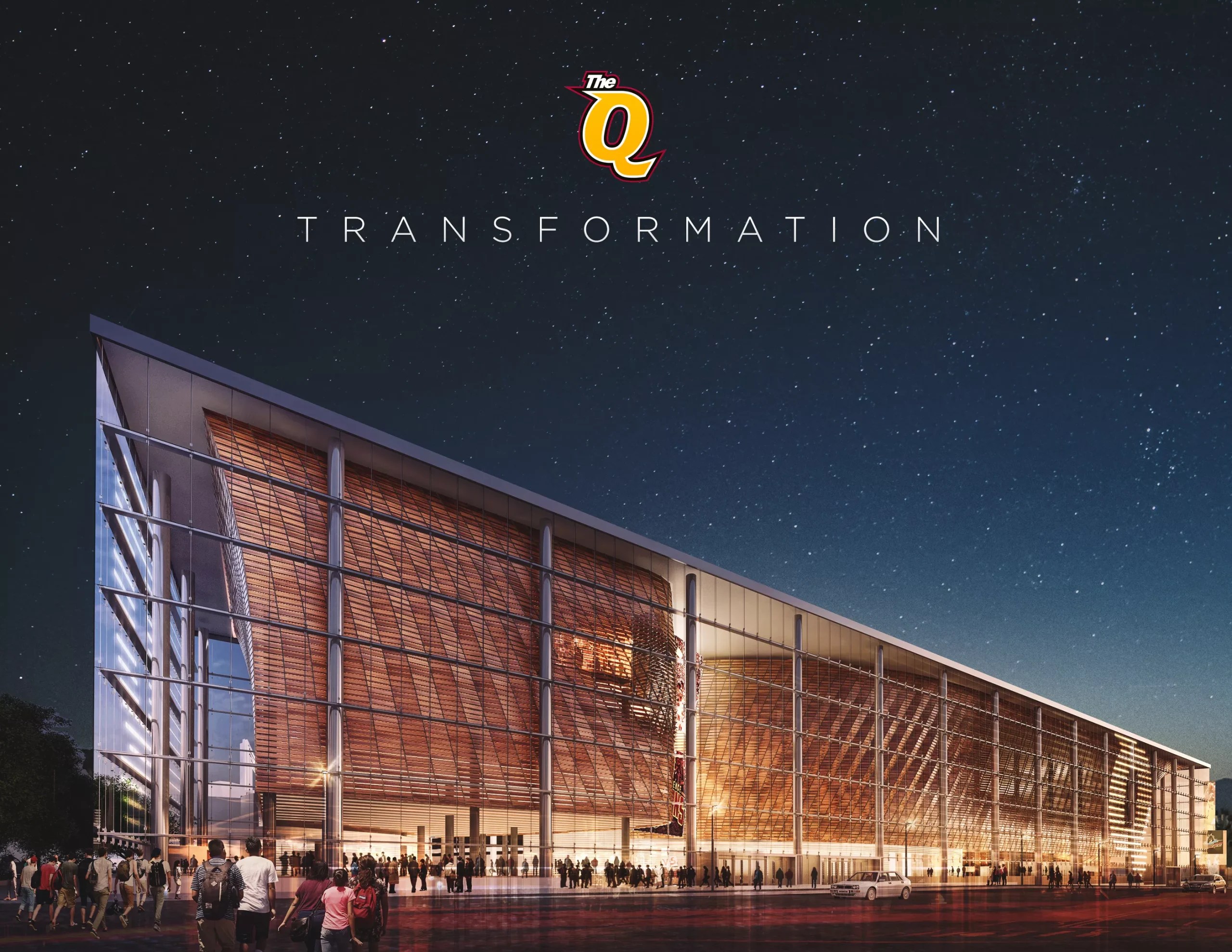
But the Tuesday announcement nonetheless scanned, once again, as propaganda. Sparkling images of the proposed new facade cycled on huge hi-def TV screens on either side of the speaker platform. The comments themselves focused on the region’s recent success, and on the Q as both motor and Mecca. The Q as “Cleveland’s living room” was the recurring metaphor.
Far from apologizing for yet another instance of a weary tax-paying public subsidizing billionaire sports owners, Armond Budish spent most of his remarks praising the generosity of the Cavaliers’ organization.
“The Cavaliers offered to pay half of the [$140 million] cost,” Budish said in opening remarks, “which I will tell you is very unusual in these types of projects, especially in a publicly owned facility. We knew that the deal was crucial to continuing the great momentum that the city and county are experiencing and we recognize that the Q is the largest economic driver for our region.”
Though the Cavaliers and city leaders continue to say this sort of stuff, the prevailing view among economists (in fact, the consensus) is that “sports subsidies cannot be justified on the grounds of local economic development, income growth or job creation.” That’s just for the record.
Nevertheless, a bouquet of fawning comments ensued from the roster of suited male executives — Budish, Frank Jackson, Destination Cleveland’s Board Chair Dan Walsh, Cavs CEO and Destination Cleveland Board Member Len Komoroski — about the changing narrative of Cleveland (for God’s sake), about the glorious potential of new and bigger events (what?), and about the peerless “public friendliness” of the financial arrangement already in place; Dan Gilbert’s mantra of “doing well by doing good,” was also lauded.]
Here’s how the public portion of the funding shakes out:
- ADMISSIONS TAX: There is expected to be a continuation of the existing portion of the eight percent tax on every ticket sold at Q events. It’s not clear how much this will generate, but the $88-million figure has been provided, which includes taxes on playoff games from 2024-2034. The Cavaliers have promised to pay any shortfalls on the predicted tax revenue.
- SALES TAX: This is the amount generated over and above the existing 1.25 percent County sales tax proceeds on all taxable purchases at the Q.
- COUNTY BED TAX: A portion of the county bed tax, which funds Destination Cleveland, will generate $44 million over 18 years.
- COUNTY DESTINATION FACILITY RESERVE: About $16 million in resources dedicated for the Hilton Hotel project, but were unused, will be re-allocated to pay down the renovations bonds.
- No sin tax dollars may be used for the renovations, as that money is earmarked for maintenance and operation.
But it was none other than Fred Nance — big-shot lawyer and Believeland talking head — not an elected official, who walked from the front row to the dais to deliver what must have been perceived as a knockout punch:
“For those of us who have lived in Cleveland for some time, we recall what happened here in 1995,” Nance thundered, and the press corps rolled its eyes. “Which is that if we don’t take care of the facilities in which our professional sports teams play, we are at risk of losing them.”
The risk of losing the Cavs must be almost zero, given the lack of viable markets elsewhere, the team’s enormous profitability, and Dan Gilbert’s web of local investments, and the Cavs contend that they’ve never brought up the possibility. But it’s a risk — a threat, really — that looms ever more ominously whenever sports teams ask for public money. And it was a threat advanced by Cleveland.com in their exhaustive coverage of the announcement Tuesday, coordinated ahead of time to coincide with the press conference.
The possibility of losing the Cavaliers, the very team that has “restored Cleveland to credibility,” is the philosophical dilemma that “hurts most to contemplate,” they said.
We are supposed to be grateful that the Cavs — “doing right by doing good,” remember — have extended their lease for seven additional years, guaranteeing that they’ll remain in town until 2034.
Cleveland will also host an NBA All-Star game. That was part of the announcement as well. The NBA has promised (we were told) that if renovations are complete, Cleveland will land the coveted weekend at some point during the next seven years. There are no specifics of course. (It was not mentioned that an All-Star weekend is small potatoes for a venue that just hosted the RNC before costly renovations.)
There was no mention, either, that the Cavs will be wanting to build a new stadium long before the bonds for these renovations are paid off. Projecting taxes on playoff games more than a decade in the future presupposes that the team will remain competitive after LeBron James retires, and that the Cleveland Cavaliers will still be playing professional basketball in the current Quicken Loans Arena. Those among us skeptical of long-term financing deals can foresee a situation in which existing or new taxes on tickets at a new stadium will still be paying down interest on bonds for renovations on a facility that may have been demolished years ago.
But this is how we roll.

“Throughout the process, we’ve actually taken a hard look at our budget, where our competitive set is,” Gilbert said. “And in this process we’ve also had the ability, with the total dollars, to smooth it out so there’s far less of an effect on the front end, and back-loading it as the bed tax grows. In the end, we are still very confident we are going to be able to perform our mission and do all the things that the organization is charged with doing.”
It’s also worth noting that City Council appears to have been kept in the dark on this (once again). Council members were outraged when they were blindsided by the Browns financing agreement back in 2013, and they’ll presumably be outraged this time, especially after they were kept in the dark about the Public Square decision. This is the city’s legislative body, (!!!) and no one’s bothering to include them in the city’s major financial decisions. The ball can’t even begin to roll on these renovations until council approves them, after which the construction is projected to last two years, during which the arena will remain fully operational.
Council President Kevin Kelley sent an email to his colleagues one hour before the press conference, saying he didn’t have all the details, but that council would “thoroughly review any proposed plan before approval.”
To sweeten the pot, Len Komoroski announced that the Cavs would be donating 15,000 tickets to Quicken Loans events each year to folks who otherwise might not be able to afford them — 10,000 of them will be for Cavs games. Well in THAT case!
All of this comes less than a year after County Executive Armond Budish advocated restraint on county spending. We’re a fat billion in debt. The “maxed-out credit card” is his oft-quoted line, and Scene asked whether or not these new bonds represented a contradiction of his earlier remarks.
“Not at all,” Budish said. “What I’ve said is we want to continue to move the county forward. We want to continue the momentum and looking for creative ways to do that. We can issue bonds as long as we have a way to pay for them. As you’ve heard, we’ve been able to work with the city and Destination Cleveland and our own sources to come up with a way to pay for these bonds without impacting city or county social services.”
We’d be remiss if we didn’t note that the energy and creativity expended to scrape every last available dollar for renovations at the Q might have been expended on worthier causes. Where is the county’s innovation and creativity in helping solve the financial perils of public transit? Where is the city’s creativity on infant mortality and lead poisoning? What if leaders bent over backwards to find money to solve, you know, actual problems?
But hey: At least the city income tax increase, lately passed, should lessen the blow of all the money the city would have received (from the Cavs’ rent on the publicly owned arena, ~$5 million per annum, from the admissions tax, from the sales tax) which will now go back into the renovation pot.
And just so we’re clear on the merits of this “public-friendly” “public-private partnership”:
To be clear, Dan Gilbert/the Cavs aren't forking over $70 million to do this upfront. (1)
— Vince Grzegorek (@vincethepolack) December 13, 2016
The Cavs "private" financial contribution is literally just their rent til 2034, which the Cle is choosing to use to payoff part of loan (2)
— Vince Grzegorek (@vincethepolack) December 13, 2016
This article appears in Dec 7-13, 2016.

thanks for this Sam.
We shouldn’t forget the past assistance given these sports facilities, including $240 million for the first sin tax; $136 million for the second; and an expected $260 million on the third, all passed by voters.
There is also this money trail as of 2013.
1990s – GATEWAY COSTS:
– JACOBS FIELD $180,000,000
– TAX EXEMPT COST $138,000,000 ($4.6 million annually – for 30 yrs.)
– GUND ARENA $157,000,000
– TAX EXEMPT COST $75,000,000 ($3,750,000 annual – 20-years)
– SITE PREPARATION $41,000,000
– LAND COST $21,000,000
(Gateway costs from a Gateway document marked “confidential.”)
– GATEWAY GARAGES $42,000,000 – city built. (City also had to rebuild city hall parking facility for another $21,000,000. It originally been built at city cost as a match for 1960 urban renewal at Erieview.)
– GATEWAY WALKWAY $13,000,000 RTA built.
(There is no total price but hundreds of thousands of dollars were spent on new street work, costly granite curbing and signage for the new projects.)
Gateway’s promoters promised some 16,000 good paying full-time jobs and 28,000 jobs in all. In subsequent years Cleveland lost tens of thousands of jobs. Gateway’s promoters promised no tax abatement but successfully fought and passed state legislation for full tax EXEMPTION for the projects.
GATEWAY POLICE PROTECTION: Mayor White & Council signed agreement that requires 50 city police at any baseball game with 35,000 attendance; 41 officers at arena large crowds. Of course, if these officers served these sports facilities they were unavailable in neighborhoods. The cost at times was at overtime rates. But who cares about them. In 2015 some 34,000 hours of police time went to the sports games.
PUBLIC TAX FUNDS PAID FOR GATEWAY & OVER-RUNS ONLY AS OF 2013 FROM COUNTY DOCUMENT:
– $240.5 Million (1st 15 years of excise sin tax)
– $125.5 Million (County general fund payments for Gateway bonds as of 2013 with $70 million still owed.)
– $38.2 Million (City admission tax for Gateway Bonds)
– $8.6 Million (County Bed Taxes for Gateway Bonds)
– $8.8 Million (excess from sin taxes for Gateway Bonds)
– $21.3 Million (labeled as “other” for County Gateway Bonds)
– $3.75 Million (County to reimburse State Loan for Gateway)
– $3.75 Million (City to reimburse State Loan for Gateway)
– $5.8 Million (City advance to Browns for Capital Improvements)
– $2.0 Million (Repay loan from Cleveland Foundation for Gateway)
– $11.5 Million (County payment on Gateway overruns)
1990s – CITY VOTED TAXES FOR BROWNS STADIUM & EXPECTED REVENUE:
DOWNTOWN PARKING 8% TAX $213,000,000
ADMISSION TAX HIKE $36,000,000
CAR RENTAL TAX $18,000,000
SIN TAX – 10 YEAR EXTEND $116,000,000
RTA WATERFRONT LINE $69,000,000
GATEWAY WALKWAY $13,738,536
If sports facilities were paying property tax (which were exempted when Hagan and White pushed state legislation to free them of any property taxes) Browns stadium would be paying some $8 million a year; Quicken Arena, $3.8 million a year; Progressive Field $4.8 million a year, based on 2010 County figures. That’s more than $16 million per year in lost taxes, about half from the city’s schools.)
– TOTAL SOME $16,000,000 PER YEAR SUBSIDY OF SPORTS FACILTY PROPERTY TAXES.
The RTA waterfront line, a big revenue loser which doesn’t even run regularly, was paid fully from local RTA revenue. Corporate leaders wanted the project done quickly and spurned federal subsidies that could have reduced RTA local costs. It showed clearly the corporate ability to ignore the major needs of poorest transit-dependent riders for the needs of downtown visitors.
1990s – BROWNS STADIUM – Financing
STATE OF OHIO $37,050,000
RTA CONTRIBUTION $3,000,000
CITY – WATER DIV. $2,000,000
N.E SEWER DIST. $2,246,760
TAX EXEMPT COST $240,000,000 (About $8 million annual 30 yrs.)
FREE USE OF CITY LAND – 2012 VALUE: $19,007,400
PRESENT YEARLY LAND TAX PAID BY CITY – $646,922.84 ON $19 MILLION VALUE
ANNUAL TAX LOSS TO CLEVELAND SCHOOLS ON STADIUM – $375,214
(I don’t have current figures for what Clevelanders are paying on bonds for the football stadium. However, by May 2009 the city had paid $102,823,947 and still owed $160,367,109 for bonds, according to city refinancing documents in 2007. Payments extend to November 2027.)
Roldo Bartimole
How ironic that those in our community who are currently losing their shit over the President-elect’s campaign to turn the U.S. Government into an explicit corporate oligarchy are seemingly okay with the unelected corporate oligarchy which has been systematically raping area taxpayers for their own purposes for the better part of two decades…
Lacking a bibliography for statements made, have to take this report with a grain of salt…. Common sense will tell you that if the Indians and the Cavs did not exist, the amount of people downtown through the playoffs spendin money would be nill…. So I don’t believe any of these studies mentioned…. Without the Cavs victory parade it could be years put together before that many people came to downtown…. The one thing missing from all these studies is COMMON SENSE….. No one ever thought the Browns would leave they were the most intertwined team and city in sports…. And then one day “Hello Baltimore”….. Scene is the worst in Cleveland and always looks to make a negative out of what ever it migjt be…..
I’m past the point of caring if a team is “going to leave” because they don’t get what they want. We have major problems that need to be addressed in Cleveland, and this is what people put forward instead. It’s sad, and its frustrating. Yes, it’s nice to make the arena look nice and all that. But the true benefit and revenue that comes from this isn’t going to benefit the local taxpayer at all. Yes the Cavs won the championship and Gilbert is paying a ton of luxury taxes to do so. But don’t forget how much taxpayers have done for him – bringing in the Gilbert backed casino (which gave him so much cash it isn’t funny), approving the sin tax, and basically handing our teams a whole bunch of money. So please don’t try to tell me that we’ve spurned these poor teams over the years. We have been AMAZING to them. Literally the only thing we ask in return is to compete and make us proud. But, as soon as there is a threat to not get what they want at that immediate time, uh oh the team could leave pops up. That’s a sad argument and a bunch of BS. But who honestly cares, because the decision makers that get all kinds of kick backs are going to push this through regardless.
Oh yeah, I love how because they won it’s like the city owes the Cavs now. Well we never got any kind of refund for all the years they didn’t win or do well. Grab your wallets, everyone, stadium renovations coming soon.
Great point about where that money would be WAY more useful! I love the Cavs and Indians, and want to love the Browns…but let’s face it, RTA is where that money could really go a LONG way to improve this town not just for tourism, but for people who actually live here and want to get a better job, but can’t get there because the bus doesn’t.
And as soon as you mentioned lead poisoningit’s not even a fair question! OF COURSE that money should go to mitigation of lead everywhere in this city! Dan Gilbert has a few bucks to spend on improving his arena that we pretend to own and lease to him. Regular folks in the city and in the suburbs need HELP getting rid of the lead in their house so their kids grow up to be plumbers, carpenters, computer programmers, doctors, and pro athletes instead of being mentally handicapped and on disability from lead exposure since the cradle.
Sports is a HUGE economic opportunityfor people in the business. For everyone else, it’s just another tax we pay so we can pay again for tickets or cable to watch them.
GO CAVS, BUT NO TO CORPORATE WELFARE: Imaginary Conversation with a regular Clevelander!
Hey Bro, can you spare a dime for Dan Gilbert?
Who?
Dan Gilbert! He is the owner of the Cleveland Cavaliers — affectionately know as the Cavs.
Really!
Well, he is super-rich with assets of $5 billion that is five followed by nine zeroes just in case you didnt know.
Huh!
The Cavs were the 2016 NBA Champions.
They were!
Now Mr. Gilbert has a big payroll for these basketball players who earn big bucks.
How big?
The current annual payroll is over $130 million — $130, 497, 470 to be exact. Lebron James, for example, earns over $30 million per year — $30,963, 450 to be exact.
Oh, my!
The Cavs play in the Quicken Loans Arena — also known as the Q — it is located downtown.
Never been there.
The Q was built in 1994. It is only 22-years old. The Republicans held their national convention in July.
Make America Great Again!
Mr. Gilbert wants to upgrade the Q. Says it will cost $140 million. Wants taxpayers in Cuyahoga County to share the cost 50/50 meaning folks like you and me will have to somehow come up with $70 million.
And our elected officials County Executive Budish and Mayor Jackson in a county with loads of existing debt ($1 billion) and high poverty rates (37% in Cleveland) — are cooking up schemes taking money from here and there and bending over backwards to help a billionaire.
Mr. Budish has stated that the Cavs are very good for the county’s economy.
Mr. Budish, however, forgot to state that while downtown Cleveland is a pocket of prosperity, none of the prosperity downtown being experienced by the 14,000 residents is trickling down to the rest of Clevelanders. With billions invested downtown the poverty rate in the 10-year period (2001-2010) climbed from 31 to 37% for adults. For children, the latest rate is over 50%.
And, if they are not successful in coming up with the $70 million Mr. Gilbert may take his team and move to some other city.
What say you?
FUHGEDDABOUTDIT!
Also, Mr. Gilbert has promised, if the taxpayers give him the $70 million he needs, Cleveland will not only host an NBA All-Star game — he will give away 15,000 free tickets, every year, to attend events at the Q including 10,000 for basketball games.
Bro, may be you will get a free ticket to the Q a.k.a. Clevelands Living Room.
GO CAVS!
There are five reasons why zero public funds should be dedicated to the renovation of Quicken Loans Arana (QLA).
1. No Need: QLA was just voted the 40th top public sports venue in the USA out of mover 700. Thats the top 6% nationally. QLA was good enough for Cleveland to be awarded the RNC in 2016 above every other city in the US. QLA does not need a $282 million upgrade to meet our needs. If the Cavs have a Christmas Wish List, they can pay for it themselves.
2. How Tenant Improvements Work: In every commercial real estate transaction, if a tenant (Cavs) wants his/ her space improved, the tenant is obligated to fund 100% of the cost of the improvements PLUS a return for the landlord (Us) with increased rent payments. The deal as presented and endorsed by our so-called leaders has the Cavs picking up only 50% of the cost. How much have the Cavs profits been in the last five years?
3. Reverse Robin Hood: The deal as presented is a gift to the rich Gilbert by the poor citizens. As proposed, QLAs renovation funding is a $160 million gift to Gilbert, whose net worth is estimated to be $5,800,000,000. He can afford to improve the facility we own if he wants to. It is morally irresponsible to have taxpayers finance Gilberts Wish List. And let’s not forget Gilbert’s broken promises of a huge development for the casino.
4. Priorities: We, the public and the QLAs landlord, have far more pressing priorities, like fixing/ replacing the 41-year old Justice Center, roads, bridges, fire stations, etc.
5. Design: Can we ever spend public money on local architects instead of shipping hundreds of millions of dollars to out-of-town firms for our communitys most important commissions? We keep shooting our own feet with our own gun. The design presented features a new monumental exterior glass wall with a large wooden barrier immediately inside a dishonest and foolish bit of design quackery form Gilberts lap dog architect.
When will we be honored with a social compact from our elected officials to act in the best interests of the community and be faithful stewards of our money instead giving sweetheart deals to rich white men who profit mightily already and dont need or deserve the handout?
This sort of thing happens in every American City with sports franchises. The money discussed is far lower than other cities. Budgets, unfortunately, do not work in a way that we are free to allocate whatever funds we want to whatever line item we want. The arena needs updates, unquestionably. It (and the franchises that call it home) will continue to help keep downtown, and Cleveland in general, relevant, which, in turn, creates more jobs and more residents. It really is as simple as that.
Too many apples and oranges arguments above. Eg. Should there be more money for RTA? Absolutely. So let’s raise the parking tax, stop building parking structures, and fix that directly and relevantly. But that has nothing to do with the Q.