


Among the miscellaneous radical values I internalized growing up on Cleveland’s near west side, one of the most readily observable was an idea that “community” was more than a buzzword — a whole lot more, in fact.
The sanctity of “community” was what might be termed a guiding tenet of the neighborhood. Abiding by it meant more than abstractly espousing its virtues. It meant girding one’s loins and doing some honest-to-god communing. Community was a thing to practice, to do, to be in.
Which was a little fetishistic and weird, it occurred to me more than once. What was the deal with all this community? Why was that word, in particular, a part of so many neighborhood institutions: Urban Community School, Near West Side Community Theatre (now Near West Theatre), St. Paul’s Community Church? Why were the block clubs so active? Why was everyone always hanging out in packs? What on earth were these hippie-dippie “intentional communities” about, places like the Jesuit Volunteer house on Church Avenue and the Catholic Worker Community behind St. Patrick’s Church?
“Community” was, in any case, deeply revered, and the apotheosis of that reverence — the major, capital-C community event, each year — was Harvest Moon. It’s a potluck that for 46 consecutive years has earnestly affirmed the following: A huge part of “community” is just getting to know and having fun with your neighbors. The potluck was and is a torchlit backyard soiree on Church Avenue, between West 32nd and West 29th Streets, replete with seasonal decorations and a kiddie pool full of bobbing beers.
Back in the ’90s, while the parents boozed and communed and tended the fire — there was always a fire — the urchins of the ‘hood would segregate more or less by age group and play hide-and-seek and Kill the Carrier in the nearby lots, which at that time were grassy and plentiful. We roamed freely among the properties owned largely by Bill Merriman, the former mailman and deacon at St. Pat’s who arrived in the neighborhood in 1969 while studying on the GI Bill. Late in the evening, we’d be summoned by the booming voice of George Hrbek, who’d lead the neighbors in “Shine on Harvest Moon,” a song which few people knew the words to, but during which everyone swayed and hummed along anyway.
When the Clinton Terrace condos arrived in 2000, Harvest Moon’s physical presence condensed a bit. It shrunk further still when another house or two went up on Church. Last year, the Mariner’s Watch complex, a new apartment building that seems far too large for its lot size, graced the neighbors with its hulking backside, blocking the view of the sunset over Lake Erie for the first time. There was a physical sensation of the potluck, and the old neighborhood that produced it, being boxed in or edged out.
But it wasn’t until this year, and the escalating tension with a competing event at Saucy Brew Works, that organizers felt that the event needed defending, that Harvest Moon was under siege.
***
Throughout the summer, before the potluck drama emerged, I’d been talking to neighbors from the Franklin-Clinton Block Club about some related concerns. I had a vague idea that I might write a followup to a piece I’d written two years ago about Ohio City development and the emergence of “Hingetown.” Recently, neighbors had been expressing frustration with the media portrayal of their neighborhood’s progress. They felt the narrative was being shaped and related almost exclusively by developers.
An identical dynamic had precipitated my 2015 coverage, when the regional and national press had anointed developer Graham Veysey in oils of euphoria — “How One Couple Turned a ‘Toxic Corner’ of Cleveland Into a Development Hotbed,” read a much-derided headline from Vanity Fair. This summer, other developers were getting similar treatment. There had been a lot of eye-rolling from the block club over a July Crain’s feature on developer Chad Kertezs, for example.
“I don’t think there’s a shared understanding of what the neighborhood’s all about between developers and business owners and long-term residents,” said Bill Merriman, thesis-wise, when we spoke this summer. “I’ve heard at least three major developers articulate that before they came here, it was a wasteland.”
“I’m one of the naysayers, but I think all this joy and development should be spread across the city, and that won’t happen as long as the planning is developer-driven.” — Gary Claxton
Priscila Rocha, 36, an attorney who has lived in the neighborhood for four years, said that when she read the Crain’s piece, the impression she received was that Kertesz had “discovered” the neighborhood.
“It’s like Christopher Columbus,” added Alex Frondorf, an attorney who serves as the block club’s vice chair. “How’d that go for the natives?”
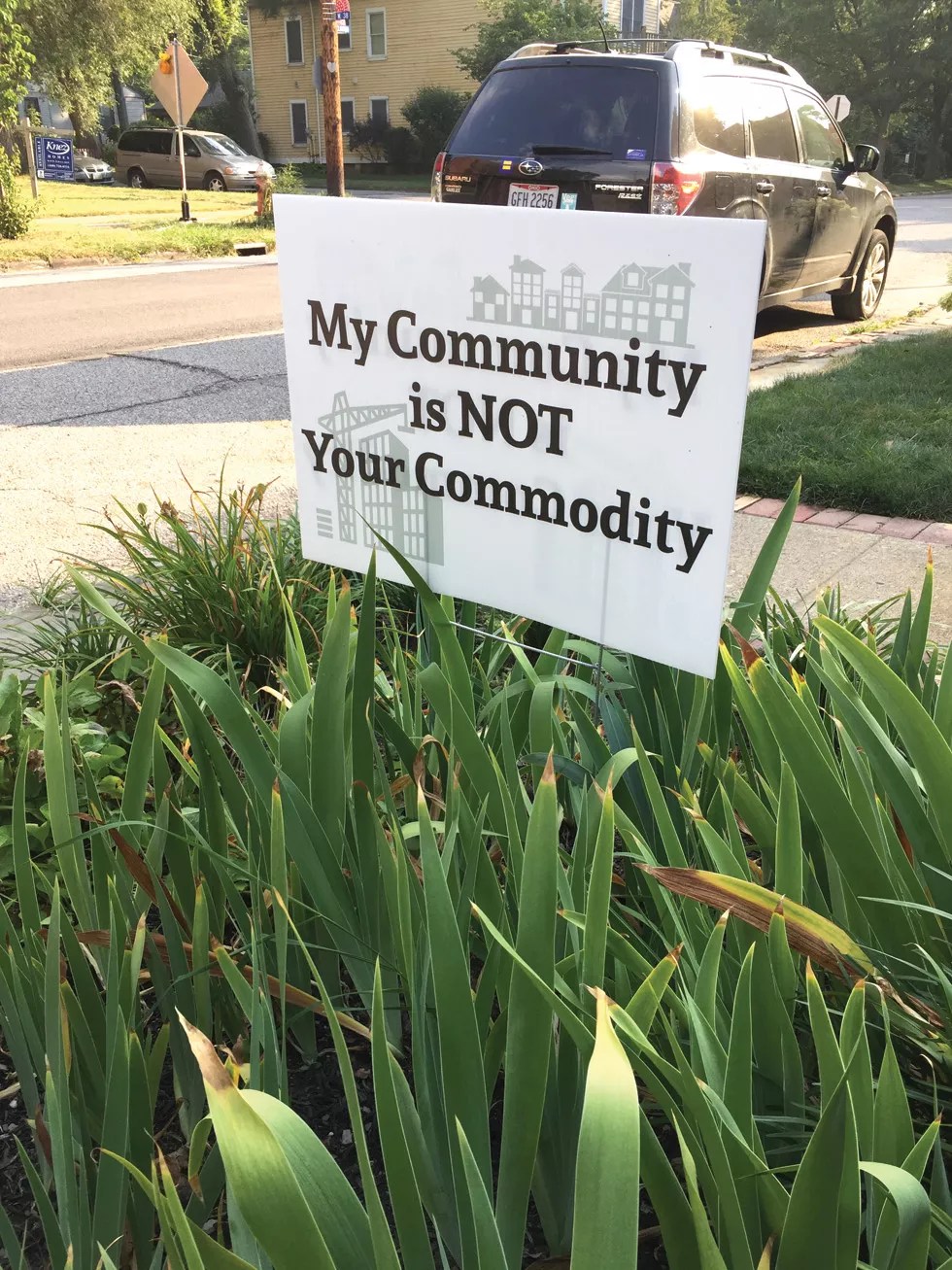
To publicize these and other frustrations this summer, many of the block club members had put signs in their yards: “My Community is NOT Your Commodity,” they read.
Next to the red signs for mayor Frank Jackson and the blue signs for councilman Kerry McCormack, these black-and-white ones seemed a bit aggressive. A bit hostile, even. The message appeared to project a strain of development opposition, but there were those who interpreted the message as one of exclusion. A few motorists I spoke to who’d seen the signs in passing thought the word “Commodity” was the word “Community” and that the signs were explicitly saying: This is my neighborhood, not yours, so get the hell out.
But the block club said the message had been misinterpreted, and that their stance, generally, had been repeatedly distorted and stereotyped. They resented being cast as disgruntled NIMBYers, (that’s Not In My Backyard, in case you weren’t hip to the acronym), and said that if the media had bothered to talk to them, they would have learned that the neighborhood’s positions were diverse and nuanced.
(For orientation: The Franklin-Clinton block club encompasses the rectangle demarcated by Detroit Avenue to the north, West 25th Street to the east, Franklin Boulevard to the south, and West 48th Street to the west. The “deliberate branding exercise known as Hingetown,” as described by one neighbor, is fully contained within its boundaries.)
“For the past two to three years, we have had almost monthly presentations from a variety of developers wanting to put their developments within our block club area,” said Karen Desotell, the block club’s secretary, in an interview this summer. “I think it’s fair to say that our block club has seen more developers than any other area in the city.”
And given the neighborhood’s spirit of community, it should come as little surprise that the neighbors want to participate in how the surrounding area is built up. The councilman (McCormack), the CDC (Ohio City Inc.) and the block club represent three critical nodes of power and influence. There’s an expectation, rightly or wrongly, that developers who want to build and thrive in Ohio City should be coordinating with at least one of these three entities, and ideally all three.
“You don’t see this in the pages of the Plain Dealer or Crain’s,” said Alex Frondorf, “but what we’d like to say is, the block club and the community are not opposed to development. Quite to the contrary, we very much support it. What we want to see is development done responsibly, and with the community in mind.
“What [the signs] are getting after is the fact that we’d like to work with developers to integrate new development into the community without destroying what made it so neat and desirable in the first place. You don’t do that by treating available land as a commodity, by making a quick buck and moving on.”
Priscila Rocha said that neighbors have been realistic. “We know development is happening,” she said. “We’re not trying to thwart development as a whole. But we live here and we need to be involved in the process.”
Gary Claxton, 69, is a retired librarian who has lived in the neighborhood for more than 40 years. He admitted that he has a more “jaundiced, radical” view of the situation.
“I think we’ve got enough,” he said. “I’m one of the naysayers, but I think all this joy and development should be spread across the city, and that won’t happen as long as the planning is developer-driven.”
Claxton and others said one of their primary objections was to the lack of strategic planning at city hall. Officials bend over backward, they said, to accommodate developers without sufficient foresight. Which is to say, without any foresight at all. The neighbors complained that the developers were not only “shaping the narrative” in the pages of the local press, but were dictating terms at a policy level. There had been no legislative discussion about targeted tax abatements, tax freezes for long-term residents or neighborhood parking permits, for example.
The city’s strategy, to the extent that there is one, prioritizes density. Frank Jackson and planning officials seem to want to capitalize on development momentum in hot neighborhoods. Urbanists, too, feel that density is essential, and that almost any development beats a vacant parking lot. The old neighbors are sometimes disparaged as parking lot-loving loons. But again, they said it’s not that simple.
“Absolutely these parking lots should be built on,” said Frondorf, when asked directly. “Our position, again, is that we want this land developed, but we want the development to foster community, development that doesn’t just take advantage of the momentum and tries to commoditize and profitize the recent success.
“Density is great,” he continued. “It allows more public transit, walkability. But do you need a 90-foot building to obtain density when a 40-foot building could do the same?”
“It’s about balance,” said Karen Desotell. “We certainly can accommodate more density. It would be awesome to see the area even more enlivened. But we don’t want to be the Gold Coast.”
The neighbors said that unlike the Gold Coast — a wealthy district in downtown Chicago comprised chiefly of high-rise apartment buildings — the new residential development on Detroit Avenue abuts single-family residences all along Clinton, and that the development should interact in a positive way with the existing residential community.
“It can’t dominate over it,” said Frondorf.
When I spoke with Karen Desotell before Frank Jackson joined members of the community on a neighborhood walk back in August, she referenced the hundreds of market-rate apartment units coming online soon, not to mention the hundreds of new apartments and condos recently built in Battery Park, one mile west. “How many of these units does this neighborhood need?” she wondered.
Gary Claxton perked up and turned toward us. “How many can it withstand?”
***
Saucy Brew Works arrived on the corner of Detroit and West 29th Street in 2016 after an extensive rehab of the long-vacant Steelman Building. The brewery-slash-artisanal-pizza-joint was a partnership between brewer Eric Anderson, formerly of Butcher and the Brewer, and developer Brent Zimmerman. Zimmerman had moved to Cleveland from New York City, where he’d worked in finance, in 2005. (Zimmerman is originally from Bellevue, Ohio.) After managing a hedge fund locally, Zimmerman began focusing on real estate investments and REspring, a company he co-founded that makes loans for infrastructure in the cannabis industry.
“We certainly can accommodate more density. It would be awesome to see the area even more enlivened. But we don’t want to be the Gold Coast.” — Karen Desotell
In the eyes of the block club, Zimmerman hasn’t been very neighborly from the start. And though they want to cooperate with new businesses, it’s behavior like his, they said, that has made neighbors leery of developers. Before the rehab, Zimmerman had attended a block club meeting to present his proposal. At the time, he agreed to four requests. The block club called them “promises.”
“We were promised four retail bays,” said Frondorf, recounting them. “We were promised no chains. We were promised that the brewery would occupy one-half to two-thirds of the total space. And we were promised parking. Not one of those four things is now true.”
Currently, the only “retail” in the building is the Title Boxing Club, a chain fitness center with 16 other locations in the state and seven other locations in the region alone, including Strongsville, Mentor, Westlake, Solon, etc.
At Zimmerman’s March 18, 2016, presentation before the city’s planning commission, his promises to the block club appear intact. The architectural plans for the renovated Steelman Building show room for four retail tenants (more than 7,000 square feet) and 47 parking spaces in the adjacent lot.
The neighbors said they voted for the development, in large part, on the basis of those promises.
“The development received unanimous support,” said Frondorf, addressing a perceived anti-development bias. “Unanimous. Including from people like Bill [Merriman] who were perfectly aware, and nervous about, the implications less than a quarter mile from his house. The block club absolutely wanted to cooperate, but we were lied to.”
A lack of trust between developers and the community was something that Merriman stressed at an April planning commission meeting, one that gave the greenlight to the “Church and State” project, a joint venture between Zimmerman, Graham Veysey and Marika Shioiri-Clark, and Hemingway Development, a subsidiary of Geis Cos., led by Fred Geis, Jim Doyle and Michael Panzica. That project will be built on the Saucy parking lot. Two years ago, Merriman had made an impassioned plea before the Board of Zoning Appeals, accurately predicting what has come to pass.
“I anticipate that [the Saucy parking lot] is going to be developed as well as they’ve developed the Striebinger Block on West 29th Street,” Merriman said at the time. “And questions have not been answered in terms of how to deal with the huge crush of crowds and loud, amplified music at 9 and 10 o’clock at night … I hate to use this word — this is a Trojan Horse. This is the beginning of something that is even more than we currently have, even more of a challenge to the residential community that has not had these basic questions answered.”
The Saucy parking lot has figured prominently in the recent tension, not because of the upcoming residential development, but because in late August, Zimmerman announced an all-day Oktoberfest event to be held there. The event would feature games, giveaways, a DJ, televised college football and limited-edition German beers. It was scheduled from 9 a.m. to midnight on Oct. 7, the same day as Harvest Moon.
***
“Long story short,” said councilman Kerry McCormack. “My priority has been and continues to be Harvest Moon. This is a well-known and well-respected community event. It’s extremely important to the people, like Bill, who have been doing it for 46 years and for folks who have only lived in the area for six months.”
Paula Kampf, who lives on Church Avenue and coordinates the potluck, said she got the date for Harvest Moon on the books back in June and then gave the date to Ohio City Inc., who dealt with the permitting with the city shortly thereafter.
McCormack confirmed.
“All the ducks have been in a row for months,” he said. “From the city’s perspective, it’s a pretty simple logistical event. The neighbors do most of the legwork.”
Neighbors were miffed — and in some cases, were galled — that Zimmerman scheduled a major event on the same day as their beloved community potluck.
“Without communicating with the block club, Ohio City Inc. or the councilman’s office,” read a Franklin Clinton block club email from Aug. 31, “developer and Saucy owner Brent Zimmerman unilaterally scheduled an Oktoberfest outdoor party for the same time … Two events on the same date create multiple issues within the neighborhood. Councilman McKormack is requesting full details for the event.”
And at first, the tension was chiefly personal. — Zimmerman’s actions seemed to demonstrate not only a “lack of shared understanding of what the neighborhood was all about,” but a pattern of contempt.
“It’s Harvest Moon!” said Paula Kampf by phone last week. “The Saucy rep who came to the block club [a Sep. 28 meeting, on Zimmerman’s behalf] said they’d done their due diligence by checking Google.” Kampf said information about Harvest Moon had been on Facebook for months, and that — once again — if Saucy had thought to check with the councilman or the neighbors, they would have realized that the weekend before or the weekend after would be much more preferable, to avoid the scheduling conflict.
The tension evolved into a logistical matter when the state of Ohio denied Zimmerman a liquor permit for the Saucy parking lot and Zimmerman attempted to get a permit to close down West 29th Street for the event. Councilman McCormack, for one, was “frustrated.”
“Include people actually living in this neighborhood when shutting down a street in their neighborhood. It takes a very minimal amount of effort to coordinate with the community on an event like this.” — Priscila Rocha
“I reached out to the city’s event planning department,” McCormack said by phone last week, “and I said, I just don’t think that works. Imagine, god forbid, that there was an emergency. How would an ambulance get down there with Church and West 29th closed? You can’t do that logistically.”
In the meantime, a debate was playing out on the Ohio City Community Facebook page. Priscila Rocha had called out Saucy in a post.
“Include people actually living in this neighborhood when shutting down a street in their neighborhood,” she wrote. “It takes a very minimal amount of effort to coordinate with the community on an event like this. Initially offering to send your lawyer to a block club meeting is not cooperative or helpful.”
Dozens of comments followed. On one side, Zimmerman was called a self-important profiteer who had only disdain for the neighborhood. On the other, the Harvest Moon folks were flagged as the ones with disdain: for small businesses and the local economy.
As of last week, McCormack still wasn’t sure where Saucy’s Oktoberfest would be held. He said city officials, including safety personnel, were working with the brewery to find another suitable location.
Brent Zimmerman initially said he’d be happy to talk to me about all this, though he said he had no interest in “fighting a war in the media.” He did not, however, respond to multiple attempts to contact him thereafter.
***
Despite the heated language of the preceding weeks, Harvest Moon itself was void of animosity or hard feelings. In fact, but for a few young sojourners in college apparel walking east on Church Avenue in the direction of Saucy, it would have been difficult to detect the presence of a competing event at all.
Ultimately, the tables and chairs of the outdoor Oktoberfest were set up on Church Avenue, on the opposite (eastern) side of West 29th Street. But in the evening, the crowds were small. There was no critical parking shortage. “My Community is NOT Your Commodity” signs greeted vehicles up and down Clinton. There was a DJ, but the music reached the potluck only as a vague and occasional disturbance.
West of West 29th, judges and state reps and city officials — many of whom have lived in the neighborhood for years — shook hands with their neighbors and pounded casseroles and chili while they talked politics and the Indians. At Mariner’s Watch, a group of young men barbecued on the building’s patio and occasionally glanced over at the potluck meters away.
When the sun went down, the fire in Paula Kampf’s backyard was encircled by young adults, many of whom had grown up in the neighborhood, others who had moved here and fallen in love. Around 11 p.m., Kampf approached the fire and, reading the lyrics from her phone, led the gathered crowd in “Shine on Harvest Moon.”
Few people knew the words, but everyone swayed and hummed along.
This article appears in Oct 11-17, 2017.

I’m sorta disappointed that this “community” spirit is now being used to essentially exclude new people from moving to the neighborhood.
For example, Rocha, who I know and who has only lived in the neighborhood for four years, makes some decent points and was pretty measured and reasonable I think. But why not let more people move in like she did and join the Harvest Moon Festival?
To me the emphasis on the personalities of the developers is sort of off base. And elides some class issues presented by the folks waging the campaign against them.
Ultimately, it’s the renters who have the biggest stake here and they are totally lost in this discussion, and arguably of lesser wealth and political power than the “community” that may, through their actions, succeed in excluding them.
This is gentrification and the lousy hipster mentality manifest. The developers don’t care about the neighborhood or the community or its traditions and people, they care about developing that space and making money and making a name for themselves…to be that newest hot spot you read about on some blog… the rest of you be damned.
Thank the mayor and the career politicians in city council for making all of this possible.
Hi Angie: With all due respect, no one in this community is “essentially exclud[ing] new people from moving to the neighborhood.” But that is the argument that is constantly espoused anytime anyone in this community speaks out about the future of this neighborhood. That argument is exactly why this article was pursued. As mentioned in the article, it’s a fools errand to believe that development isn’t happening here. Renters are here, more are coming. No one is opposed to renters. I repeat, no one is opposed to renters. Expensive Condos are here, more are coming. Were only going to get more desirable neighborhoods if we have difficult conversations about what it truly means to have a mixed-income neighborhood. Were great at celebrating diversity in this city, and far less able to realize that diversity as lived experience through meaningful policy reform.
Since this whole thing has come to light I’ve heard grumblings that Ohio City residents should just sit back, shut up, and be happy that someone wants to hold any event, open any business, or develop anything in this neighborhood. It has been argued that residents who want a voice in their neighborhood (as it relates to businesses, events, proposed development, etc) are old, resistant to change, and stifling growth and economic prosperity by speaking out about topics like gentrification, inequitable development, and business owners who show a lack of regard for the neighborhood they chose to start a business in. I imagine these are the types of comments that will appear later today in response to this article.
To me, sitting back and shutting up is the OLD Cleveland way. OLD Cleveland sits back and says any new development of any variety is good development. OLD Cleveland says we need growth of any kind and for any reason even if it’s inequitable (racially and economically) and often not design appropriate for a particular district. OLD Cleveland is arguing were not big enough or important enough to have things that matter. We shouldn’t demand more, but just accept what is put before us without question or further dialogue. OLD Cleveland is not having a proactive plan for anything but then complaining about an outcome afterwards. OLD Cleveland is labeling a group of residents with legitimate concerns about the future of a neighborhood as NIMBYers without listening to any of the nuances of their concerns. OLD Cleveland means that knowing someone or being wealthy is the only way to get a meaningful seat at the table. OLD Cleveland is how we get stuck with places like Burke Lakefront Airport and other development decisions that don’t make a whole lot of common sense. The point is the media only focuses on one narrative. New development from the voice of developers. We’d also like to be a part of the narrative.
– PR
I hear you Priscila. To me this is a smart development though. It’s in a walkable, transit oriented area. It’s all on surface parking lots. This is very sustainable development. A big obstacle to this kind of sustainable development nationally is this kind of pushback from neighbors.
People want to move to the neighborhood like you did. And that’s why developers are here. To provide housing for them.
As far as gentrification goes, no one is being displaced because this is happening on parking lots. I think this group needs to be upfront about being in a rather privileged position in this discussion, which is fine.
Cleveland is very badly in need of new housing and different housing types — specifically multi-family. And we are in need of new investment and new population that can support services for lower-income folks. There aren’t a lot of places in the city that can support this type of market rate housing, unfortunately, because we’re still a poor, shrinking city.
IMO, this right next to downtown, is the PERFECT place for high-density multi-family. I think the city rightly recognizes that. I think the neighbors’ fears that these renters will ruin the neighborhood are natural enough, but are also a bit hyperbolic. I think if they build, they will find that the community that they love will continue to grow and maybe change some but still be a place that they are proud of and love and more people will be able to enjoy it.
I was not misquoted and Sam described the thrust of the comments I made correctly.
“Naysayer” was however used by me to refer not to development but to the form that it has taken in one neighborhood.
“Density” as a principle is the idea that increased population fosters stores, public transport, and improvements in neighborhoods that would not otherwise be possible with a smaller population.
But that is the case for all neighborhoods. In other cities the permission to build or convert in one neighborhood is tied to development in other areas. Or to development that follows a plan that speaks to more than the class of people who can afford 1,200 mo. for a one bedroom apartment (a sign at Edge 32, a new high rise on West 32nd st.) Or five times that for larger spaces in that building.
Most of the grassy lots of Sam’s childhood had houses on them before “Ohio City” existed.
Turning those and other spaces over to developers who, perhaps legitimately from their perspective, are going for maximum return on their money rather than planning what would be of a more general benefit to both this neighborhood and to the entire city is short sighted and not to the advantage of one neighborhood or generally to my city, Cleveland.
In my opinion, they need to stop the tax abatement in Ohio City and Tremont. The areas are already desirable enough to develop now on their own. Use tax abatement strategically to draw development to other neighborhoods. It worked well for Ohio City and Tremont, but is now unnecessary and potentially problematic.
Again, no one is anti-renter. New people are moving to the neighborhood and that’s a great thing. Mixed income development is welcomed, but that’s not what is happening. And it is disingenuous to state that “It’s all on surface parking lots,” when it is absolutely not all on surface parking lots. If you need evidence of that fact just drive around the neighborhood or read some block club meeting notes. Gentrification, in its earliest stages is happening, and displacement is likely on the way and to stifle conversation about these topics fearing that development will cease is unfounded.
Your position conveys the message that the current practices of tax abated market-rate housing and public spending that draws in wealthier residents should be favored above all other forms of investments as both the existing and the most logical path to neighborhood stability. Fairness and inclusion are not guaranteed by these strategies. Its a privileged position to suggest that those struggling with the climb in neighborhood rents and increased tax assessments arent worthy of a conversation.
Also, Angie, I’d like to point out that I am a renter in a home that remains affordable to me only because–at great personal financial sacrifice–my landstewards make it possible. I’m not sure on what basis you’re assuming things about who is part of this conversation….
I think it’s hilarious that folks complain about being misconstrued, a sentiment that Allard validates.
You’re not being misconstrued. Your audience is either identifying biases that you hold but won’t acknowledge, or your message is unclear.
There is a palpable anti-development, anti-outsider, anti-new resident sentiment on behalf of a set incredibly vocal residents. It’s hilarious that Allard had a lengthy conversation with Kampf and not any of the new residents who might have a different point of view.
Kampf deserves space should Allard feel it’s necessary to tell the story. But so do others, especially the evil intruder who has violated the sanctity of the neighborhood by deciding to move/visit here.
It seems like the harvest moon festival went on without issue. I’m very happy about that. Maybe this “controversy” was just a way to engage in yet more ideological conflicts — a standard way to approach any new thing in ohio city.
Priscilla,
Can you clarify what you mean when you say “that’s exactly why this article was pursued”?
It’s strange for a reader to know the exact purpose of an article.
Who pursued the article? Who determined the purpose of writing this article? What is the purpose of this article?
Did you, or a group of residents, approach Sam Allard to write this piece after your Facebook post didn’t quite go exactly the way you would have liked?
Sam Allard is this objective coverage of an issues (it doesn’t have to be) or was it influenced by connections you might have with particular residents?
Can’t we all just get along and put a damn community center in the neighborhood? Something that everyone can utilize?
Hey @resident, author here. Regarding the genesis of the story, see the first graf of the second section:
“Throughout the summer, before the potluck drama emerged, I’d been talking to neighbors from the Franklin-Clinton Block Club about some related concerns. I had a vague idea that I might write a followup to a piece I’d written two years ago about Ohio City development and the emergence of “Hingetown.” Recently, neighbors had been expressing frustration with the media portrayal of their neighborhood’s progress. They felt the narrative was being shaped and related almost exclusively by developers.”
I was indeed reached out to — pursued, if you like — by members of the block club this summer to see if I’d be interested in writing a story. I wasn’t sure if I’d follow through with it, but it merited, in my mind, some conversation about a topic that I agreed had been one-sided in the media. It wasn’t until the “potluck drama,” as I call it, that I felt there was enough of a narrative hook for the piece. It seemed like a pretty good physical illustration of the tension the neighbors had described.
And regarding objectivity: The obvious missing source in the story is Brent Zimmerman himself. We’d made contact on social media, but as I say he did not respond to multiple attempts to schedule an interview or even provide a comment via email. If you look at my 2015 piece on Hingetown, you’ll see I spent considerable time with developers Graham Veysey and Marika Shioiri-Clark. I wanted to faithfully present their perspective, and was eager to do the same here. Brent wasn’t interested.
You’re right, though. Getting the perspectives of newer residents would be a good idea and would provide even more depth on this. Thanks for the comment.
What I cant undetstand is why Harvest Moon organizers were so upset about Saucys attempt to stage another party, an Oktoberfest, on the same day as Harvest Moon.
Whats to be upset about?
More parties mean more people in the neighborhood. Wouldnt it be great if people from different strokes could meet each other and walk between the two parties?
Isnt the idea of a party to bring people together? The more the merrier, right?
Then, why the fight over this??
They promised 4 retail bays and only built 2!!!!! And 1 of the tenets is a national fitness center!!!!!! Oh the humanity!?!?!?!
When my husband and I bought a house in Ohio City in 1994, we were very confused about our place in the community. After perhaps my tenth block club meeting of listening to neighbors voicing their hostility toward developers, gentrifiers, outsiders who tampered with their community or failed to give back, I finally asked someone: “Are you talking about me? Would the neighborhood be better if I hadn’t bought my house?”
All these years later, having raised my kids here, I’m still not sure of the answer to that question. What are the actual requirements for citizenship in this community, and how does one earn the office of speaking for the silent majority?
I think there’s something that people are missing on the part of long-term residents in these neighborhoods.
On the one hand, we realize that new businesses, visitors and residents are good for the neighborhood, but on the other, we moved here because we liked the views, the quiet streets and the pace of the life as it was.
We didn’t move into a neighborhood with a brewery on every corner, and 100-unit, 10-story apartment buildings in our back yards. Many of us moved to Ohio City back in the days when the only competition for street parking were the Ignatius kids or the Saturday morning market crowd – now we frequently have to park blocks away from home on the weekends.
Many of us are torn between applauding the economic development of the neighborhood, and lamenting the fact that this is no longer the neighborhood that we moved in to.
So – we have a difficult and painful choice: do we move to a different neighborhood that still has single-family homes, duplexes, an occasional vacant lot, and a few friendly local businesses, or get used to the idea of living in the middle of a bunch of high rises and big commercial enterprises?
We’re not exclusionary – we just want our neighborhood to stay our neighborhood. Not change into something we no longer recognize.
Cleveland has its Old Brooklyn. Now it has its very own New Brooklyn. As in the one in NYC. Better name than that stupid Hingetown. It will always be Ohio City to most Clevelanders. The name will never stick. Trust me. No matter how manybrew eries and high-rises are built.
It’s the way of the world. Neighborhoods are built, erased like a blackboard (oops…make that whiteboard), and rebuilt again, God help you if you’re the chalk that gets in the way of the army of the developers’ steamrollers.
Gentrification and Cleveland..who’da thunk it twenty years ago? Putting those two words together back then woulda been laughable. Now it’s finally here…and we’re facing the same issues that the bigger or hipper cities (and all those bigger, hipper cities) began dealing with thirty and forty years ago. WE’re cutting-ege now! We’re cool! Ain’t it grand? Yeah, right…
Once Brooklynization begins, it’s like a named storm on one of the coasts. You can try to hunker down and ride it out, but you’ll probably lose everything. The world you knew will be changed and lost forever. All you can really do is hit the road and the hell get out of the way. Money and Greed are like Harvey and Irma. They cannot be stopped…only dealt with…and lived through. and the survivors have to pick up the pieces of their shattered lives, dust themselves off, and start all over again. This, too, is the way of the world.