Most, if not all of those riders, of course, were wearing Browns gear.
Thus began the return of the RTA’s troubled Waterfront Line, which had resumed service last fall after a two-year repair hiatus. That comeback, solely during games at Cleveland Browns Stadium, spelled what seemed to be a decent return for the lakefront’s only transit line: about 2,400 riders on average every Sunday for the 2023-2024 season.
At least until one brings up past ridership. Fifteen years ago, during the Romeo Crennel era of the Browns, according to RTA data, 7,300 rode the Waterfront on your average game day.
As the RTA waits to offer the public a date for the Waterfront Line’s true reopening—that is, specifics beyond “spring/summer”—questions abound regarding the service’s potential in the next five, ten years. Especially as a fleet of development projects and rising downtown population beckon new thoughts on what the Waterfront Line could be.
“The RTA board really needs to think long-term out into the future,” Stu Nicholson, the previous director of All Aboard Ohio, told Scene. “We need some assurance that something is coming. The next logical step is to revive earlier plans, if you will. Make the line more than it already is.”
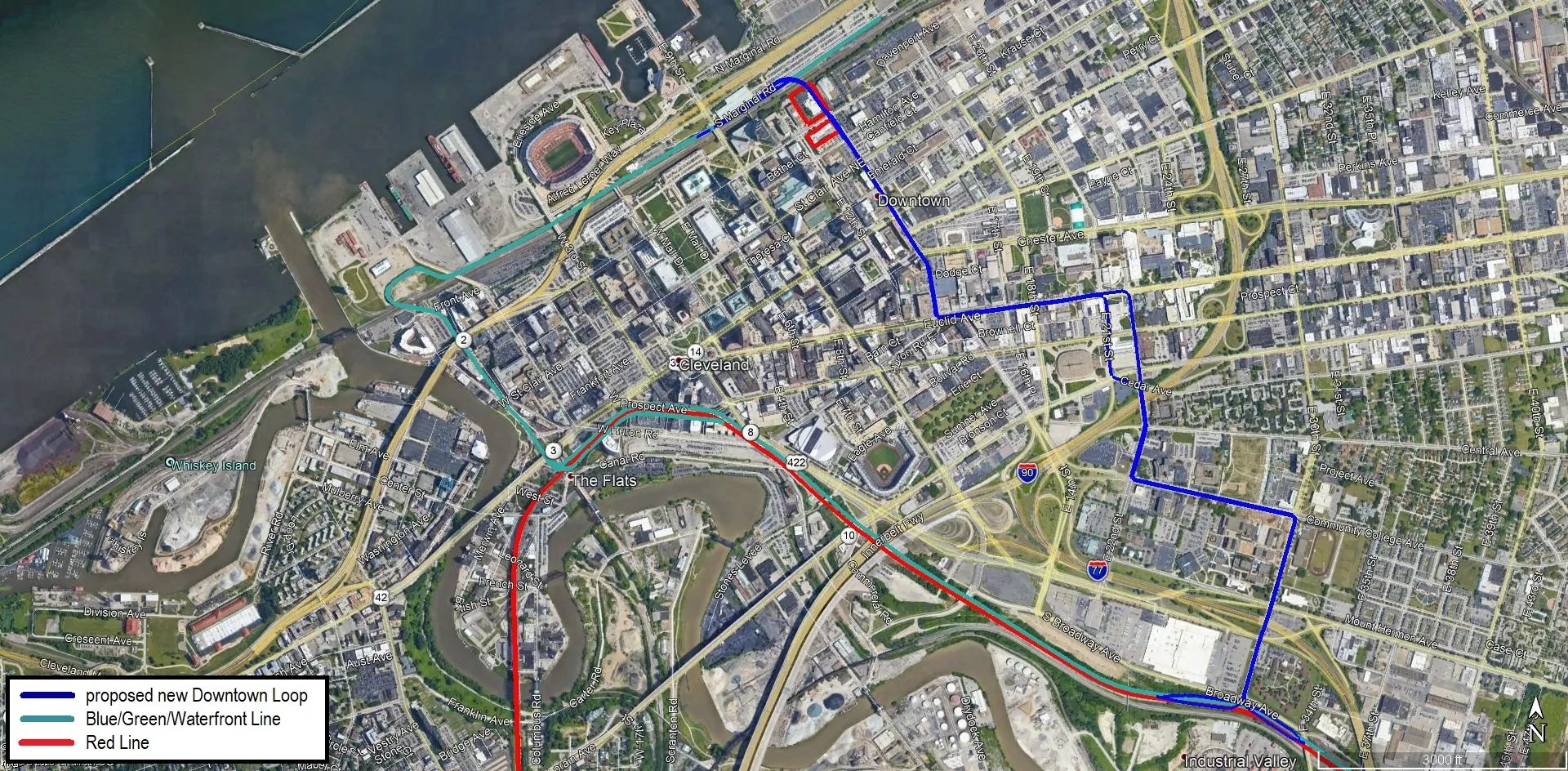
Those earlier plans Nicholson loves talking about date back to at least the winter of 2000, when the Waterfront Line, then just three years old, was promised a major extension: two miles of track linking its South Harbor Station near East 13th, down East 12th or East 17th, and eventually meeting the Tri-C stop off East 30th.
It would be, the Plain Dealer reported at the time, Cleveland’s own Downtown Loop, the Waterfront Line’s inevitable destiny that then-General Manager Richard Tober proposed to the city—promised!—in exchange for millions of funding. Nine new stations would be created. Street track would be laid. Such extension, the RTA predicted, “would increase riders systemwide by approximately 780,000 riders a year by 2025.”
“Either the service is being underutilized,” RTA General Manager Joseph Calabrese told the Plain Dealer in 2007, “or, before a Browns game, the rib cook-off and the tall ships, we are overwhelmed with passengers.”
Yet today, after the Flats East Bank’s rebirth and the green-ification of Voinovich Park on East 9th, the Waterfront Line seems ripe for yet another uptick in ridership.
Any idealist would offer good reason why: the Irishtown Bend Park build to the west; the makeover of the lakefront and Downtown’s Master Plan; the thousands of apartments to open doors by 2030; a renovated stadium. If Downtown’s population growth continues at the current 32 percent rate, then that area, folks like Nicholson argue, is the place to fuel new tracks.
Especially, he said, with RTA’s new railcars. Those modern, new cars, expected to hit all of RTA’s four lines sometime in 2027, could push the transit agency to rethink its layout for the decades following.
“As for that study you mention,” an RTA spokesperson told Scene via email. “I don’t know.”
As the story of any transit authority goes, funding is the crystal ball for progress. The $102 million to $118 million in early 2000s dollars projected to pay for the Downtown Loop extension could easily, Nicholson said, cost double these days, minding federal interest rates and construction costs that have been climbing since early 2021.
But, as any Cleveland cynic will tell you, everything starts—or simmers—with a plan. On Friday, RTA received about $9 million from the Ohio Department of Transportation to help fund its new railcar fleet; Nicholson sees that as a sign that the agency should be vying for more. More on a federal level. More at a state level.
And to build more track?
“It all depends if they’re asking for those dollars,” he said. “And if you want to ask for those dollars, you need to have a plan.”
He added, “Any good local rapid transit system around the nation had a starting point; and from that starting point, you’ve seen demand for more.”
Subscribe to Cleveland Scene newsletters.
Follow us: Apple News | Google News | NewsBreak | Reddit | Instagram | Facebook | Twitter | Or sign up for our RSS Feed
Related Stories

RTA Gets $700,000 From Feds to Study Transit-Oriented Development, Bus Rapid Line Along Ohio City to North Olmsted Corridor

Cleveland City Council Hesitantly Approves More Money to Fund Lakefront Study
This article appears in Feb 14-27, 2024.