

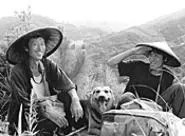
There lurks in all of this a stone-faced reverence for civil service that may seem downright bizarre to most Americans. We embrace our police and firefighters, of course (now more than ever), but we don’t warble many love songs to the woman behind the counter at the bureau of motor vehicles or the building inspector who approves our new gutter drains. Neither snow, nor rain, nor heat, nor gloom of night? In this internet-addicted age, many of us scoff at “snail mail.” But Postmen comes from mainland China, and in it we find vestiges of the old social realism — those numbing Maoist documentaries celebrating the wheat harvest and Soviet snoozefests about the glory of manufacturing road graders. No doubt about it: The nameless postman we meet here (played by veteran actor Teng Rujun) is a hero of the people.
Faced with only this, most of us would walk out of the theater without further ado. But Postmen is a smarter, more intriguing film than you might first imagine. Along with its politically correct valentine to mail carriers — director Huo dedicates the film to “members of the 22nd Postal Union” — we also get a vivid story about family and family legacy. The father we meet here is walking his last route, because his legs have become arthritic and the postmaster has forced early retirement on him; his son (Liu Ye) will succeed him, hoisting the huge tan rucksack stuffed with mail onto his shoulders in a poignant changing of the guard.
Little by little, scene by scene (all of it gorgeously shot by cinematographer Zhao Lei), we come to learn that father and son have never known each other well, because the father’s long work absences fostered fear, bewilderment, and later, detachment in the boy. Now that they find themselves on the hazardous mountain trail together, the older man is finally in a position to pass on his values — everything from the right way to let oncoming pedestrians pass to the sacred trust of safeguarding each letter — while the son at last gets a view of his father’s true worth to himself, to the mountain-born wife he’s seen so little of, and to the poor mountain people he connects to the world below. Quietly but inexorably, Huo forges a bond between the two that has nothing to do with politics or public service: Their arduous trek is all about personal discovery, and when the son at last takes his frail father onto his back to cross one final rushing stream, the reversal of roles is complete.
Postmen is by no means the most radical, regime-angering film to emerge from China in recent years. Zhang Yimou, Huo’s former classmate at the famous Beijing Film Academy, is far more likely than he to stir things up. But this meditation on love and respect has all the depth and beauty — in a different, gentler key — of the Zhang films Americans have come to love (Raise the Red Lantern, Ju Dou, and others). Adapted from a short story in Mandarin by Peng Jianming (rough English translation: That Mountain, That Man, That Dog), it was written for the screen by Si Wu — the pen name of director Huo’s wife of 17 years, who is one of China’s most experienced and celebrated screenwriters. Huo didn’t begin directing until he was 40, and all five of his films (including Life Show and The Singer) have been collaborations with his wife — a testament to the power of family their mail-carrier (and the once-fearful son who succeeds him) would be happy to endorse.
This article appears in Jan 26 – Feb 1, 2005.