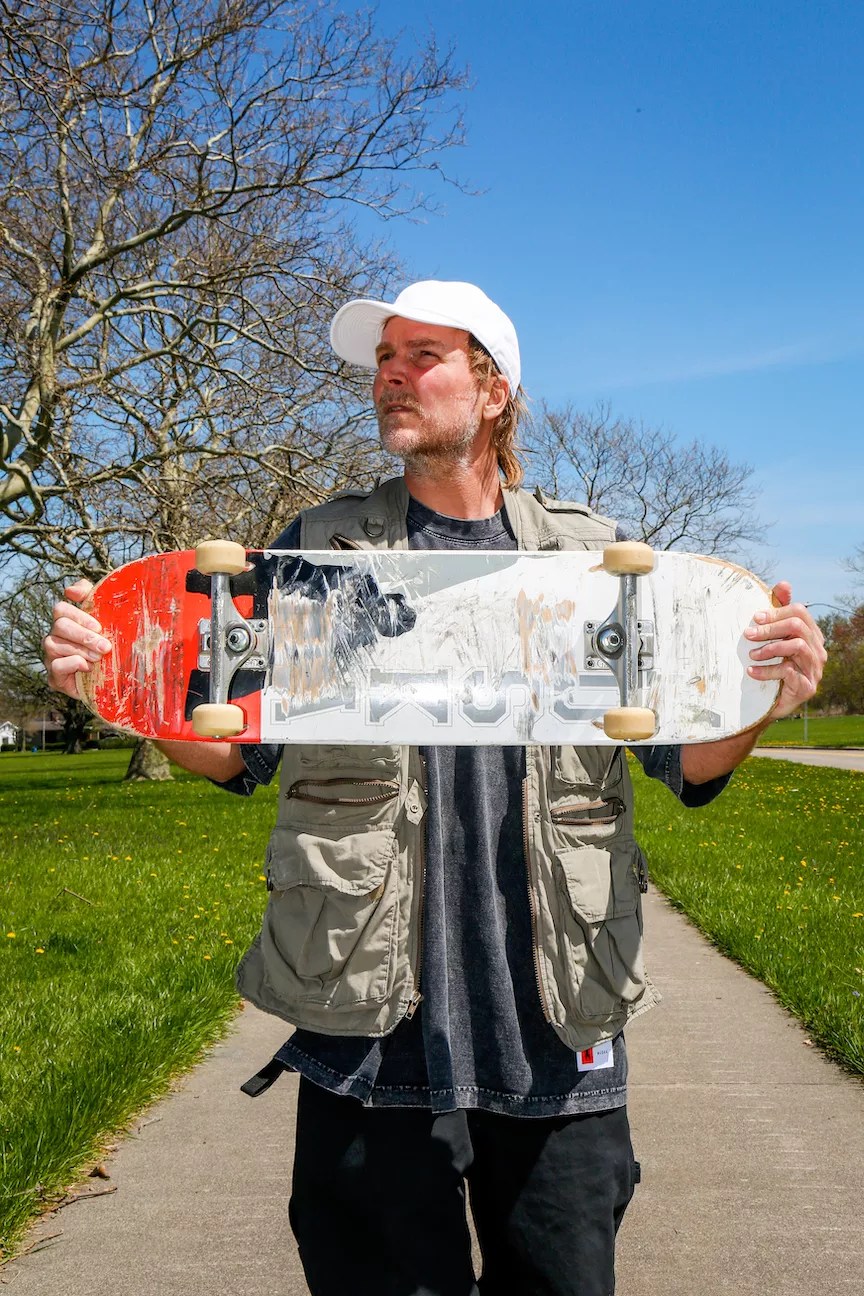
The history of skateboarding is a history of injury. Of arms and ankles bent in ways nature did not intend somewhere in an empty pool in seventies Sacramento. Of inverted boards jabbing groins on the streets of Japan. Of Tony Hawk, knees bruised and reddened, weeks before he landed the world’s first 900 at the 1999 X Games.
Injury is a strange friend to professional skater Chad Muska. And Muska—you know him as the boombox-wielder in Tony Hawk’s Pro Skater—has had his fair share over his tumultuous and resilient past 47 years of life. There were the broken legs and ankles, the herniated disc at a park in Mexico City. And then, there was that time, at 15, Muska broke his leg after attempting a frontside kickflip on a quarter pipe in Las Vegas. Doctors had “to take out my existing titanium metal rod,” Muska said, “and put another one in.”
“There’s a lot of injuries,” Muska told Scene in April, sitting in a coffee shop on Cleveland Street in Lorain, Ohio. “There’s something like hundreds, I think? My career has been plagued with injuries, pretty much. Like one after the other to be honest with you.”
This, it could be said, is a different Muska than the one effortlessly grinding ledges in front of ebullient crowds in Madrid or Paris in the late aughts. In 2020, after two decades solidifying his legend in the West Coast skate scene, Muska moved to a former flower farm in Collins, Ohio, in a bifurcated effort to focus on his merch business and live closer to the family he grew up around. At 47, Muska has replaced jovial skate contests and Hollywood clubbing with an existence marked by small-team corporatism and caretaking for an assortment of farm animals. As Muska puts it, “a complete 180.”
But not entirely. For the past four years, Muska has been partnering with a group of city boosters and like-aged skaters and BMXers to design and hopefully build his hometown’s first official skatepark. A park, that is, worthy of Muska’s reputation: some ten-thousand square feet of launch ramps, faux staircases, jellybean bowls, hand rails and stands for spectators of future contests. The only problem? Money, of course. So far there’s a $200,000 grant from the city, which arrived this year and portions of which have been spent on design and renderings. It could be renewed for 2025 if certain benchmarks are met. Outside of that, other fundraising hasn’t gotten off the ground much, with $20,000 secured so far.
But the goal is a park that would lift Lorain to national levels. “I want to see people of all ages and abilities,” Linda O’Connor, an administrative assistant in Lorain’s Department of Public Property, said sitting behind her desk, in some industrial park on the west side of town. “I want to see families having picnics. I want to see skateboard competitions. I want eyes to be on our skatepark.” She held up a piece of paper that resembled a skater’s mood board, of ramps in Colorado and Tennessee. “I think we have the potential to have a park unlike anything this part of the country has ever seen.”
A city working with a pro skater to build a million-dollar park is like a Big Tech company hiring a hacker to code its security system. But skate culture, once an image of delinquency and cop evasion, has seemed to mellow out as the 21st century brought it mainstream. Skaters land six-figure contracts with Nike and Adidas. The New York Times profiles quinquagenarians competing in the Olympics. Today, skateboarding—a $2-billion industry—wrestles to keep its anti-establishment image while the same punks that made it anti-establishment enmesh their mid-life bodies in wellness cures and yoga routines.
A reality that Muska isn’t pushing away. Since March of 2020, when O’Connor first asked for Muska’s help, the Lorain group has been leveraging the myth of The Muska to ensure their skatepark is built right. They’ve auctioned off a signed board. They’ve hosted a biker raffle at a riverside concert. They’ve bitten their tongues and approached corporate sponsors. “Jesus, we’re definitely willing to jump through the hoops,” local BMXer Dominic Jacobs said, “to get more money.”
In October of 2021, roughly a year after Muska bought his farm in Collins and a home for his mother in Amherst, he was invited to speak at a breakout rally for the new park, at the Lorain Palace Theater. To the city’s surprise, Muska fans of all ages swarmed the space, wanting autographs, holding boards with Muska’s name on it. “Most town hall events we have average about twenty to thirty, maybe fifty people,” Lorain Mayor Jack Bradley said. At the Palace “there was well over 200 that showed up that night.”
Muska viewed the event as more of a survey than a celeb meet-and-greet. “I wanted to listen,” he said. “When you bring in one BMX kid, one street skater, one vert skater, one rollerblader, one wheelchair rider, and you ask them, ‘How do you want this park?’ You’re gonna get a million different answers.”

Most saw a relaxed Muska. One who had been increasingly cautious since healing a bad back injury in the Hollywood Hills; one who hadn’t competed since a Europe tour with Supra in his thirties. (“We’re alive, battled and bruised,” Muska said in the tour video. “You can’t stop us.”) Who appeared more in videos hawking new shoe lines and rotating boards than films showing Muska jump entire staircases.
At least until last summer. Tony Hawk was on a national lecture circuit, and was telling crowds about his friends, about landing his famous 900 for the last time, at 48. “Chad actually moved back to Ohio recently,” Hawk told fellow podcast host Jason Ellis. “He’s living on a farm and raising chickens.”
“Yo!” Ellis said. “He’s raising chickens.”
“Yeah,” Hawk said.
Following a talk at Youngstown State, Hawk called Muska, and the two reunited at an indoor skatepark in Columbia Station. “I’m working on my 900,” Muska joked, as dozens of skaters watched him on the lip of a bowl. “But I got my 180 down.”
“Alright,” Hawk said, smiling. “Let’s see it.”
Muska dropped in. He did fifty-fifties. He attempted his signature Muska Flip—a front side maneuver of the board—twice. On the third try, he landed awkwardly on his right foot. His ankle snapped. The room went silent. “Oh man,” Muska shouted, holding his leg. “Who’s gonna take care of my chickens!”
An ambulance came. Hawk and paramedics carried Muska out on a gurney.
“Skateboarding!” Muska shouted in the ambulance. “You cannot stop me!”
If skateboarding is a history of injury, it is also a business of image and apparel. Every collage of a skateboarder’s tricks in Thrasher or Transworld were placed next to an ad selling their hat, wheels, shoes. It’s a mentality that still seems to jolt Muska today. “If I want to compete with the machine,” he wrote on Instagram recently, captioning a post for a new board, “I must think like the machine; I must work like the machine, study and adapt like the machine. I must become the machine.”
But diving face-first into the machine was how, as Muska likes to tell it, he escaped a somewhat directionless youth and an upbringing shaped by itineracy and outside addiction.
Born in Lorain in 1977, Muska grew up around Longfellow Park on the city’s east side and was influenced by his grandmother Helen’s garden art and his grandfather Rudy’s homesteading and ice fishing on Lake Erie. After his parents split, he moved to Philadelphia, then to New Jersey, Delaware, Phoenix, then to Las Vegas, where he found skateboarding after a neighborhood punk stole his bicycle. At 14, he dropped out of school, and lived with his mother or in an apartment with a bunch of local skaters. “A lot of ups and downs,” Muska recalled. “Divorce, back together, divorce, back together.”
When Muska turned 15, he got his first sponsorship, from a burgeoning skate company in San Diego called G&S. A skater he’d admired, Paul Smith, had tipped off a G&S manager, and soon Muska was sporting their shirts and boards—flowing product, as he calls it. A teenage Muska saw the light. He and two girls drove out to San Diego’s Mission Beach starry-eyed and never really looked back. The result was quintessential nineties SoCal skatehood: squatting, public showering, smoking, graffiti, breakdancing, emceeing, DJ-ing, vandalizing. “All of these things were a part of my life,” he said.
In the next three years, Muska, a towheaded looker and friend to everyone, managed to find himself on the good and bad ends of the skate hierarchy. He developed a reputation as the showman—kids called him Muskrat—and hyped up circles in a white tank top, gold chain, toting a boombox playing the Wu Tang Clan or Souls of Mischief. We see that image in a massive stair jump in Toy Machine’s Welcome To Hell video, on the 1995 cover of Thrasher, in the red Shorty’s hats and baggy grey tanks that budding skaters would be wearing at the next meet.
By 1999, Muska’s persona went global. He was one of the first skaters called up by Tony Hawk to appear as a character in Tony Hawk’s Pro Skater, the video game that would tie into the interest teenagers across America had for the life. Muska’s own exploded. He moved to the Hollywood Hills. Wearing his own Circa shoe line (with a stash pocket in the tongue), he went on world tours, was bum rushed by hoards of kids like Beatlemania. With his contemporaries—Jamie Thomas, Rodney Mullen, Paul Rodriguez—Muska helped solidify skateboarding’s shift from gym-short half-piping of the eighties to the baggy-jeaned ledge-grinding of the nineties. Muska was street; street was Muska.
“He totally changed the image with the style of tricks, with style in general,” said Adam Eichorn, the 51-year-old director of Spohn Ranch, a skatepark designer based in California. Meeting Muska in 2021, Eichorn saw Muska beyond the badassery. “He’s actually pretty humble, he’s a good guy,” he added, “and he uses his persona and his power as a skateboarder in the most positive way.”
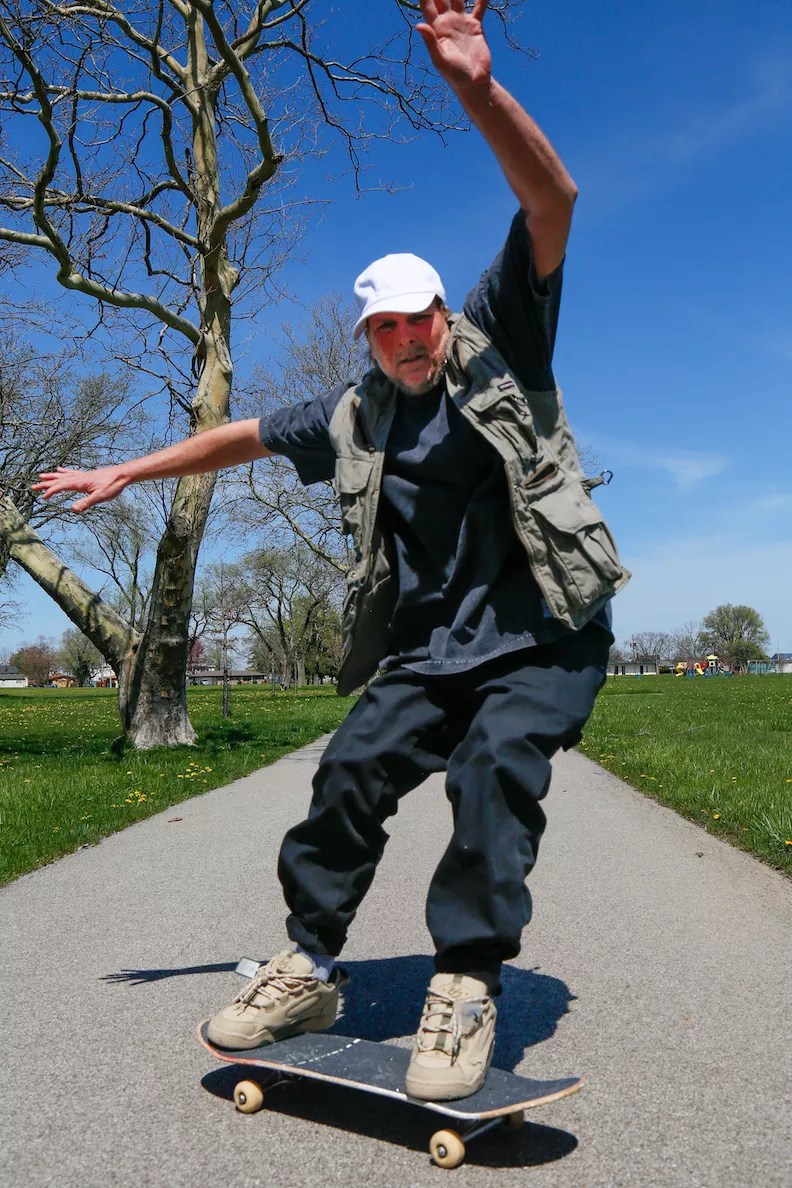
As others saw. Muska used his persona to get into LA’s most revered nightclubs. He was soon partying with Mick Jagger, Prince and the Olson Twins, dating Paris Hilton and recording music with Flavor Flav and Ice-T. “I was making a lot of money,” Muska said in his episode of VICE’s Epicly Later’d. “But spending it just as fast.” In 2011, shortly after his father, Joel, died, Muska was caught by LAPD tagging two buildings looking like Gregg Allman on a heroin binge. He called security guards racial slurs. He spraypainted “MUSKA KILLS” on the front of the El Capitan Theater.
He was booked for felony vandalism. “Eventually the drinking took over, and it was just too much,” Muska told me. “Something that was a positive thing in my life eventually became a negative.” He didn’t compete or tour for two years.
Muska’s partying-driven low point, and his herniated disc from a Mexico City fall, inched him into a new state of mind in his mid-thirties. After the last tour came a major wake-up. “You travel across the world, meet all these people who wanna see you ride,” he said, “you’re hurt, you’re sore, you’ve flown, maybe you partied the night before—but you have to perform. You have to do it. You have to skate.”
“But at some point, no matter how much you love something, if you do it for money or you do it for a living,” Muska said. He paused. “It can be just complicated.”
In June, I biked to Cleveland’s Rivergate Skate Park both out of personal intrigue and influence from Muska. At 33, I hadn’t skated consistently in almost two decades, and feared an injury akin to Muska’s, a shattered ACL or twisted ankle. But Muska had awoken something in me. I started having dreams where I bought a new board, where I attempted 360 flips with childlike ease. After all, as a kid I’d owned Muska’s Circa shoes (green), I’d bought Muska’s board (and broke it), I’d studied Muska’s backside grinds in Feedback, vibed to the everything’s-alright soundtrack of drum and bass, this window outside the doldrums of white suburbia.
At Cleveland’s park, my expectations were tilted. There were only three kids, two with bikes. I walked up to one, contemplating asking to borrow his board.
I asked if they knew Chad. “Who?” the bike kid said.
“Chad Muska,” the only one with a board said. “Tony Hawk,” he said.
“Yeah,” he added. “Muska’s sick.”
In late April, roughly four years into the attempt to build the best skatepark in the Midwest, Muska drove thirty minutes from his farm in Collins to take me on the tour of Longfellow Park and the site that could, one day, bear the handiwork of his team of eleven.
Handiwork that’s deeper for Muska. Meaning, if the group raises the $600,000 to $1 million needed for their park, it will be situated on land no more than a block or two from where Muska grew up on Kentucky Street. As Muska drove the SUV around the blocks, a certain kind of understanding warms over him. This was only the third time he’d driven through the neighborhood since he’d returned home to Lorain, so Muska’s goofy schtick took a back seat to what I can only call nostalgia.
“There was a willow tree, I swear,” Muska said, as his eyes ran along the houses on Louisiana. He stopped in front of a modest home with sunflowers near the garage. “There it is, the one right there with the porch—this is it! Holy shit!” He rested his chin on his palm and put the SUV into Park. “It’s trippy,” he said. “It looks different. Different.”
Afterwards, Muska drove us a block up, past the elementary school he went to, to the southern end of Longfellow Park, where a tree line nestles up to a railroad line. The area is spacious and could easily fit twelve-thousand feet of rails and ramps. There’s so much grass and open space that, if money wasn’t a problem, Muska could put five parks in.
But could Lorain do it without Muska? Most of his group told me that it wouldn’t be the same process without him. O’Connor, the development director, was a lot more blunt. “It’s just the facts,” she said. “Chad was from here, and we have a chance to do something in Lorain that nobody else can do. He was only born in one place. And that was here.”
Muska parked in a lot closest to the site and grabbed his eponymous board from the back seat. In his beige fisherman’s vest and oversized denim shirt, Muska looked like a cross between a punk musician and a deer hunter. He calls himself a hermit. “I had the gnarliest beard yesterday,” Muska said stepping into the day’s sun. “I feel naked right now. Like I shaved a small animal off my face.”
At that, for the first time since his ankle-twisting episode in Columbia Station, Muska hopped on his board, and took off briskly. He left the parking lot and zigzagged up and down the sidewalks that run parallel to the tree line. He teased a few ollies and manuals. He ran his board into the grass.
As Muska rode, I thought back to a story he told me. Of course, an injury was tied to it. It was 2015, and Muska had just been told by doctors that he would have to have back surgery to remedy the pain from that herniated disc. It spooked him. “Back surgery is a whole other thing,” he said. He spent months in anguish, semi-paralyzed in bed. “But one day, I said, ‘Fuck this, I’m not going out like this,” Muska said. “I left my house in the Hills with my skateboard. I made it all the way to Hollywood Boulevard, threw my board down and started pushing. I started pushing, and felt this, like, energy come up through my whole body, up through my spine. I just kept pushing, pushing for, like, seven hours, skating all over the city. All around the city and came back.”
At Longfellow Park that day in April, Muska looped back and skated towards me. He kicked his board up into his hands, catching his breath, saying, “It feels good, good just to roll!” He held his board out. “Careful. The trucks are mad loose.”
“I don’t know, man,” I said, my right foot in position. “I don’t want to injure myself.”
“Just do it,” he said. “Ride.”
I looked down at Muska’s board, then the sidewalk, then the grass, then the sky.
I looked down again. I pushed.
Subscribe to Cleveland Scene newsletters.
Follow us: Apple News | Google News | NewsBreak | Reddit | Instagram | Facebook | Twitter | Or sign up for our RSS Feed
Related Stories

Tri-Star Skate Park is Shutting Down
This article appears in Jul 17-30, 2024.