
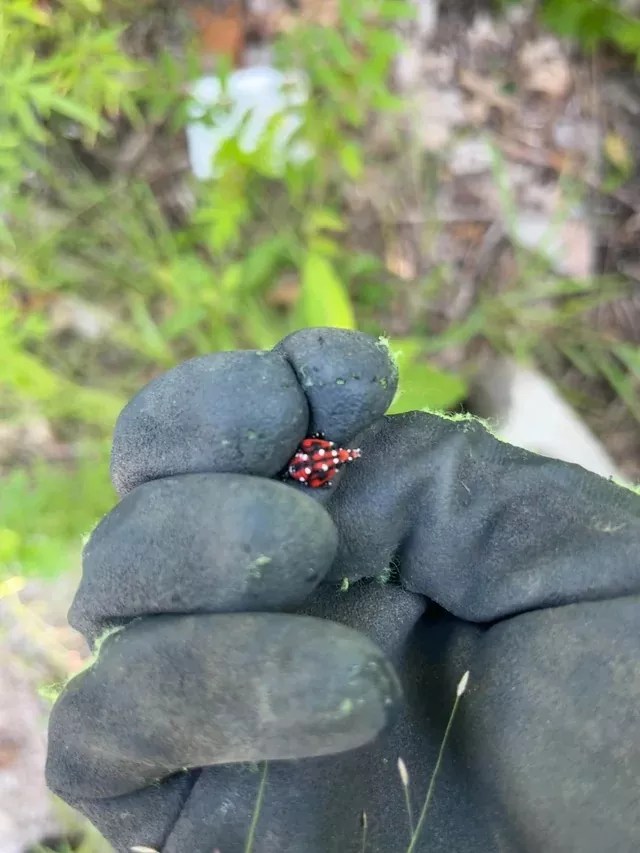
There, near the intersection of East 65th and Hawthorne, was a group of spotted lanternflies, the notorious invasive species that has been devastating East Coast agriculture since the summer of 2020.
Lyons, a copy technician who works frequently on the east side, exited his truck on his lunch break last week to get photo evidence. He’d been in Pittsburgh when lanternflies covered cars and lampposts, and gone on a squashing spree himself.
“I thought, ‘Oh shit! I never realized they were here,” Lyons, 37, told Scene. “I’d been taking it upon myself to keep an eye out constantly, and be out on the watch for them. And now they’re here.”
The bugs, which were first discovered on a Pennsylvania construction site in 2014, have grown into an infamous cultural phenomenon and a threat to agriculture in the past few years.
In Pittsburgh and New York City, for example, millions of dollars have been spent on ads urging the public to “Kill it! Squash it!” while hundreds of millions more in damage has been surveyed by grape and hops growers across the Eastern Seaboard.
And now, as confirmed by the Ohio Department of Agriculture, the flies are here in Cleveland.
Jonathan Shields, an inspection manager, said that, in the past week, the department has received some “5 to 10 reports a day” of lanternfly sightings, “a lot more” than when lanternflies made their first appearance in Ohio in 2021.
“In Cleveland, they’re just now starting to become adults,” Shields told Scene. “We’re at the part of the life cycle where they’re much more visible.”
Citing recent sightings in Columbus and Toledo, Shields maintained a sort of neutral tone as he predicted the outcome in Northeast Ohio. Because lanternflies feed on tree saps and fruits, the most glaring impact is economical, save for the visual nuisances that could shape one’s walk in the Metroparks.
“Remember that the Ohio wine industry is a $1 billion a year industry,” Shields said. “I mean, when the population gets high enough, you really won’t be able to see the bark on a tree.”
Though it’s hard to quantify the impact on Northeast Ohio’s crops, reports from Pennsylvania could tell of similar hardships. One report from 2019, though disputed by experts, suggests that the lanternfly caused a $325 million blow to the state economy.
It’s precisely why Gene Sigel, the owner of South River Vineyard in Geneva, Ohio, has been abreast of all the latest reports of lanternflies in his neck of the woods.

“There’s really not a lot that we can do, frankly,” Sigel told Scene. “The best way I once heard a farmer describe it was that it’s a slow-speed trainweck.”
As of early August, City Hall and Cuyahoga County does not have any major public awareness campaign to alert the public—like in New York—of what to do if the bugs appear in their front yards. The Metroparks has been surveying its land for impacted Trees of Heaven and its bugs since 2020, according to its website. (It doesn’t advise its readers to kill lanternflies, but to merely report a sighting.)
Shields, along with a spokesperson for the county, pointed to the Ohio State University Extension, which is apparently in charge of gathering report data and executing surveys of growing adult fly sightings. The same advice goes for the Asian Long-horned Beetle, a threat to Ohio hardwood trees, or the Gypsy Moth.
“Stomp them when you see them, kill them at your home,” Shields said. “Hey, there’s always an element of surprise when you discover a new area of infestation.”
It may be hard to calm down Lyons. Since his own sighting last week, Lyons has armed himself with a spray bottle filled with white vinegar, dish soap and water. (His own method of extermination.) He’s posted alerts on social media, texted friends messages in the form of PSAs.
A general frustration almost overwhelms Lyons when he thinks of the potential damage to Metroparks trees. An avid hiker with an electric longboard, Lyons gets angry when he transplants those images of Pittsburgh’s infestation—those covered lamp posts—in his own backyard.
“I really don’t want these things here. The parks and the environment are such a big part of my life,” he said. “It frustrates me to think of us looking back 10 years from now, saying, ‘Oh, if we only would’ve done more! I wish we would’ve done something!'”
Clevelanders can submit their own reports of lanternflies in the area using the Great Lakes Early Detection Network app.
Subscribe to Cleveland Scene newsletters.
Follow us: Apple News | Google News | NewsBreak | Reddit | Instagram | Facebook | Twitter | Or sign up for our RSS Feed
Related Stories

Metroparks Buys Barge 225 for $1.3 Million, Will Move It to Wildwood Park

Downtown Cleveland Sees the Most Bird-Building Collisions In Ohio. This Group Wants to Eliminate Them
This article appears in Jul 26 – Aug 8, 2023.