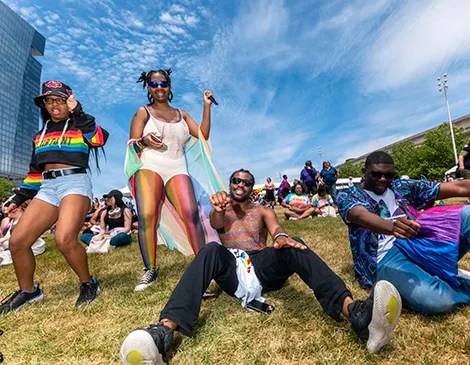
It’s somewhat tricky to pinpoint when Cleveland’s first Pride celebration occurred – sources hint at 1972 or 1973 – but it’s not difficult to discern the why.
There were the riots at the Stonewall Inn in New York City. Nixon had refused to include gay folks in federal anti-discrimination laws. Waves of demonstration were popping up around the country in response.
Locally, in September 1972, civil rights backers stood outside a gay bar on Euclid Avenue to lead a Gay Pride March to Public Square. Two hundred were invited; only about 40 came.
1975 wasn’t that much different. The Gay Education Awareness and Resources center invited thousands to a Gay Pride Picnic at Edgewater in the face of public opposition: West Side bars refused to hang posters or keep brochures. (Others trashed them.) A partnering church received threatening calls to its hotline. Speakers at Cleveland State canceled last-minute.
Still, 100 gathered on the beach, some doubling as makeshift security. They sang the protest anthem “We Shall Overcome.” They prayed. “All in all, however,” an article in GEAR read after, it was “a good step forward for the newly emerging political gay community.”
A half century later, Pride backers, participants and allies seem to be back in a similar political arena.
As previewed by the far-right policy playbook, Project 2025, President Donald Trump immediately began his second term leading the White House signing a suite of executive orders meant to either restrict or completely eliminate every single iota of governmental recognition—from grants to Harvard to words on federal IDs or forms—of anything involving diversity, equity and inclusion.
They were policies that automatically seeped into the LGBTQ sphere. And policies that seem obsessed with so-called biology. Whether it be restoring the “biological reality of sex” on foreign visas or employee email signatures. Or slashing LGBTQ sections on .gov sites, erasing 11 Biden-era policy briefs, cutting $125 million in AIDS/HIV research, making it U.S. policy to “keep men out of women’s sports,” or closing all links to transgender healthcare, especially for minors. (“Identity-based confusion,” according to Trump’s order.)
“This dangerous trend will be a stain on our nation’s history,” one January order, “Protecting Children From Chemical and Surgical Mutilation,” reads. “And it must end.”
Such political thought has also been found at Ohio Statehouse in what seems to be a heavier-than-usual year for anti-LGBTQ bills. Bills that could, if signed by Gov. DeWine, prevent preferred names or pronouns from being spoken at Ohio schools without a parent’s permission, ban the Pride flag on state grounds, and make it state policy to, as Ohio’s Budget Bill reads, “recognize two sexes, male and female.”
“We are well aware that we are who this administration is targeting,” Phyllis Harris, the director of the LGBT Center for the past 13 years, told Scene recently from her office in Gordon Square. “We’re aware that our lives have been politicized by the executive orders.”
As has been standard for the past decade (save for 2016, when there was no Pride in Cleveland), Harris and her team began prepping for Pride in the CLE in January, weeks before Trump sat down in the Oval Office to sign a handful of orders that would effectively eviscerate every single LGBTQ protection signed by President Biden.
Harris knew what was coming. She had studied Project 2025 like a general under Sun Tzu. She sensed DEI offices, like at Case Western or the Cleveland Clinic, would shutter or be rolled back. She figured some of Pride’s usual corporate sponsors might back out, or, as would soon happen, decide to support Pride anonymously. (“A handful,” Harris said.)
Months of planning told Harris to fashion June 7th as a kind of retaliatory retrospective: If they’re taking us back, well, so the hell are we. “Pride in the CLE doesn’t have a parade” this year, Harris said. “We have a march.”
And that they will. After the 11 a.m. march from Public Square to the Malls, a day’s worth of entertainment mingles fittingly with an activist’s showcase on the Speak Out Stage. There will be Mexican food trucks, ice cream vendors, mobile healthcare units, a fully-ADA-accessible bathroom called the Momentum Refresh.
And there will be Veranda L’Ni, Cleveland’s tallest drag queen and realtor by day, marching from Public Square behind a banner reading “DRAG IS NOT A CRIME.”
L’Ni, who made national headlines in 2023 after hosting a drag show at a restaurant in Chardon despite a bomb threat, feels that, ironically enough, the Ohio Statehouse’s attempt to stifle and shut away drag is a helpful reminder. One that might’ve gotten lost amidst the bubble-blowing fun and the electric afterparties at Studio West 117.
“Actually, I think we did lose something here,” L’Ni told Scene. “That Pride is meant to be a protest, not a party. And while we’ve surely gotten to that point, we’re back to the protest end of it. At least that’s what it feels like to me.”
L’Ni’s anxiety isn’t unwarranted. Earlier this year, state representatives Josh Williams and Angela King co-sponsored a bill that would punish drag performers for violating Ohio obscenity laws the same way, and in the same category, as “topless dancers, go-go dancers, exotic dancers and strippers.”
And that bill, the Indecent Exposure Modernization Act, could make some if not all public-facing drag acts—where kids could be present—potentially punishable, if convicted by the courts, with a fourth-degree felony.
“No person, with knowledge of its character or conduct,” the bill reads, “shall recklessly engage in an adult cabaret performance in a location other than an adult cabaret.”
In an interview with Scene, Williams defended his bill as simply an updating of Ohio’s current obscenity laws, which typically punish those for exhibitionism. Not, he urged Scene understand, a timely, all-out attack on Pride.
“I go to the R&B Park Jam [in Toledo] all the time,” Williams said. “And guess what? If somebody started engaging in conduct that rose to the level of obscenity, they will be arrested.”
“It’s either you want to be included in society, and held to the same standards, with the rights and obligations of every other adult,” he added. “Or you want to be treated special, based on your sexual preference or gender ideology—you can’t have it both ways.”
Ken Schneck, the editor of the Buckeye Flame, calls bullshit.
“It could not be more clear that the super majority of state representatives, in the state where they live, are attempting to criminalize them,” he said. “Not just devalue them. But criminalize them based on subjective standards.”
Schneck pointed to Mark King, Angela King’s husband, who had photos of him surface dressed as a woman in a church play, in 2018. “But Pride is ‘obscene’!” Schneck said. “Right? This over here is ‘art.’ But this over there is ‘obscene’?”
Over at the LGBT Community Center in mid-May, Harris walks around as team members make final preparations on Pride in the CLE from their decked-out cubicles. Upstairs, a group of gay men in the Rainbow Pioneers program vent about Trump’s slashing of HIV research. Politics are ever present.
“You know what?” a man in his sixties told Scene, standing near the elevators. “My daughter voted for Trump. And her father’s gay. And her daughter needs an abortion. What do you make of that right there?”
Downstairs, Harris sits at her desk, juggling both the size of the June 7th march and the political ideology at the Statehouse that’s led to it.
When read pieces of Williams and King’s bill, Harris laughs as only an activist at her age could laugh.
“As a Black lesbian feminist, there’s a lot about heteronormativity that I think is obscene,” she said. “You know what I’m saying?”
She brought up the American event probably most studded with obscenity citations, New Orleans’ Mardi Gras. (Ten people were arrested on that charge last year.)
“Like come on—what are we doing here?” Harris said. “I mean, we don’t have time for that nonsense. We’re worried about HIV medicines being taken away. Trans and non-binary youth are saying, ‘Why does everybody hate us?’”
Harris cupped her hands under her chin. “We have to pay attention to policymakers and legislation and things like that,” she said. “But we are fighting for our lives.”
Subscribe to Cleveland Scene newsletters.
Follow us: Apple News | Google News | NewsBreak | Reddit | Instagram | Facebook | Twitter | Or sign up for our RSS Feed
Related Stories

Music, Art, Community Take Center Stage at Freedom Fest Cleveland
This article appears in May 22 – Jun 4, 2025.