That’s the upshot of the county’s latest attempt to provide beds, meals and showers for the local homeless population as the groundbreaking of the Norma Herr II Emergency Shelter for women signaled off East 23rd and Superior on Wednesday.
The announcement, trumpeted by nine politicians and nonprofit officials, showcased a $15.5-million facility with 98 beds, private rooms, kitchen spaces, showers, a computer lab, a courtyard and on-staff nurses. When fully built, roughly 203 women will have access to a temporary place to sleep in the shelter district in Midtown.
A shelter billed by the county, which footed about half the bill—$8.5 million total, mostly from ARPA dollars—as a chess piece to try and end homelessness in the coming years. And, as County Executive Chris Ronayne hinted at in his speech, an attempt to remedy the past foibles of Norma Herr II’s predecessor on 2229 Payne Avenue. (Currently in Tremont during its own renovation, as Cleveland.com reported.)
“When you walk through, what you see is something that has got potential, but it’s too crowded, right? There’s too many bodies next to one another,” Ronayne said from the podium, recounting a recent tour of Norma Herr I.
“So this expansion is about dignity,” he added. “It’s about a place that gives our residents new front doors, and the dignity of private space.”
Related

Cleveland Planning Commission Gives Green Light for City’s First Four Outdoor, Public Bathrooms
Both shelter builds and lease signing on the city and county levels spell of a brighter opportunity to fast track the hundreds of Cleveland’s unhoused through the local system.
Yet, as Norma Herr II was framed by many Wednesday morning, subpar shelter is often, but not always, a roadblock for those looking for a way forward off of Cleveland’s sidewalks. That is, if they seek outside help in the first place.
It’s how Ward 7 Councilwoman Stephanie Howse-Jones chose to frame the numerous complaints she’d heard from residents of her ward who’ve had trouble finding suitable housing, due to tough landlords, job loss or criminal records. Those who are skeptical of the shelter system too.
“You want to go to a place where you can at least get your mind together—to be able to be stabilized,” she told the crowd. “To, then, get your housing choice voucher, to then go out and recreate the life you have.”
Comments Wednesday brought up the specter of Norma Herr’s past, years ago, when it was the recipient of several complaints from the Cuyahoga County Department of Public Health, and lambasted for its subpar meals, brawls between guests and, as Ronayne himself witnessed, overcrowding.
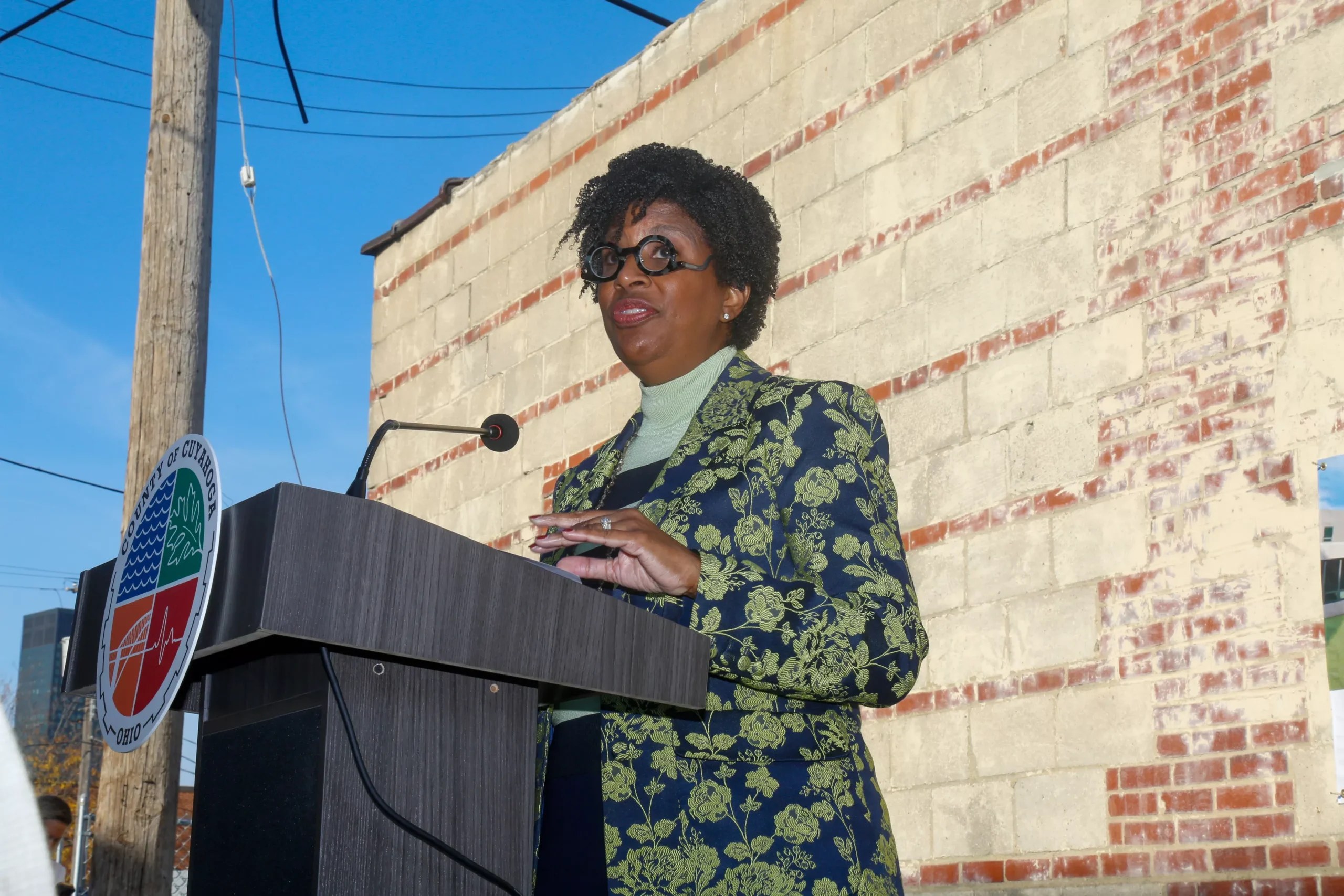
“Fortunately, I only had to spend one night at Norma Herr,” she added.
Helen Forbes Fields, the president of the Cleveland YWCA, which took over management of Norma Herr in 2018, suggested that the shelter’s come a long way in eight years. (The county found no food-related health violations in September.)
“We know that living and working in a dignified, humane setting will greatly enhance the mood, the morale, the behavior of our guests, as well as retention of our staff,” Forbes Fields said, making reference as well to the “improved” interim spot on Walton Avenue in Tremont.
Thanking the county, she added: “We will do better, we will provide better, because our guests deserve better from all of us.”
As long as those guests find their way, of course, to help in the first place.
Like with Cleveland’s Home For Every Neighbor program, the county, as Ronayne confirmed, hires outreach workers a part of the Northeast Ohio Coalition for the Homeless to encourage the unhoused on the street level to enter the shelter-to-home process.
But many resist, opting instead to set up tent cities on Superior, or sleep on heat grates downtown, or under the Main Avenue Bridge in Canal Basin Park. Both county and city reps affirmed to Scene Wednesday that the unsheltered are never forced into the system unless they’re seeking it out. (Or they break the law.)
A grey area remains. NEOCH Director Chris Knestrick told Scene that the only people brought to Norma Herr in the future will be those deciding to seek help of their own volition.
“Our work is about, ‘How do we get this person the treatment, the services they want,’” Knestrick said after the groundbreaking. “And services they need to be healthy.”
“But if I’m having a psychotic episode, I’m not in my right state of mind,” Scene asked.
“But people in psychotic episodes have a will to choose,” Knestrick said. And “they do choose therapeutic methods all the time.”
Ronayne, who said he’s tagged along with NEOCH outreach workers in the past, reiterated Knestrick’s philosophy.
“There are people who are shelter resistant, and that’s their right,” he told Scene. “But you try to promote a doorway so that they can have a quality place to sleep, to eat, and get the hygiene that they need.”
Norma Herr II should be open in early 2025.
Related

Cleveland Says New Program Housed 47 Unsheltered People This Year
Subscribe to Cleveland Scene newsletters.
Follow us: Apple News | Google News | NewsBreak | Reddit | Instagram | Facebook | Twitter | Or sign up for our RSS Feed
Related Stories
Cleveland Planning Commission Gives Green Light for City’s First Four Outdoor, Public Bathrooms
Cleveland Says New Program Housed 47 Unsheltered People This Year

Cleveland Street Chronicle’s Holiday Gift Wrap Edition is Now Available

Judge Shoots Down Proposed Youth Homeless Drop-in Center in Ohio City
This article appears in Oct 9-22, 2024.