

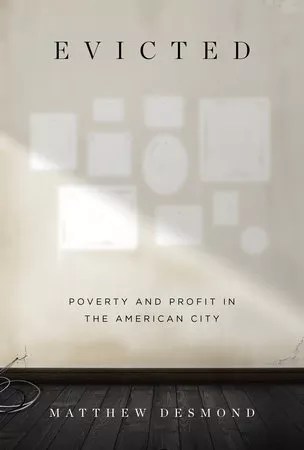
Mentioned on several occasions by the audience and the panelists was the recent loss of the Cleveland Tenants Organization.
That organization, which had been serving predominantly low-income tenants in the region for more than 40 years, suspended its operations earlier this month due to a lack of funding.
“We lost some significant funding contracts,” CTO Board President Cheri Smith told ideastream. “We lost some significant funding grants over the last several years. So we were looking for other ways to, you know, kind of fill that gap, and we weren’t able to come up with those ways.”
That the county and the region’s grantmaking institutions would let CTO flounder at the very moment we’ve all decided to come together to read an important book about housing inequality and roll up our sleeves to improve poor tenant services is frankly stunning. At Friday’s panel, housing court judge Ron O’Leary said that “more robust tenant representation” was necessary in the region, in order to help guide low-income tenants through the eviction process, the housing voucher program and other issues.
O’Leary also stressed that CTO had only “suspended its operations.” He said he and Cleveland City Councilman Tony Brancatelli reached out in the immediate aftermath of the closure and believed that the organization was still searching for ways to provide its services. It was not officially dead, he said. He encouraged those gathered at the City Club forum, and the institutions they represented, to “offer whatever support [they could]” to keep CTO open.
South Euclid City Councilman Marty Gelfand, during the forum’s Q&A portion, said that CTO was “the most powerful tool in his toolbox” when tenants called him with issues and concerns.
Those working in the fields of affordable housing certainly recognize the magnitude of the loss.
Scene spoke last week with Michael Lepley, who does research for the Housing Center, a local fair housing nonprofit. He said that CTO’s closing “leaves an enormous, enormous gap.” (By way of comparison, he said that CTO handled roughly 10 times the call volume as the Housing Center, with two fewer employees.)
He tried to explain the current, seemingly paradoxical situation: that a region purportedly seeking solutions to housing inequality would permit the demise of one the organizations on that issue’s front lines.
“To be somewhat critical of the funders, especially the private funders, that organizations like CTO depend on,” Lepley said: “They love the new, sexy stuff. They love to create programs. They do not want to be in the business of maintaining programs. And so what happens is, we get all these brand-new nonprofits instead of a few highly functioning organizations. “
This article appears in Feb 21-27, 2018.

I know since the publication of “Bowling Alone” the general consensus in the non-profit community has been that volunteers have no place in non-profit management, beyond their Boards.
Cleveland’s non-profit scene is so incestuous and chock full of Cronie-Capitalists, it is amazing anything ever gets done beyond the “feel-good” fund-raising events that keep their “professional” administrative staff’s employed with generous expense accounts, health care, and retirement plans.
When it comes to making profit on poverty, Cleveland is, and mostly has been at the top of the list.
Just check out the Journal of Philanthropy or Foundation Center’s databases at their Hanna Building Offices, paid for by the Gund and Cleveland Foundations, co-located downtown.
While many good things in University Circle and Downtown have been done, they’ve all had serious commercial pay-outs for their sponsors. The continued lack of focus, funding ,and serious efforts beyond tourism, has and continue to leave Cleveland’s Residents, and Neighborhoods decimated for the foreseeable future.
(There’s a reason Cleveland’s one of the top-5 poorest cities in the U.S. and its not the obvious Rust-Belt/Heavy Industry connection that constantly touted. It directly relates to the incestuous relationships between commercial interests and “professional” non-profits.)
Where’s the academic or graduate candidate(s) from CSU’ Levin College of Urban Affairs, or CWRU’s Mandel School of Social Work to document this connection to Cleveland’s repeated economic crashes and generations of residents of all races, mired in poverty for over a half-century now?
Oops, those “academic” programs are funded by the very institutions they’d have to research, and call-out, which would upset Cleveland’s continuing “old-boy network”.
Where’s OSU, Harvard, Columbia, Yale, Cornell, Stanford, Berkley, U of Chicago, or Kent State when you need them? Just research the non-profit “Boards” and their “professional staff” connections of CPL, Burten, Bell & Carr, The Conservancy, University District, Detroit-Shoreway, Cleveland Playhouse, or Ideastream. The duplicity and self-dealing of just these few examples will make the Cuyahoga County’s Democratic Party under Jimmy Demora look like pikers! Where’s the next Roldo, when you really need them?