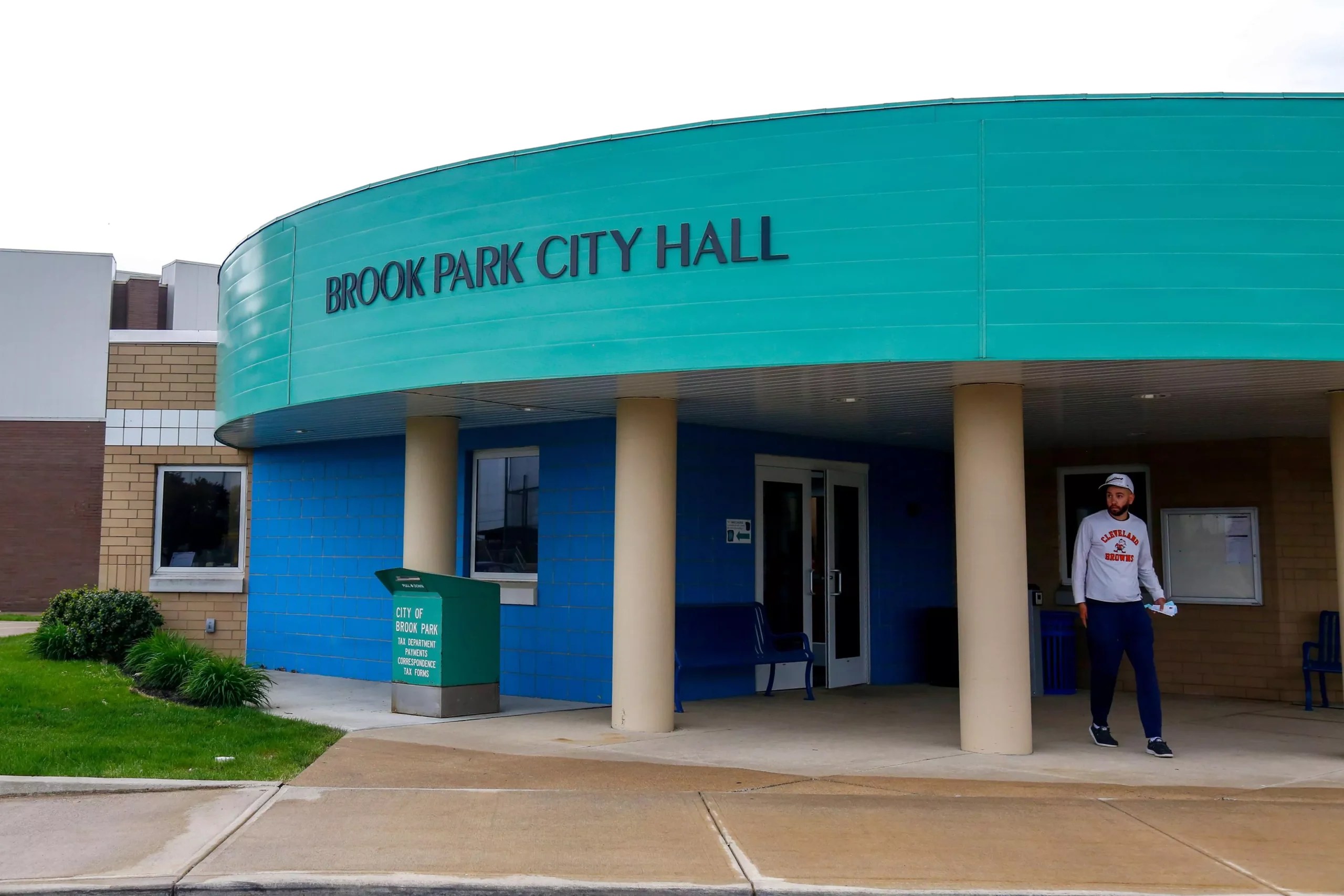
After all, the potential relocation of the team a few miles south and the possible mega development project would mean drastic changes to the city she’s long called home.
Panian has lived in Brook Park most of her life. She had worked at the Cleveland Hopkins Airport for 24 years, then for another two as a machine operator at the Ford Plant.
Then, Continental shut down their hub at Hopkins. In 2012, that Ford Plant along Snow Road was shuttered, the plot now part of what the Haslams could make a new Browns Stadium village.
Related

‘These Are the Cleveland Browns’: Council Proposes Legislation Holding Browns to Art Modell Law Amid Stadium Negotiations
The news divided Panian. A stadium in Brook Park, especially one that would cost $2.4 billion, could help revive a flailing local economy, both hit hard by the depleted manufacturing industry and aging residents. But then, the expected traffic. The impact on the neighboring airport, Panian thought.
“It would be a major tax hike, I’m sure,” Panian said. It’s the cost factor that mostly has her a skeptic: “I love the idea,” she said, “but it’s not going to happen.”
On Wednesday, the Haslams announced at a meeting with stakeholders that half of that $2.4 billion projected cost for a domed stadium outside Cleveland’s city limits, in their plan, would be split amongst Ohio, Cuyahoga County and the city of residence—Brook Park. (Any Stadium Village built around it would be Haslam-funded. The billionaires would also like to see taxpayers pick up half the tab — amounting to about $600 million — for a renovated stadium on the lakefront.)
Such a weighty price tag would make that dome the third costliest stadium in the world, a matter that’s only amplified the wonders and anxieties of those that, if the Haslams are serious, would be Cleveland Browns Stadium 3.0’s neighbors. That which adds only more concerns: How much they would pay being the most imminent.
“I say go for it,” Cathy Riva, a resident on Engle Road, said in the parking lot of the Brookgate Shopping Center. “We’re going to pay either way. They put it downtown—they’re still going to charge us Cuyahoga County people.”
“And we’ll take the tax revenue it’ll generate,” she added. “Because you know it’s going to generate.”

And there’s no certainty with Brook Park dollars, too. As several members of Brook Park City Council reiterated to Scene, the city would most likely hold a special election for its 15,000 or so of voting age if it were to put up funds.
Jim Mencini, Brook Park’s councilman covering Ward 2, just south of where the new stadium would sit, shares the same kind of pros-cons list as his constituents. On one end, a Stadium Village could easily be an employment magnet. (Mencini’s nicknamed it, optimistically, “Super Bowl City.”) On the other, it could lead to a traffic congestion quagmire, leading to necessary road widening.
That is, of course, if Brook Parkers are sold on the forest for the trees.
“I mean, look: interest rates are 7.2 percent. The average ranch in Brook Park is selling for $200,000. A half gallon of orange juice is $4.50. Things are expensive,” Mencini told Scene in a call. “You know, I think it’d be tough to get a tax passed, don’t you?”
“If it’s going to cost us an arm and a leg,” he added, “then that’s that.”
With the Ford Plant, and its tax revenue, merely mounds of dirt today, Brook Park isn’t necessarily swimming in amenities. NASA Glenn is its glorious pride—Hopkins is on Cleveland land—which leaves mostly strips of hotels (including a failed Howard Johnson), big box outlet stores, a Giant Eagle and the Brook Park Rec Center.
Its Brookgate Shopping Center, off Smith Road, is used often by residents as a metaphor for the city’s struggling economy. Roughly 20 percent of its main plaza sits empty.
“All of us are kind of disgusted that Middleburg Heights is booming,” Linda Riedel, a resident on nearby Muskingum Blvd., told Scene from her front door. “It’s frustrating for us because we wanted to breathe new life into our city, too.
“And Brookgate’s been a series of failed businesses over and over and over.” she said.
Because the Haslams would own the entirety of their Brook Park Stadium Village, they would control the parking and its retail components, from the hotel tenants to bill for parking your car. (Or one’s orange Dawg Pound RV.) High parking rates, for one, could lead to fans exploring options around the area.
Another reality Wiedel’s considering. “That’s a good question,” she said. “Would our streets be filled up with cars? I can see people trying to avoid, I don’t know, that $50 per game.”
Which might not bother Wiedel, who sports a Browns sticker on the back of her Ford Escape, if she’s at the game.
Though when you start throwing around a $2.4 billion pricetag and questions about taxpayers’ wallets opening up, somet things start to change.
“Wait,” Wiedel said, “how much?”
Related

Op-Ed: Stadiums, Slogans and Cleveland Past
Subscribe to Cleveland Scene newsletters.
Follow us: Apple News | Google News | NewsBreak | Reddit | Instagram | Facebook | Twitter | Or sign up for our RSS Feed
Related Stories

Cleveland City Council Hesitantly Approves More Money to Fund Lakefront Study
Op-Ed: Stadiums, Slogans and Cleveland Past
‘These Are the Cleveland Browns’: Council Proposes Legislation Holding Browns to Art Modell Law Amid Stadium Negotiations

Cleveland Muny League Expands This Year, Now Offering Girls Flag Football

At Recent Panel, Sports Stadium Financing Experts Warn Against Massive Public Subsidies for Cleveland Browns

A NASA Engineer Spent Years Writing Fiction About Venus. Now He Wants to Send a Mission There For Real
This article appears in Apr 24 – May 7, 2024.