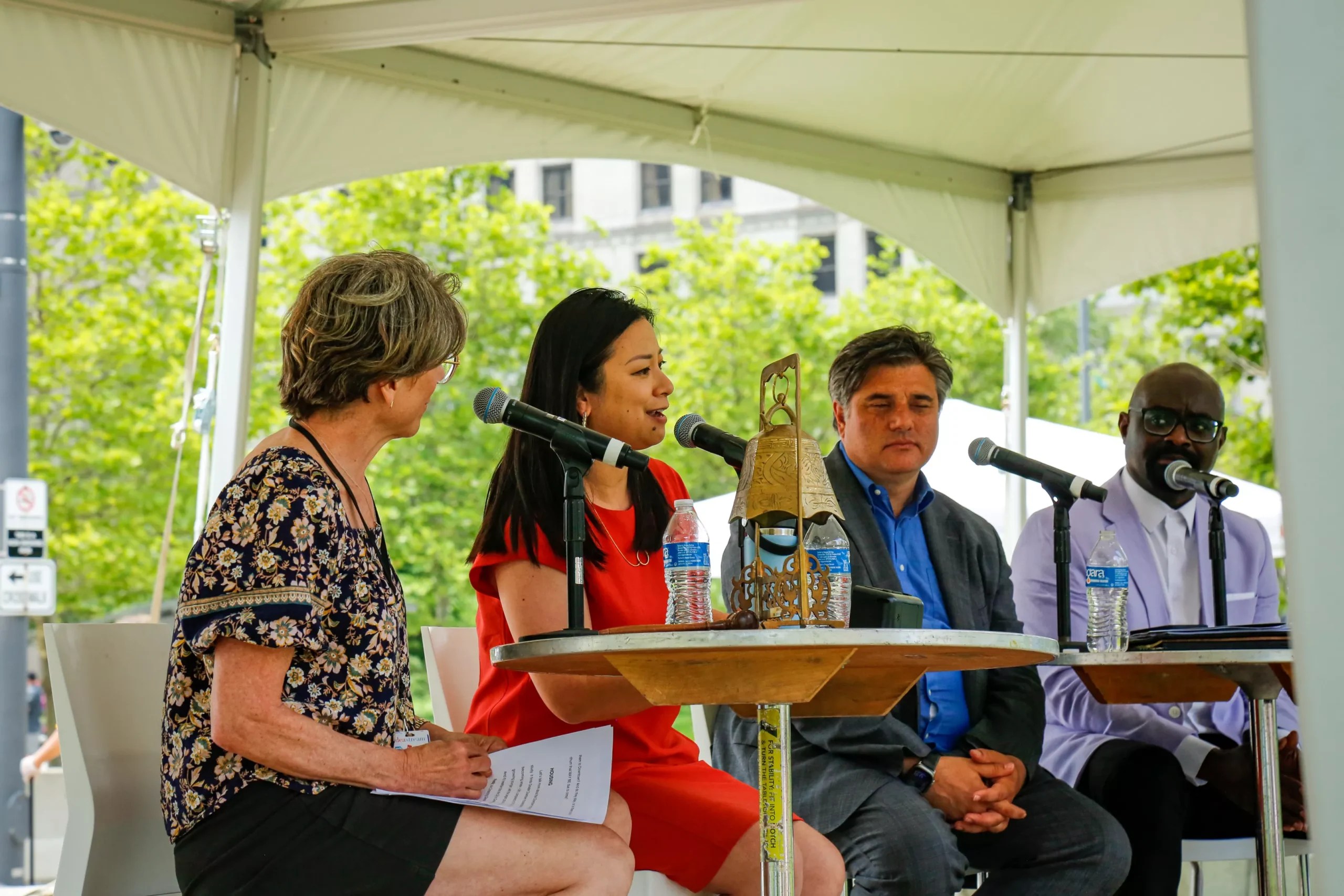
DCI President Michael Deemer, City Planning Chief Joyce Pan Huang and Freddy Collier, Sr. Vice President of Strategy & New Initiatives at Greater Cleveland Partnership, convened for a midday City Club dissection while fielding some hardball questions from WKSU’s Amy Eddings.
Those mostly pertained to an ongoing theme in urbanist circles: Does recent data reports on Downtown’s growth in the past decade truly reflect its reality?
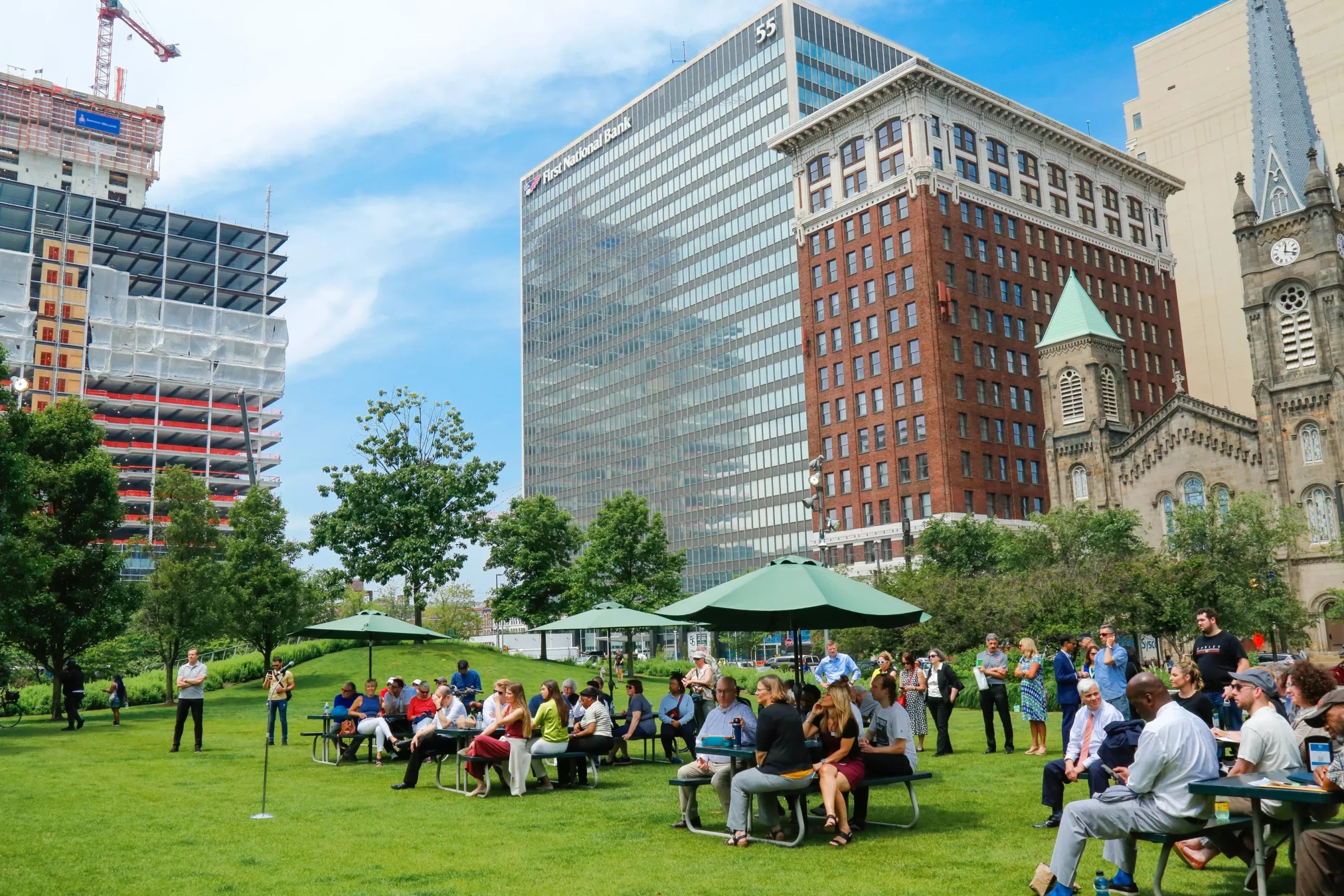
The panel discussion, the first in City Club’s outdoor series in Public Square, was held two weeks after the announcement of “Reimagining Downtown Cleveland,” a five-year plan to direct the city center into a more livable, attractive space.
A month before, in April, DCI released an updated housing demand study, which confirmed that Downtown is the fast-growing area—at a 22 percent climb since 2020 — that DCI regularly sells it as. One, as the talking points ran aglow of Tuesday, eager for housing, high on amenities, in need of retail, starved for affordability, excited for talent, and ready to warp suburban perception.
“We’re not building a downtown to compete with suburban neighborhoods—we just aren’t,” Deemer told Eddings, when asked about Downtown’s more unappealing side: its “noise,” its “public nuisance[s]”, its—yes—”public drunkenness.”
“We want to continue to build an intergenerational downtown,” Deemer added. “Downtowns are a little bit messy. And that’s okay. That’s okay. That’s part of the beauty of it.”
Deemer’s qualifying Downtown as “messy” runs tandem with a barrage of summertime criticisms about crime.
Related

Downtown Cleveland Alliance Rebrands as Downtown Cleveland, Inc.
Huang, a major force behind Bibb’s fight to actualize Cleveland’s lakefront and riverfront, spent most of her mic time decrying longstanding stereotypes about urban life. That it’s all white. That it’s super expensive. That it’s not fit for family-raising.
“There are many of you in the audience, too, who have families who live downtown,” Huang, who lives in Cleveland Heights with her husband and daughter, said. “Oftentimes people are like, ‘Oh, how do you do it? And babies sleep. They get used to the noise. Once you’re used to an environment, it’s there. It’s part of your everyday environment.”
Collier, who had Huang’s job until his departure in 2022, said he doesn’t like to put too much emphasis on population data, such as the 56 percent increase in Downtown’s white population since 2010.
But, whether Downtown has 12,000 or 22,000 residents relies, he said, on an ultimately frail system. That is, the U.S. Census always, he said, misses a portion of the population—mostly persons “who didn’t hand in that form.”
“Over time, those statistics ebb and flow,” he said. “I never get caught up in a moment in time type of statistics and let that define the situation. That’s just an indicator of what you need to do to course correct, if in fact, you find that concerning.”
Related

Cleveland and Cuyahoga County Unveil Plan for ‘Downtown 3.0,’ Aiming to Boost Population, Visitors and Amenities
Subscribe to Cleveland Scene newsletters.
Follow us: Apple News | Google News | NewsBreak | Reddit | Instagram | Facebook | Twitter | Or sign up for our RSS Feed
Related Stories
Downtown Cleveland Alliance Rebrands as Downtown Cleveland, Inc.

East 4th Designated Outdoor Refreshment Area Earns Council Approval
Cleveland and Cuyahoga County Unveil Plan for ‘Downtown 3.0,’ Aiming to Boost Population, Visitors and Amenities
This article appears in Jun 14-27, 2023.