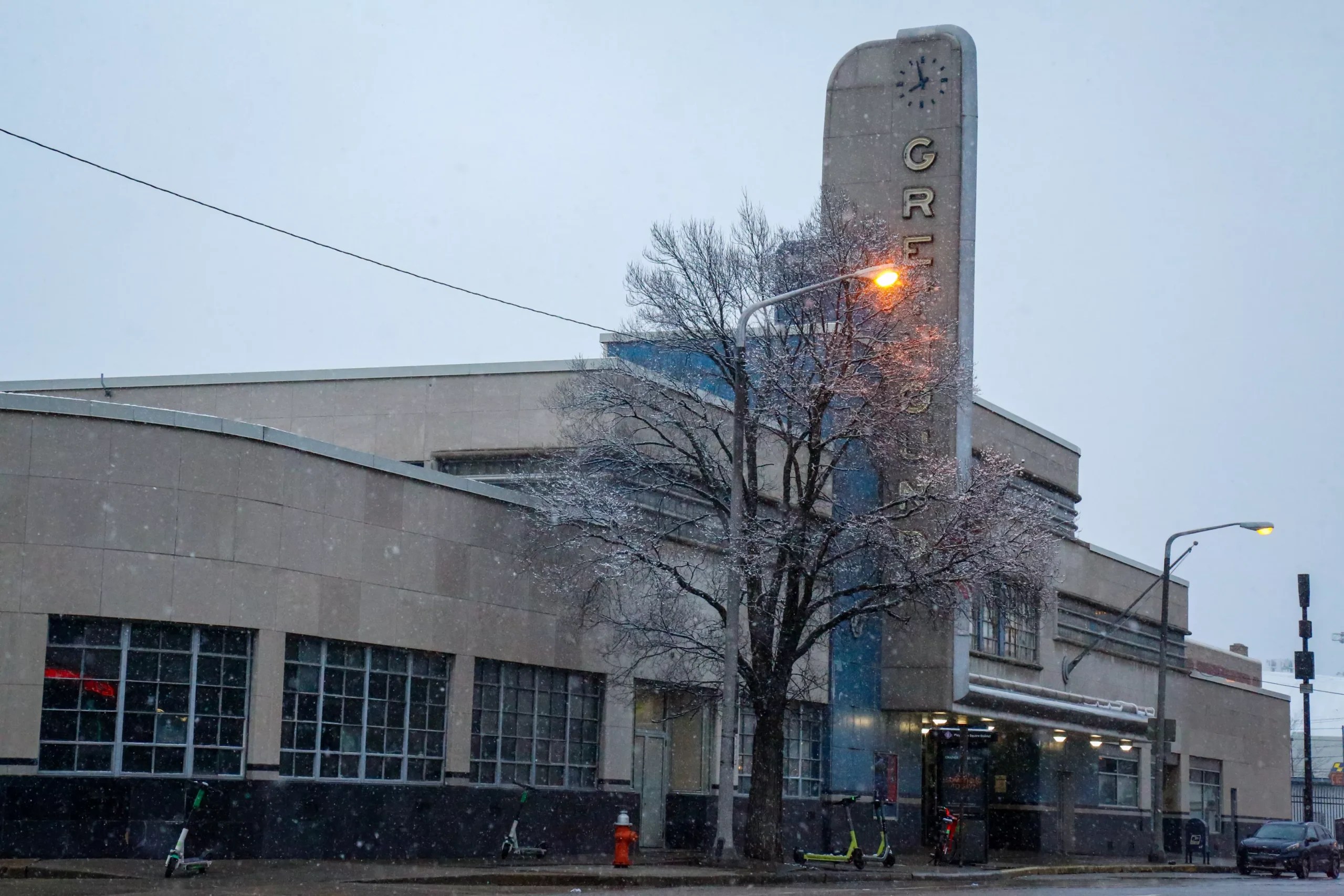
When Downtown’s Greyhound bus station was sold earlier this year, the $1.72 million transaction occurred amidst a flourishing time for center city building conversions.
Cleveland was recently cited on a national list of cities leading the conversion of office buildings into residential units. (A difficult task for newer, glassier buildings.) Long-running projects, like the 925 Building/The Centennial conversion, and the Erieview/Blue Lofts project, are set to cross major hurdles in 2023.
For the Greyhound station, a 75-year-old building in the spaceship-esque streamline moderne style, the future is unclear. Twenty Lake Holdings, based in Connecticut, has been mum on its plans for the latest addition to its portfolio except to say it does not intend on operating the building as a bus terminal. Could it be turned into apartments though? A boutique hotel? (An Orbit Hotel Part Deux?)
It could also raze the property, since 1465 Chester Avenue is not an historic city landmark.
Barbara Powers, Deputy State Historic Preservation Officer at the Ohio History Connection, told Scene that though the 36,000-square-foot structure is on the National Registry of Historic Places, such a designation does not keep it safe.
“National Register listing doesn’t necessarily change a property owner’s rights as a property owner,” Powers, the signatory on the original 1991 registration, said in a phone call. “It doesn’t prohibit them from making changes to the property or doesn’t require that they make certain changes or improvements to the property.”
Also, Powers added, “it doesn’t even prohibit them from demolishing the property either.”
With some exceptions. Powers said that, if Twenty Lake—or whomever—applied for federal historic tax credits to rehab 1465 Chester, then a historic clause in the National Registry would effectively bar a wrecking crew. Such application for the credits, at 25 or 40 percent, would trigger a “review and coordination” to weigh the alteration in a more historical light, she said.
Which could very well be a worthy case. After all, when debuted in the late 1940s, the Greyhound station was seen as a lodestar of newfangled design—from its gray Indiana limestone to its terrazzo floor tiling and, most significantly, the final-frontier symbolism of its exterior.
The 1991 registration document, written by its architect, William Arrasmith, reads:
“The Streamline Moderne genre was a statement of the national sense of the victory of science and technology over the country’s persistent problems which had been brought on by the Depression. It is a masterful statement of efficiency. There is no more appropriate reflection in architecture of the Industrial Design philosophy. No other building in the city compares with the Greyhound terminal.”
Other than the Coast Guard Station and the Bond Clothing Company Store, which was demolished in 1978, there are relatively few Art Moderne-styled structures in Ohio worthy of Greyhound’s stature, said Brett Gaj, a Greyhound Lines district manager. Only “a few” of the 33 stations managed by Twenty Lake are in the style, Gaj said.
But he wouldn’t be surprised if Twenty Lake stays true to its statement suggesting the station will close. (“We have no intention of operating it as a bus terminal,” Marc McGehan, a Twenty Lake spokesperson, told Cleveland.com.)
After all, Gaj said, ridership has plummeted since 2000, when the building got a $4-million interior and exterior facelift which added a driver dormitory still in use today. Yet, times have changed drastically: In 2000, Gaj said, “70 or 80 buses” would depart per day; in 2023, they’re lucky to see 30, 35. “A far cry,” Gaj said, “from where it was.”
Which is why Gaj believes that 1465 Chester could go the way of stations in other cities, like Cincinatti, which closed its station in 2021.
“I don’t know that I can say that, ‘Yes, it’s the end of an era. We’re going to be outside of every downtown area or outside of every major terminal,'” Gaj told Scene. “It’s not that that’s the case. It’s really just going to continue to be evaluated, each location at a time.”
It’s possible that the Cleveland Planning Commission could move to label the station a historic landmark in the near future. Doing such, according to its ordinances, would necessitate a rigorous review process before any aesthetic alterations were carried out.
It’s accurate to say that anything drastic, like toppling its iconic signage, would hurt, at least people like Powers.
“Well, it is a pretty significant building, right?” she said. “This was built in the ’40s, and there are only a few left like it. It kind of looks like the station is going to board the station and it’s gonna take off.”
Coming soon: Cleveland Scene Daily newsletter. We’ll send you a handful of interesting Cleveland stories every morning. Subscribe now to not miss a thing.
Follow us: Google News | NewsBreak | Instagram | Facebook | Twitter
Related Stories


Millennia Says Construction on Centennial Project Could Begin This Fall, Adjusts Total of Workforce Apartments

City Council Greenlights Slew of Development Legislation in Marathon August Meeting

Greyhound Likely Staying in Downtown Cleveland Following Playhouse Purchase of Historic Building
This article appears in Mar 8-21, 2023.