Mayor Justin Bibb on Wednesday moderated a City Club talk focused on the future revamp of the West Side Market with insight from three leaders of noted public markets across the country — Dan Carmody, president of Detroit’s Eastern Market Corporation; Kelly Lanser, of Cincinnati’s Findlay Market; and Robert Thomas, the chief of Baltimore Public Markets Corporation.
The conversation comes in the wake of the city’s decision to transition management of Cleveland’s historic public market to a new non-profit — the Cleveland Public Market Corporation. It takes the reins from the Department of Public Works, which had long been the subject of complaints from both vendors and patrons.
By this summer, Market Ventures, Inc., the Maine-based consultant hired for deep market insight, will whittle down the 100 or so applicants for Public Market’s executive spot. That person will be tasked with bringing suggestions from a 64-page master plan to fruition—from expanding market seating space to adding food classes and possible small business incubation.
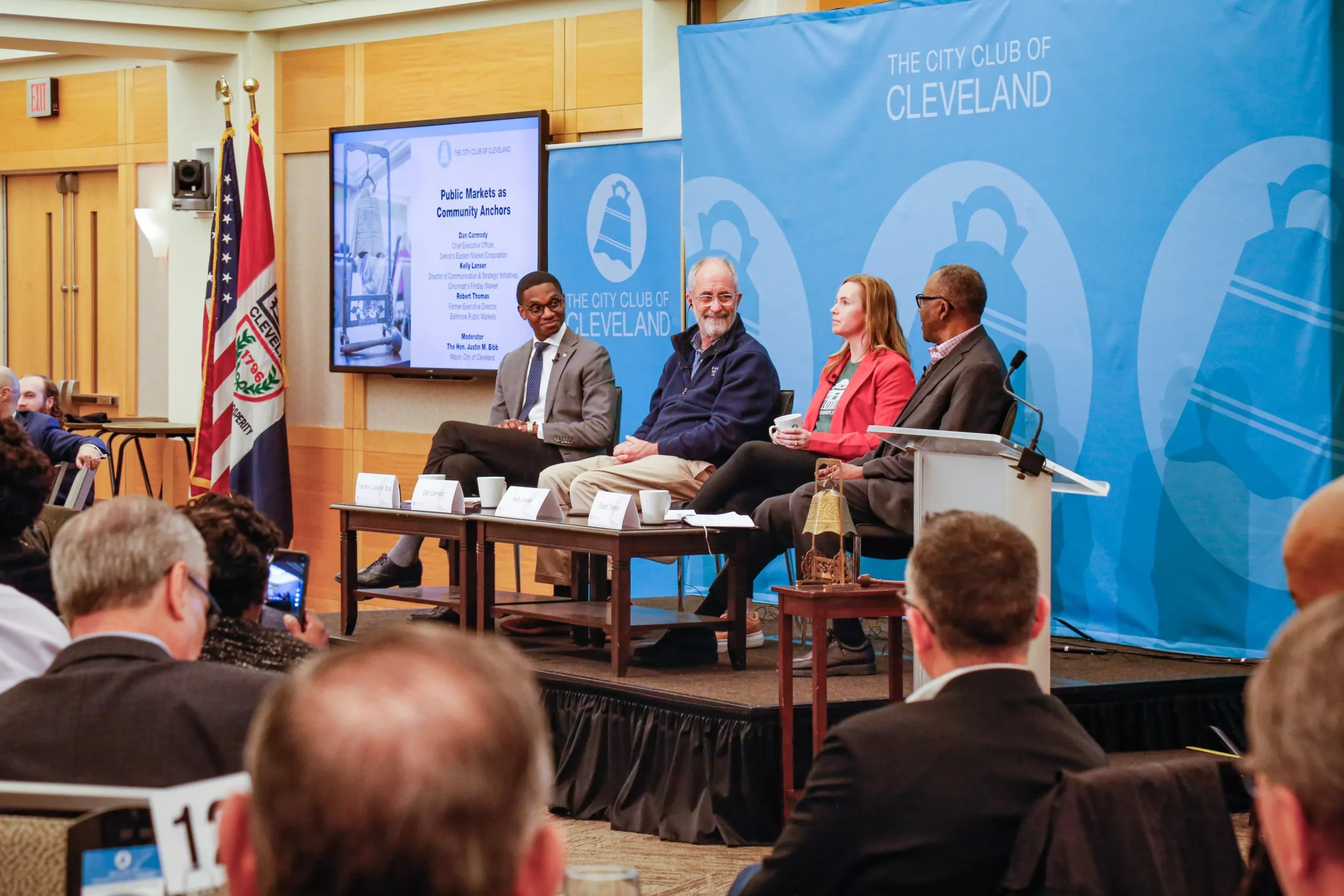
“Over the last ten years, what we’ve realized is that there are so many people with barriers to entry as a food entrepreneur,” said Lanser, talking about Findlay’s shared-use kitchen space. “Specifically those that are [Black] women or immigrants. We have placed special emphasis on those groups of people in a few programs.”
If there was any gem the CPMC could look to as far as a guiding North Star, it seems the Findlay Market is a good model.
With similar consulting from Market Ventures, Inc., Findlay blossomed in the early 2010s as both a retail hub and fresh food epicenter, adding culinary classes, a Findlay Learn project to teach “food basics,” and a colorful facelift that helped grow the surrounding Over-The-Rhine neighborhood. (They also introduced an app.)
Though the area of densely-packed row homes used to have 60,000 residents, many had moved away, Lanser said. It now has 6,000—and growing.
“I remember when I was campaigning for mayor a long time ago, in 2021, all across the community, they would say, how does Cleveland’s West Side Market become like Findlay Market in Cincinnati?” Bibb said.
Thomas echoed the market development effect. In the past year, he said, there’s been $1.6 million in development—apartments, namely—on the fringe of Baltimore’s Lexington Market, which has been a nonprofit since 1981.
That trails a combined $45 million in investment, the Baltimore Banner reported in September, which revamped Lexington’s community-focused assets, added an open-air plaza and assistance for SNAP users.
“There’s a lot more interest in residential,” Thomas said. “A lot more interest in that area now, because that area, once the department stores left, was just this valley of the shadow of death. We’re coming back from that now.”
Besides the obvious parallel benefit to neighborhood growth, a lot of the talk Wednesday danced around the idea of the market as a tourist destination and as a stop for weekly groceries.
It’s what Carmedy said the Eastern Market’s been tackling since 2005, when it reformed as a nonprofit. Since then, Carmedy said, Eastern’s grown to host 150 brick-and-mortars, 120 being food distributors that either deal wholesale with Michigan and Ohio farmers (and the “occasional Ontario” farmer), or sell meat, say, to nearby Five Guy’s and Walmarts.
And, of course, the “30,000 to 40,000 people on a Sunday,” Carmedy added, who stop to pick up cheap produce.
“Number one, like public markets everywhere, we’re the place where people go without a lot of means,” he said.
Navigating the tourist-local spectrum will be a focus of the new nonprofit management, Jessica Trivisonno, the West Side Market’s senior strategist, said after the panel concluded.
She’s visited 11 other public markets — London’s Borough Market being the most inspiring, she said — and is eager to bring Cleveland’s up to the same quality. But it’s not as simple as duplicating what has worked elsewhere exactly.
“There are so many other cities that have made this transition from a publicly-owned-and-operated to publicly-owned and nonprofit-operated. And all of them are 20 years ahead of where Cleveland is,” Trivisonno said. “But I don’t think that there’s a single market that’s like a copy-paste for the West Side Market. I think we’re going to have to find our own solutions.”
Coming soon: Cleveland Scene Daily newsletter. We’ll send you a handful of interesting Cleveland stories every morning. Subscribe now to not miss a thing.
Follow us: Google News | NewsBreak | Instagram | Facebook | Twitter
Related Stories

Is This Downtown Cleveland’s Retail Moment?

Here’s What Happened to the Plan to Open a Constantino’s in Tremont

West Side Market Nonprofit Board Announced, Master Plan Unveiled

With End of Pandemic-Era Bonus SNAP Benefits, City of Cleveland Launches Monthly Free Food Pickups

Bibb Leans Into Public Safety, Jobs and Housing in Second State of the City Address

As City Unveils Master Plan for Renovated West Side Market, Now the Question of How to Pay For It
This article appears in Mar 8-21, 2023.