“I moved to the area in 2007 and one of the earliest memories I have is when my dad brought me here and said, ‘This is Little Arabia,’” says Omar Kurdi. “This is where I got my first haircut, my first Arabic meal outside of home. This is definitely the spot I come to whenever I am missing the homeland.”
Kurdi wears many hats professionally, but it’s his role as co-founder and president of Arab Americans of Cleveland Young Professionals Network that inspired me to reach out. Selfishly, I was eager to try a new Yemeni restaurant, and I was looking for an enthusiastic dining partner. Kurdi, who was born in San Francisco but spent most of his formative years in Oman and Jordan, more than fit the bill.
Reef al Yemen opened last summer in the heart of Cleveland’s Little Arabia neighborhood. Like other unofficial ethnic enclaves, the district has no definitive borders, just a heavy concentration of Arab American-owned shops, markets and restaurants. If we pushed pins onto a map, they would cluster along and around Lorain Avenue between W. 117th and W. 130th streets.

Yousef Qartit opened Reef al Yemen last summer, in a space that had been home to a Dominican restaurant. It returned to the area a source for traditional Yemeni cuisine following the untimely departure of Yemen Gate, whose opening coincided with the arrival of Covid. When I reviewed that restaurant in the summer of 2020, I did so based on a meal that was packaged up, driven across town, and consumed in a quiet residential dining room. That is not how Arabic meals are meant to be enjoyed.
“We come together around food,” explains Awatef Assad, a member of the family behind the heavenly Assad’s Bakery in Little Arabia. “It is the most beautiful thing. These recipes have been in our families for generations and when you eat something that goes back hundreds and hundreds of years, you can sense your ancestors. That connection with your roots, your heritage…”
I’m still thinking about that meal at Reef al Yemen. For many years, our Middle Eastern food experiences in Greater Cleveland have been dominated by hummus, baba ghanoush, falafel, shawarma and pita bread. But as demographics continue to shift, and new waves of immigrants and refugees settle here, the food offerings expand in beautiful and delicious ways.
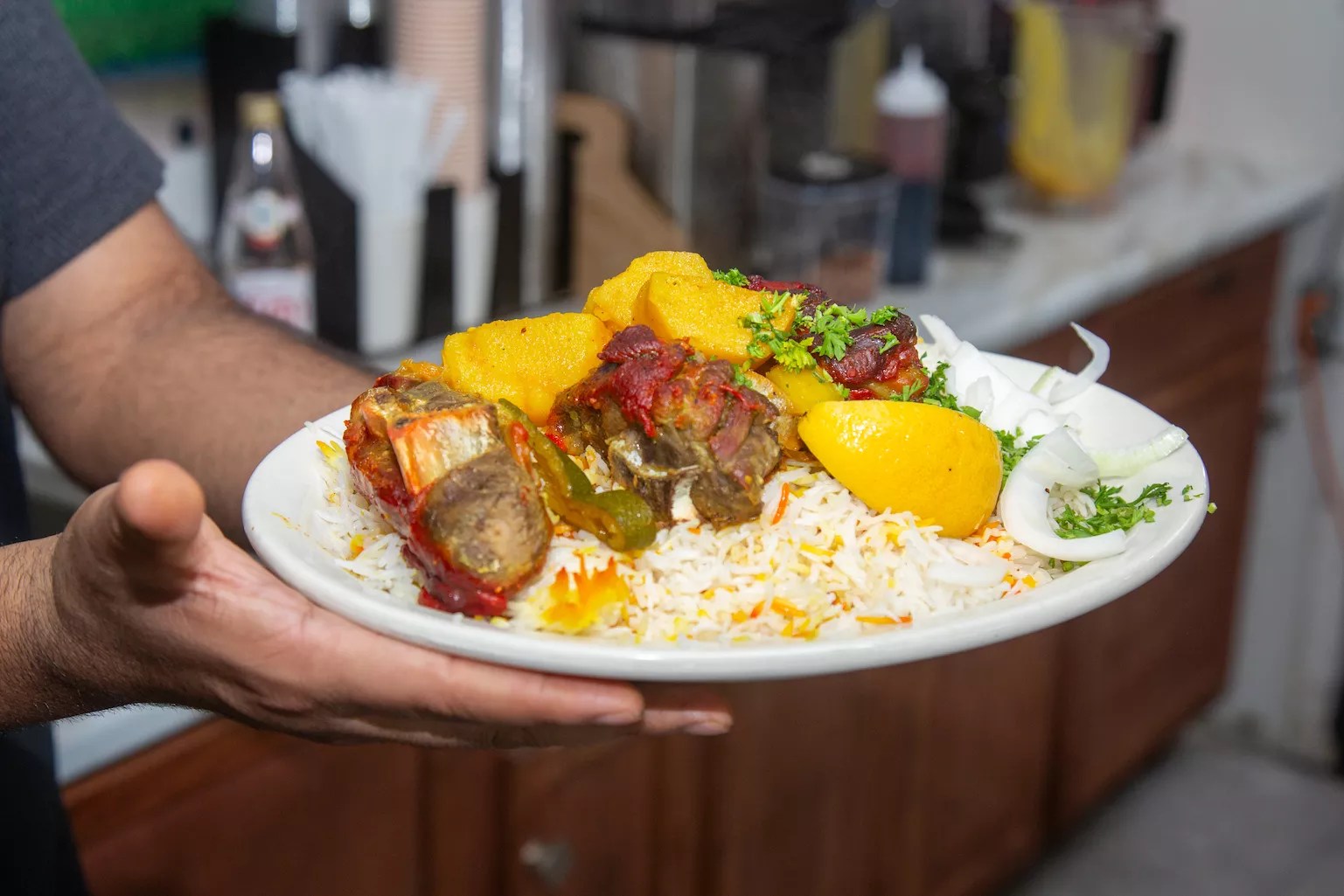
With Kurdi’s guidance, we placed our order. While he and I were getting to know each other, a server brought out cups of marak, an aromatic broth made from long-simmered lamb bones. I would return simply for another sip of this savory, expertly spiced soup. The broth is a traditional accompaniment to lamb mendi, fall-off-the-bone tender meat that arrives on a mountain of fragrant long-grain rice. Kurdi pointed to a tomato-based condiment that appeared on the table and explained that it was sahawiq, meant to be eaten with the lamb and rice. Fahseh, a savory lamb stew, arrives in a stone pot, still sizzling from the kitchen. Another platter holds expertly char-grilled shish kebab, shish tawook and shish kofta. On the side is a serving of malawah, buttery flatbread the size of a hubcap.
When I spoke to Qartit soon after he opened Reef al Yemin, we briefly discussed the restaurant turnover that the area has experienced over the past five or so years. He seemed unconcerned.
“If you have good food, something different, people will come and try it,” he told me.
In 2020, as a way to assist struggling owners and operators, Kurdi and his colleagues launched a database of Arab American-owned businesses that the community could support through take out and other measures. Even he was surprised by the numbers.
“It was shocking how many places I wasn’t aware of,” he says. “These were restaurants, yes, that served Middle Eastern or Arabic food, but there were also Arab-owned restaurants that served American food that you might not think were Arab owned.”
Because Arab Americans were not specifically counted on the U.S. census until 2020 – instead being lumped into the category of racially white – accurate numbers are difficult to come by. By Kurdi’s best estimates there are about 170,000 Arab Americans living in Ohio, with roughly 60,000 of them calling Northeast Ohio home.
If you’re in search of the seed that grew into the thriving tree that is now Little Arabia, you’ll find it at the corner of West 128th and Lorain. That’s where brothers Fred and Mike Assad opened Assad’s Bakery 35 years ago after the family settled here from Palestine via Dearborn, Michigan.

“We’re the original,” Mike says. “We’ve been here since 1990. When we started, there was nothing of Middle Eastern descent.”
But before there was Assad’s, there was Middle East Foods on West 25th Street in Ohio City.
“In 1979, my brother opened an Arabic food store because he didn’t see anything in Cleveland at that time,” Mike explains. “He was doing very well, and he was buying a lot of bread from Aladdin’s (the bakery not the restaurant). He had the idea to get his own pita bread oven and make his own pita bread.”
In the late-1980s, a group of family members travelled to Jordan, Syria and Lebanon to research baking techniques and equipment. After returning home with everything they needed, they opened a bakery on Cleveland’s near-west side. In 1990, the first batches of warm, fresh pita were rolling down the line, where it is still baked today in the rear of Assad’s Bakery on Lorain.
Given the importance of pita, Assad’s Bakery made the area very appealing to other Arab American families. The bread is served with most meals and store-bought brands – if at all available – pale in comparison to fresh-baked. From early on, the Assads supplemented the bakery items with imported retail products and prepared foods. But as the neighborhood continued to expand, so too did the offerings.
“In 2010, we wanted to do something a little different,” says Mike. “We were doing hummus, baba, grape leaves and pies – we’ve always been doing that – but we started doing sandwiches and grilled items. Now, we have people from all over the city that come here for the falafel, our shawarma…”

With the continued arrival of Muslim immigrants into the area from places like Lebanon, Syria, Jordan, Palestine, Egypt and Yemin, markets specializing in halal foods began to spring up. Today, shoppers have their pick of well-stocked grocery stores like Holyland, West Town Village, Almadina Imported Foods and Arabian Village, all located within walking distance from one another.
“Before we opened our own shop, my go-to store was Holyland,” says Fasih Syed, who opened Cleaveland Grocers in Brook Park in 2021. “With the influx of immigrants into our community, the demand for halal products has definitely gone up – and the demand for different products.”
You don’t have to keep halal to appreciate the selection of fresh goat, lamb, chicken, beef – not to mention hard-to-find specialty items like lamb fries, sweetbreads and liver – available at most of these markets. Like any grocery store, those items are joined by a dizzying selection of fresh produce, yogurts, cheeses, olive oils, nuts, rice, spices, canned and jarred goods, flatbreads and candy. I had my first taste of Dubai chocolate after purchasing a bar as an impulse item while checking out at West Town.
At most of these markets you can do your shopping and walk out the door with a hot wrap filled with falafel, shawarma or shish tawook. Or simply grab one of the ready-to-eat pastries like spinach pies, cheese turnovers or mincemeat-topped flatbreads that also are commonly stocked at most markets.
One of the newer additions to the area is Levant, a popular shawarma restaurant that Adib Toubya opened in 2024. After attending culinary school at home in Syria, he worked as a professional chef for nearly 20 years before landing in Cleveland a decade ago. His goal at Levant, he explains, is to offer wholesome food at affordable prices.
“I want people to eat healthy,” he says. “For almost the same price of McDonald’s you can eat healthier. I don’t like expensive items.”
Each day, Toubya arrives hours before opening to make the shawarma cones from scratch. Two types are available, chicken and beef/lamb. The meat is thinly sliced, seasoned and meticulously stacked on a vertical spit to form the characteristic inverted-cone shape. Come mealtime, the lightly charred meat is shaved from the exterior as it cooks. Diners have their choice of wraps filled with meat, veggies, pickles and sauces, customizable platters and bowls. Order your shawarma wrap “Arabic-style” and it arrives in tidy bite-size pieces.

In addition to the shawarma, Toubya makes hummus, baba ghanoush, tabbouleh and falafel from scratch. His mother Noura makes the cheese pies, kibbe and stuffed grape leaves.
Perhaps due to the same ever-shifting demographics that make Little Arabia a great place to eat, shop and stroll, the area has struggled with restaurant turnover over the past few years. Despite spectacular food and service, Yemen Gate shuttered a few months ago. Damas Eatery, a lovely Syrian restaurant that opened in 2022, closed last year. But turnover suggests rebirth, and there are always fresh restaurants in the area to explore. Saffron Restaurant, which specializes in Afghan cuisine, took the spot formerly home to Damas Eatery. Damascus Gate and Dar Al Yemen both are new dining options in the neighborhood.
Of course, it’s not just Arab American restaurants that call Little Arabia home. The area has long been a hub for Latin-owned spots like Mi Pueblo Taqueria and Mercado, which enjoyed a 20-year-run on Lorain until it closed a decade ago. Tapatia’s Taqueria has been attracting diners for eight years thanks to tasty tacos, tortas, sopes, tostadas and burritos – all washed down with refreshing micheladas. That neighborhood staple has recently been joined by J-G Taqueria el Milagro and Los Abuelitos, a Salvadoran restaurant. City Slice, a Latina-owned pizzeria, has been slinging mega NY-style slices since 2022.
Given the neighborhood’s rich history, culture and wealth of culinary assets, it’s natural to compare it to other ethnic enclaves in town like Little Italy or Asiatown. But for reasons unknown – perhaps because it is such a melting pot of immigrants and cultures from all around the world — Little Arabia hasn’t received the same public or media attention. Despite generations of immigrants and Arab Americans settling in the area, it drew little notoriety as a dining or cultural destination — the first appearance of “Little Arabia” in the Plain Dealer didn’t come until 2001.
And stakeholders say they’re still fighting for respect.
Last year, Westown CDC, the community development corporation that operates in that area, hosted the Ward 11 Street Fest. Most of the Arab American business owners that line those same streets say that they were not asked to participate, a slight that some suggest as indifference or worse.
“We need city representatives to see the opportunity to invest in the neighborhood and the brand,” states Kurdi. “We’re an economically thriving community. We’re a diverse community too. I do invite city officials to consider rebranding the neighborhood officially to Little Arabia, consider engaging with the business owners and community leaders, and not ignore this important population.”
Spend a few minutes inside Assad’s and you’ll likely observe owner Mike devoting half his time to doing his tasks and the other half to chatting up shoppers. He prides himself on being able to greet most customers by name and in their native tongues, of which there is an impressive diversity.
“At least half my customers are non-Arabic,” he says. “Over the past 15 years there has been a lot of immigration from Afghanistan, from India, from Africa, from all over – and I have met people from almost every culture and nationality known to man.”
But just as those new families move in, many Arab American families have been moving out. Over the past decade or so, there has been a mini-diaspora in Northeast Ohio, with many Arab Americans relocating to places like North Olmsted, where a second Little Arabia is forming. Brookpark Road Extension has long been home to Middle Eastern hubs like Olive Tree Middle East Food and Ya Hala Bakery & Grill, but those businesses have since been joined by Arab American owned places like the Nut Shop, Cocky’s Bagels, CREPEscape and Shibam, a Yemeni coffee spot. After calling Cleveland’s near-west side home for 40 years, the Palestinian cultural center Beit Hanina also is relocating to North Olmsted.
“I’m a little concerned about the status of Little Arabia with a lot of the businesses opening on the west side, but I feel like after Levant and the Yemeni restaurants opened, they brought in a lot of hype to this area,” Kurdi says.
To Mike Assad, who has been watching the neighborhood’s ebbs and flows for 35 years, the perpetual metamorphosis is part and parcel of living in a welcoming, affordable, immigrant-rich community.
“I think this is one of the best melting-pot neighborhoods in Cleveland,” he says. “I think right now, the neighborhood is the best it’s ever been with variety, with diversity. I love the way the neighborhood has grown and improved. You have new refugees moving into the area and when they become more successful, they move out of the area. And that person will be replaced by another one. Everybody wants the American dream.”
Subscribe to Cleveland Scene newsletters.
Follow us: Apple News | Google News | NewsBreak | Reddit | Instagram | Facebook | Twitter | Or sign up for our RSS Feed
This article appears in Cleveland SCENE 7/30/25.