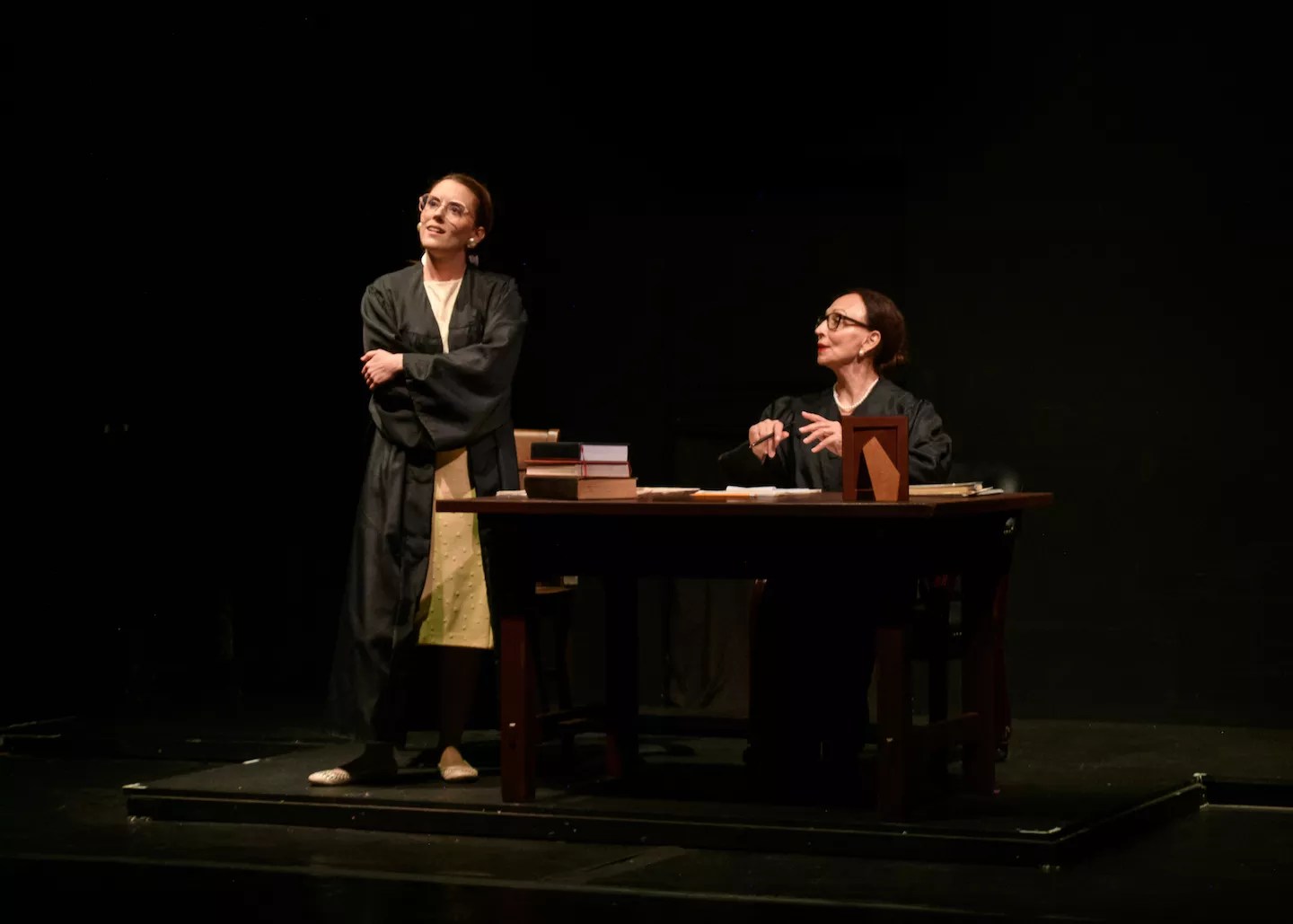
Labeled a firebrand by some, Ginsburg started off as a moderate consensus-builder but soon took on the role of fighting for equality for many through her arguments and decisions. Her contributions in that regard once seemed “permanent” until recent Supreme Court appointments proved, and continue to prove, that for some on the highest bench there is no such thing as settled law and no respect for precedent.
Thus, it is easy to understand why Zake would fall in playwright love with this woman and do everything in her power to convey how extraordinary a person she was. Unfortunately, the result in this case is a less-than-compelling piece of theater.
Indeed, both the script and the staging fall short in the task of giving us a close-up encounter with the lively, intellectually curious individual that Ginsburg was. (How curious? She was best pals and opera buddies with the uber-conservative Antonin Scalia, who was her polar opposite on virtually every important issue on which they voted.)
Despite strong performances from the nine-person cast—especially Samantha Cocco as Ruth gal-pal Margie and Doug Sutherland as Ruth’s hubby Martin—they are fighting an uphill battle from the start under the direction of Celeste Cosentino. Part of the problem stems from the organization of the two-act show, which hews to a strictly chronological structure. This would be helpful in a classroom where it’s important to connect a person’s activities to the times they happened, but it gets in the way of our momentary relationship with Ruth.
Since we are yoked to the calendar as the play progresses, we don’t get to the juicy judicial decisions until the second act. Meanwhile, the scenes in Act One play out with clarity but without much energy. Ruth meets her lifelong love Marty, Ruth gets married and moves to Oklahoma, Ruth goes to Harvard where female students aren’t allowed in the library (!), Ruth goes to Columbia, and so forth.
Each of these scenes is separated by a soft piano interlude and screen graphics that show buildings Ruth occupied and headlines from the time. They often feature one character or another testifying to Ruth’s smarts and dedication. What’s missing are moments when we can watch RBG in action and then come to our own conclusions about her intellectual strengths.
As the bullet points of Ginsburg’s outstanding life accumulate, the audience is kept at arm’s length. As young Ruth, Erin Moran brings as much life as possible to her character, within these tight confines. And she receives encouragement from the older RBG (Laura Perrotta) who appears in young Ruth’s imagination, armed with helpful advice and motivation to keep on truckin’ through all the barriers to female advancement in the middle of the last century.
After intermission, Perrotta takes over the role and there is an instant infusion of heft and wit as the fully adult and capable RBG finally begins to deal with the issues we all associate with her. Powered by the motto “We’re not done yet” Ginsburg keeps pushing, through her appointment to the U.S. Court of Appeals to her seat on the Supreme Court.
But still, playwright Zake prefers to bathe us in the praise others give to RBG rather than allowing us to experience the redoubtable Perrotta explore her character’s feisty spirit in courtroom scenes or in cloakroom banter with her contemporaries. Yes, she and Scalia do chat briefly, but it’s a love fest not a mano a mano verbal fisticuff.
The parade of praise seems to culminate in a stilted scene where people are lined up to talk-up Ruth’s resume to President Clinton when he’s deciding on her Supreme nomination. Then somehow, it’s topped with more blandishments at her 75th birthday.
The set design by Ian Hinz doesn’t help the play much, since the runway stage flanked by audience on each side puts many scenes in awkward positions. And the projections are often either irrelevant or obvious.
According to this play the only downside to RBG’s personality was her poor cooking skills. That seems dubious. But if you’re only interested in looking at the bright side of this woman’s amazing career, especially since we’re only weeks away from the latest onslaught from the Alito-ized Supreme Court, this is the show for you.
Come and bask in the bright light and brilliant achievements of one Ruth Bader Ginsburg.
The Prospect of Equality
Through June 9 at Ensemble Theatre, Performing Arts Center—Notre Dame College, 4545 College Rd., South Euclid, 216-321-2930, ensembletheatrecle.org.
Subscribe to Cleveland Scene newsletters.
Follow us: Google News | NewsBreak | Reddit | Instagram | Facebook | Twitter
This article appears in May 22 – Jun 5, 2024.