

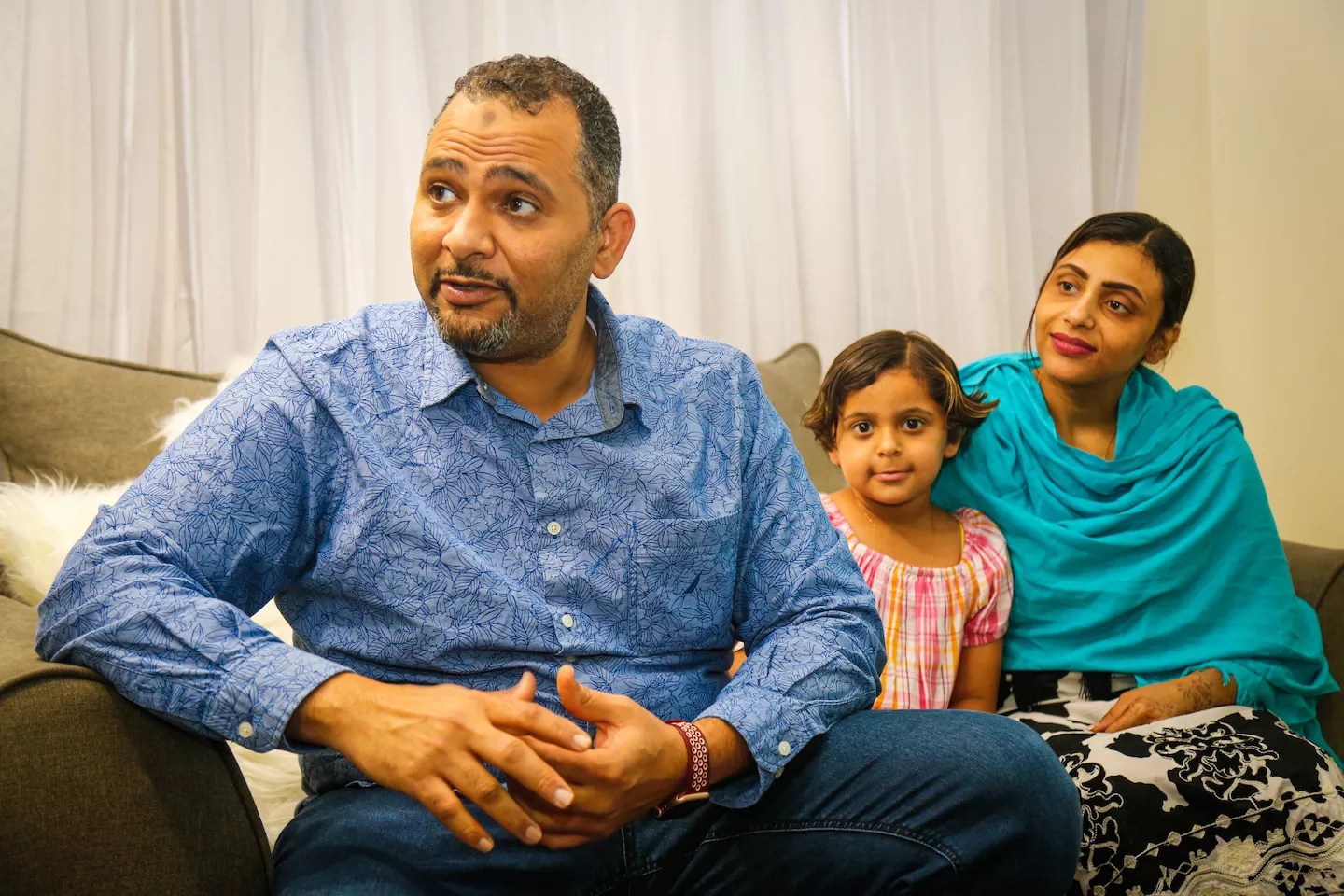
Mohamed Hameid and his family began seeking asylum to the United States from Sudan in 2014.
“We had trouble in Sudan because our government was very bad, very corrupt,” Mohamed said.
Since its liberation from colonial rule in 1956, Sudan endured two civil wars before the establishment of South Sudan in 2011. Through the two wars, citizens were victims of famine, disease, enslavement and child soldiering. Roughly 2.5 million people died and millions more were displaced as civil unrest enveloped the country..
Much of that happened under the rule of now-deposed leader Omar Hassan Ahmad al-Bashir, who was indicted by the International Criminal Court for allegedly overseeing genocide and human rights violations. Al-Bashir rose to power in a 1989 military coup and led Sudan for 30 years before being deposed in 2019 following massive protests.
Living in Sudan under al-Bashir’s rule was brutal and Mohamed said he was arrested four times.
“Sometimes people protested and my shop was on the main street, so I’d just bring them some water and [the police] caught me because I helped [the protesters],” Mohamed said. “I just helped people and gave them some water. [The police] covered my eyes and took me somewhere with no indication of where I [was].”
Another time, Mohamed said he filmed protests on his phone and was, once again, blindfolded and taken to an undisclosed location.
By 2014, the family – his wife Tagreed and daughter Tala – decided to leave, applying for asylum in the States. But it would be years before they were interviewed by the U.S. Embassy. So long that by the time Tagreed’s interview was scheduled, their family had grown, as Mohamed and Tagreed welcomed a new daughter, Renad, in 2017.
Understaffing at the Embassy due to civil unrest, a bureaucratic gap, and wrong advice from U.S. officials then conspired to separate the family for years, with Renad remaining in Sudan as the family, by that point settled in Northeast Ohio, fought to be reunited.
“It’s a really hard, hard situation,” said Mohamed. “I prayed everyday and asked God to help me.”
When Tagreed attended her interview at the American embassy in Khartoum, she said she was incorrectly told it was impossible to bring Renad to the United States with her because Mohamed had not yet received his green card.
“Instead of being told at the interview, ‘We need to add your daughter to this application because she has since been born and therefore this is the only way to bring her to the United States’, [Tagreed] was informed that there had to be a separate petition filed from the U.S. on [Renad’s] behalf,” said Columbus-based immigration attorney Jana Al-Akhras, who has represented the family in their legal fight against the government. “She shouldn’t have been separated from them to begin with.”
But the family didn’t know any better.
And so, believing it to be the only way to bring her daughter to the United States, Tagreed reluctantly left Renad in Sudan in 2019 with the child’s aging grandmother, who suffers from diabetes and struggled to care for the child.
“I felt excited that I would come, but when I spent more time without her, I noticed that I wasn’t with my sister anymore,” said Tala, now 11, of her move to Ohio in 2019. “My life started changing without her.”
In addition to the stress of moving to a new country and starting at a school where she didn’t speak the language, Tala struggled with her younger sister’s absence, crying often and having difficulty focusing on schoolwork.
Mohamed said the stress of the family’s separation from Renad caused everyone untold stress.
“How can I live without my family?” said Mohamed, who runs a non-emergency medical transport business in Stow. “I just wanted my kids to grow up better than my life because Sudan was horrible at that time, still Sudan is very bad.”
The application process essentially restarted for Renad. Mohamed said that they had no trouble with the United States Citizenship and Immigration Services office, but when the application reached the National Visa Center, it was stuck for years.
“When you start a whole new application separately for a child from anybody from the United States, it kind of resets the clock,” Al-Akhras said.
There were additional complications.
Crucially, in the United States, President Trump’s ‘Protecting the Nation from Foreign Terrorist Entry into the United States’ executive orders–commonly critiqued as de facto ‘Muslim bans’ – were enacted in 2017 and served as backdrops to the Hameid family’s migration troubles.
The orders lowered the refugee admission ceiling–the annual number of refugees allowed to enter the United States –and sought to suspend the entry of people migrating from Iran, Iraq (though it was later removed), Libya, Somalia, Sudan, Syria and Yemen.
In 2020, the explosion of the Covid pandemic further complicated international travel and migration. Through all of this, Renad remained thousands of miles away from her family while the Embassy in Sudan trimmed visa processing and staff in response to unrest.
After years of trying and failing to reunite with Renad and seeking help from their Congressman without success, the family finally enlisted lawyers in the battle.
“If you were to tell anybody else in the world at any point in time that there is a 5-year-old without her parents stuck in a country where the embassy’s having issues because of the civil unrest then the question would be: ‘Why are we not doing more to make sure that these families are reunited?’” said Al-Akhras.
In July 2022, Al-Akhras helped Mohamed file a lawsuit against Secretary of State Anthony Blinken, hoping that drawing attention to Renad’s case would compel the government to finally schedule an interview for Renad.
“Since the case [was] already at the embassy, we just need it to be scheduled,” said Al-Akhras. “That’s all that needed to happen.”
Instead, a government attorney responded with a motion to dismiss. However, the suit ultimately proved helpful, as once a government attorney was appointed, Al-Akhras had someone with whom to negotiate.
The government attorney working with Al-Akhras in Northeast Ohio was willing to expedite the case, signaling the first breakthrough in Renad’s case in years.
“Part of what we were trying to do was just ensure that the child had an interview, which is kind of a silly thing to say seeing as she’s not even six years old,” Al-Akhras said. “But everyone who comes to the United States needs to have at least a 10-minute interview appointment, do a medical exam, things like that.”
Then, on Thursday, December 15, 2022, the Hameid family was informed that Renad had an interview scheduled for that Sunday, December 18. Finally, on January 3, Renad was finally issued a visa after three years of separation from her family.
While the reunion has been joyous, it’s also been difficult, as the separation at such an early age from her family has led Renad to struggle to adjust.
“Renad has not lived a normal life, she’s lived a hard life,” said Mohamed. In Sudan Renad refused to go to school. “She was crying all the time and asking for her mom.”
Now in the United States, Renad continues to struggle after her years without her family, and is struggling to recognize her family as her family.
She’s unable to trust people and refuses to be alone with her father, who she doesn’t identify as her father.
“Right now, Renad, she doesn’t know me. Sometimes she wakes up at night and asks ‘who is this?’” Mohamed said. “She still doesn’t trust me…she cannot go with me in the car alone.”
At night, Renad is plagued with nightmares. She won’t let her parents turn out the lights and calls for Tagreed in the middle of the night.
But the family is optimistic that, with time, Renad will grow more comfortable and secure.
“She is very excited to be here, she’d never seen the snow,” Mohamed said. “These days I’m always trying to keep her inside, she wants to play with the snow.”
Tala is trying to teach Renad English, and Renad enjoys playing with Tala and the Hameid’s youngest, 1-year-old Basil, their “Ohio boy,” as they call him, who was born in 2021.
“It’s like a feeling I can’t trust,” said Tala of finally reuniting with her sister. “I got really excited. I cried when I saw her.”
Besides the excitement of playing in the snow, Renad, who turned five in September, has taken to all the usual allures of American childhood, mastering her neighbors’ hoverboard in an hour. She especially likes making videos and says she wants to be a YouTuber.
But although the Hameids are together again at last, they recognize that their situation is not unique.
“Family separation is a real issue,” Al-Akhras said. “Most of the time when we request things like expedited requests from an embassy in a case where there’s a minor separated from their parent, that should be cause for concern and should warrant an expedite and that shouldn’t really take as long as it has in this case in particular.”
Legal immigration to the United States is a complicated, often convoluted process. Most legal migrants to the United States come either through family (61%) or employment (26%), according to data from 2021. Immigrants coming on employment visas are subject to numerical caps but, unlike refugees, the ceilings remain the same every year.
In total, no more than 140,000 of employment-based immigrants are granted green cards annually. That number includes the spouses and children of the person being sponsored by an employer. Within that 140,000, no more than 7% can come from the same country, regardless of population.
For the 61% of immigrants coming through family, their relationship to their sponsor determines whether they face a numerical cap. For spouses, unmarried children under the age of 21 and parents of citizens over the age of 21, there are no limits. For all others, the combined limit is 226,000 and is subject to the same 7% country cap as employment-based immigration.
Because of these country caps, immigrants coming from populous countries can face prohibitively long waits.
Without a close family member or an employer to sponsor, most people looking to immigrate to the United States have no viable pathway to do so. If a person comes from a country where fewer than 50,000 foreign nationals were granted legal permanent resident status through family and employment-based migration in the previous five years, they are eligible for America’s diversity lottery. However, in 2021, the number of diversity visas was limited to just 54,850 and, once again, is rarely a viable option for people coming from populous countries.
For people like the Hameids, living in dangerous situations without family or employer sponsors, the only practical ways to come to the United States are as refugees or asylees.
Asylum seekers like the Hameid family made up just 2.8% of green card recipients in 2021. Although there are no technical limits for the number of asylees granted green cards annually, the president sets an annual limit for the number of refugees accepted as permanent legal immigrants.
In 2020, President Trump set that number at just 18,000, the lowest ever. In practice, that number was even lower, with just 11,814 refugees being admitted that year. In 2022, President Biden increased the ceiling to 125,000, but only 25,465 refugees were admitted that year.
“I know many people in [a Sudanese immigration Facebook group] that are stuck in my same situation,” said Mohamed. “It’s not me alone…they talk all the time about, ‘We are short-staffed at the embassy in Sudan.’ I hope the government or someone will fix this problem. Family must live together, especially the kids.”
Coming soon: Cleveland Scene Daily newsletter. We’ll send you a handful of interesting Cleveland stories every morning. Subscribe now to not miss a thing.
Follow us: Google News | NewsBreak | Instagram | Facebook | Twitter
Related Stories

Two Years After the Chaotic Mass Evacuation of Afghanistan, Asylees in Cleveland Are Still in Legal Limbo
This article appears in Feb 8-21, 2023.