

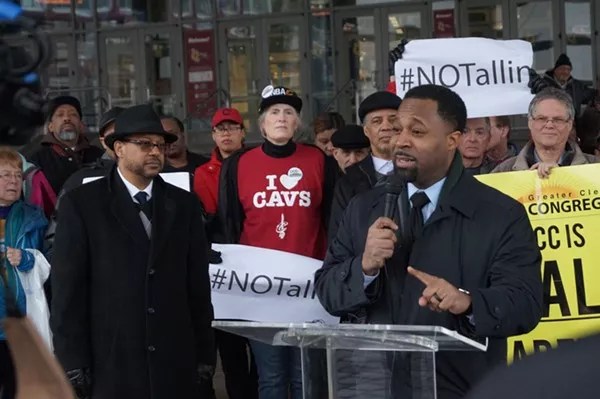
When the Greater Cleveland Congregations announced in late August of 2017 that it would withdraw its petitions for a ballot referendum on the city of Cleveland’s portion of the Q Deal renovations, it came as almost a complete surprise. The groundswell campaign to rectify a secretive and speedy decision to give Cavs owner and billionaire Dan Gilbert what many, including Scene, felt was an outsized public handout represented an invigorating and righteous democratic check on Mayor Jackson and company.
Surely, one thought in the immediate aftermath, they had won hard-fought compromises from the powers that be and not succumbed to backroom pressure from the brokers — Carole Hoover, Marcia Fudge, among others — who’d been dispatched as intermediaries to convince the GCC that it would be in its best interest to simply go away. Surely, they had held firm to their demands: “a community investment fund with matching dollars that would go toward ‘urgent and concrete’ regional issues in communities of need: workforce development, youth programming, housing, mental health, others.”
Turns out, not so much.
That day in August of 2017 the GCC issued a statement saying, “The GCC applauds the expressed commitment from County Executive Armond Budish, through mediators, to mental health and substance abuse crisis centers, which GCC has sought throughout its current campaign. This commitment represents a dramatic shift toward decriminalizing mental illness and drug and alcohol addiction. Research and evidence suggest that the construction or rehab costs for at least two centers to be $10 million, with an annual costs of roughly $1.4 million per center. We recognize the county’s intent to further research these investment costs and search for best practices.”
There was, of course, no actual commitment from the county. In later interviews with Cleveland.com and others, Budish would say there was never any concrete agreement. And over the past two years, a county spokesperson would tell Scene repeatedly that there was nothing to announce or discuss on the matter.
The need for mental health crisis centers was already evident in 2017, with the case of Tanisha Anderson just the most visible example of the kind of interactions with police and the criminal justice system that would be far better handled by those with mental health expertise. That need has only become more clear and dire in the ensuing years, as the county jail’s disastrous track record has been exposed and laid bare, sadly on the backs of nine people who have died there in just the past year.
There were 69 suicide attempts by inmates in the Cuyahoga County jail in 2018, according to numbers released by the county. That’s a 64-percent increase from 2017, when there were 42 suicide attempts, which itself was a jump from 2016, when there were 23 attempts. And, as the sad death of a National Guard vet who had struggled with heroin addiction who hanged himself in the county jail last week reminds us, there’s a broad intersection between the need for mental health and substance abuse treatment.
So, what’s up with those crisis centers?
Prosecutor Mike O’Malley has been meeting regularly with the GCC since winning the election, and in addition to plans for a specific gun docket for youthful offenders (which just recently launched) and hopes for a fourth drug court, the sides have continued to work on the issue.
“We’ve been working with people within the county and outside the county trying to develop them, both for pre-arrest and post-arrest, where people who hare having a crisis can be taken to help stabilize them and doing what we can to help them avoid the criminal justice system,” O’Malley told Scene last month.
While progress has been made, they’ve also encountered a hiccup in a newly interested county executive who, after years of sidelining the issue and following a round of indictments against jail officials and a blistering U.S. Marshal’s report on its operations, surprisingly announced in February that he hoped to build a facility for those dealing with mental health or substance abuse issues where they could be diverted instead of the county jail.
This nugget from Cleveland.com’s report on the announcement says all you need to know, however: “Budish offered no timeline or price tag for the project, and declined to disclose the proposed location. But he said his administration has been working on the plans for more than a year.”
If the administration had been working on the plans for more than a year, that was news to O’Malley, the GCC, as well as Judge John Russo and Judge Holly Gallagher, the latter of which runs the county’s mental health court docket.
“There are two separate groups, and I was assisting with the GCC,” O’Malley said. “We were trying to work toward that goal, and the county executive has been working as well. We’ve been talking to the Gund Foundation, trying to get a study done as to what type of center is needed in terms of size, beds, population, what the best model out there is. And, now, we’ve also been working with the county executive as well, as he goes down that track. He had been meeting with St. Vincent, trying to work out a deal where we can get a center at or near the St. Vincent campus to have a one-stop mental health crisis center. As for whatever speech it was when he first said it, I can tell you I didn’t know anything bout it and the court was very surprised.”
Given Budish’s late-arriving interest in the county jail, as well as what one might assume are lingering misgivings over the GCC’s effort to squash the Q Deal and O’Malley’s office’s investigation into his administration, it’s not hard to believe he’d refuse to seek out the assistance of those who he might blame for his woes.
O’Malley hopes that the two sides can eventually work hand-in-hand with each other.
For his part, he was part of a group that made a trip to Franklin County where they’re in the brick-and-mortar phase of a mental health crisis center, and also to Miami, where the city is building a new one.
“I see progress being made, and with the crisis at the jail, it’s all so interconnected,” he said. As for a timeframe when we might see a ceremonial ribbon cut: “It’s too early to predict; I wish it were yesterday.”
Reached for comment, Donna Weinberger of the GCC said, “GCC is continuing to push for pre-booking mental health Crisis Centers as we work on diverting the mentally ill and addicted away from jail and into treatment. We are not yet ready to be public beyond that at this point, but will certainly be in touch with when we are.”
Sign up for Scene’s weekly newsletters to get the latest on Cleveland news, things to do and places to eat delivered right to your inbox.
This article appears in May 15-21, 2019.

Ill tell you what the countys plans are for this… Absolutely Nothing!!! -Except, that is, to come up with another hefty tax so they can fill their own pockets with more taxpayer funded cash to waste!!!
Again, until thieves like Taxin Jackson, and thief Budish are finally recalled from office, nothing will likely ever change around here except paying more and more taxes for their nonsensical pet projects and never-ending shenanigans!!!
What a JOKE. THEY HOLD PRISONERS W OUT BOND DENY MEDICATION, MEDICAL CARE. They HAVE DONE NOTHING. Probation officers CANCEL COURT HEARINGS for NO REASON. It’s all about the MONEY. Judges allow CASES to go yrs UNHEARD on THEIR DOCKET as PRISONERS sit in JAIL. THE CORRUPTION is worse than when RUSSO n DIMORA were in office. AT LEASE DIMORA was making deals FOR THE COUNTY