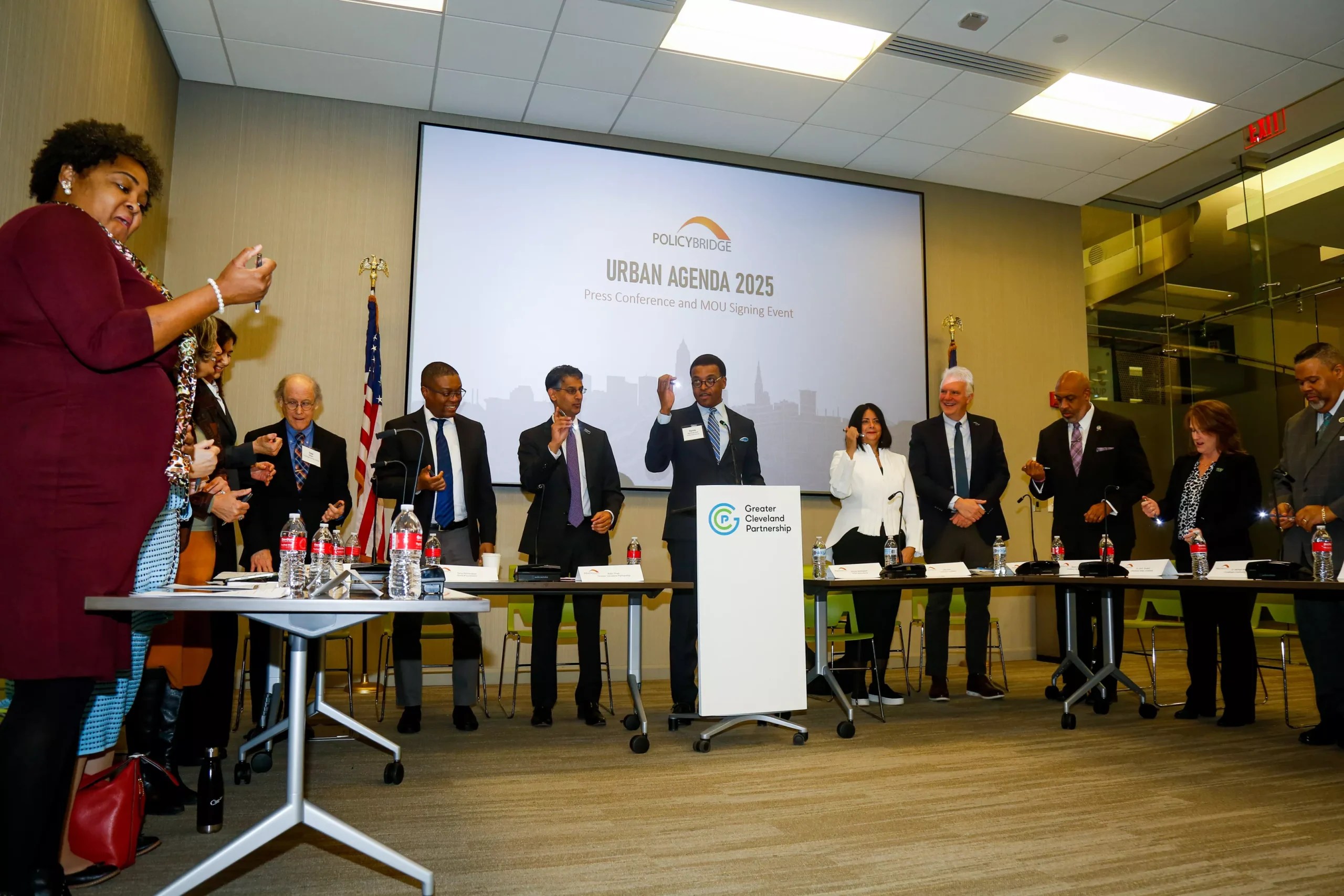
They were there — including Blaine Griffin and Justin Bibb, Lillian Kuri of the Cleveland Foundation, GCP’s Baiju Shah, reps from the Gund Foundation, United Way and others — to sign a ceremonial memorandum of understanding for the Urban Agenda drafted by PolicyBridge, a two-decade-old Cleveland think tank focused on minority uplift. The 13 displayed light-up pens. They took group photos for press. They gave speeches peppered with promises of “reducing the poverty rate” and tackling “racial disparity” with help from an “amazing array of partners.”
But through the corporate jargon and high-aiming promises, some clear pieces of information seemed to have escaped that day’s itinerary. How did they plan on doing that? And what the hell did the ceremonial MOU have to do with it?
“After two years of meetings and joint research,” Randall McShepard, the VP of public affairs for RPM International who emcee’d Friday’s meeting of the minds, told the crowd, “all these partners have agreed to join forces, handle resources around one critical area of focus—economic mobility.”
To be clear: the economic mobility of Cleveland’s minorities, which has been the focus of PolicyBridge since the Black-led research firm formed in 2004. And the objective of their “Urban Agenda for Cleveland and Cuyahoga County,” a policy guidance package in the works since 2019. One “directed toward rebooting long-entrenched systems and upending biased structures that have perpetuated racial disparities,” its Executive Director Greg Brown wrote.
Related

Cleveland Police Stop and Search Black Drivers at Higher Rates Despite DOJ Oversight
A pen-to-paper moment that, at some points, seemed to veer more on political theater than a hard agreement to solve poverty once and for all. An MOU is not legally-binding by nature; they’re moreso used to link together good-faith intentions by government entities and private-sector businesses for some goal—halting river pollution, hiring more LGBTQ folks, helping the FDA protect American consumers, etc.
In PolicyBridge’s case, it focused on three main bullet points: reducing the poverty rate in Cleveland; growing the median-household income for “Black, brown or Hispanic” persons; and closing the Black, Hispanic and white wealth gap.
Points that seem quite obvious to anyone with their eyes open on a daily basis. Predatory landlords have taken control over entire streets in Old Brooklyn or Kinsman. Black East Siders have the lowest life expectancy in the county, cross the most perilous streets for pedestrians, and have the city’s highest unemployment rate.
And, earlier this year, East Cleveland was confirmed as having the lowest household median income for American cities of more than 5,000 people, Cleveland.com reported.
So did we really need a summit on a Friday morning to realize all of that on paper?
More frustrating was that no one had answers as to what the loose coalition would do. The most specific thing shared was that they would all work more efficiently instead of working in their respective silos and that they would continue meeting and talking about things they could do.
(Editor’s note: They could perhaps begin with reading what happened with Cleveland Rising??)
“If it was easy, it would be done by now,” Cleveland Foundation CEO Lillian Kuri, who helps oversee a $3.1 billion asset portfolio, told the audience from the podium. “That’s why this partnership in this collective is so important: Our resources at this table, aligned with what you see before you, are unparalleled.”
It is hard to compare something that doesn’t exist, something with no policy planks or actions, to something else. This much we concede.
“This is a great way for the many systems that we have to talk to each other—the public, private, philanthropic systems to be able to communicate with each other,” Griffin said in his speech, “and break down barriers so that families aren’t overwhelmed in talking to multiple systems and not getting the results that they need.”
Griffin quoted the title of a 1991 album by American bluesman Gary B.B. Coleman: “Romance without finance is a nuisance,” he said.
But why did they invite everyone here to watch them sign a memorandum of understanding that Cleveland has a poverty problem and many of the leaders in the room are at least partially to blame for not fixing it sooner?
Maybe it’s the data! Maybe we are all here in this fishbowl of a room at 10 o’clock in the morning with our high socks and GCP-branded coffee cups because all of us here direly want a hard look into the lived realities of those who aren’t present. (Griffin: “What gets measured gets done.”)
“By signing this MOU today,” United Way of Greater Cleveland CEO Sharon Sobol Jordan explained, “we are bringing our network of community connections, our understanding of what works and where the gaps are and our commitment to collective impact.”
“For us, this isn’t just another partnership or initiative to join,” she added. “We’re in this to help fundamentally redesign how Greater Cleveland creates economic opportunity for everyone—particularly those that have been excluded for too long.”
But what is this MOU exactly? Scene asked the dais after the hour of speech-giving had ended. “Are there certain benchmarks that the MOU states?” Scene wanted to know, tapping into an attempt at corporatese.
Scene turned to the host. “And Baiju, will you have all of us here again to, like, talk about those benchmarks?”
McShepard took the podium. He ensured the room that a “community score card” would be available shortly on PolicyBridge’s website. There will be data publicly available.
And there will be, McShepard confirmed, another press event in a year’s time.
“We want to have an annual event,” he said, then turned to Shah for confirmation. “This will happen again? Can we?”
Shah looked up, assured. “Yes,” he said.
Related

Wary Cleveland City Council Cautiously Vets Mayor’s Picks to Rebuild Fractured Community Police Commission
Subscribe to Cleveland Scene newsletters.
Follow us: Apple News | Google News | NewsBreak | Reddit | Instagram | Facebook | Twitter | Or sign up for our RSS Feed
Related Stories
Cleveland Police Stop and Search Black Drivers at Higher Rates Despite DOJ Oversight
Wary Cleveland City Council Cautiously Vets Mayor’s Picks to Rebuild Fractured Community Police Commission

Op-Ed: An Urban Agenda for Cleveland Workers or the Chamber of Commerce?

Local Leaders Discuss “Unprecedented,” Possible Nobel Peace Prize-Winning “Urban Agenda” for Cleveland at City Club
This article appears in Jan 30 – Feb 12, 2025.