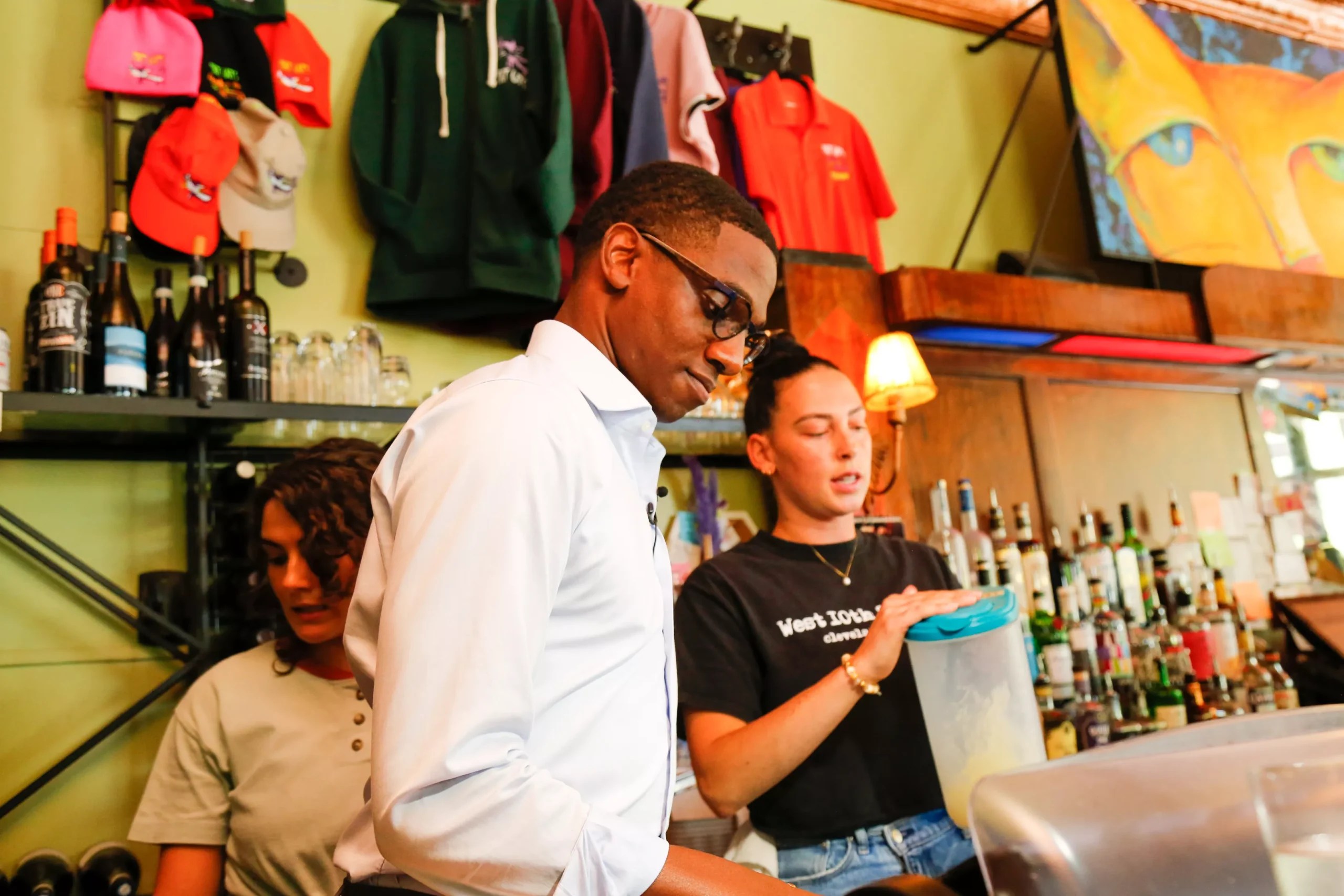
That server was Mayor Bibb, who waited tables for an hour to usher in a $50,000 grant program led by One Fair Wage, a restaurant activism coalition based in Los Angeles. The grant announcement—which Bibb said he’d match, to City Hall’s surprise—came parallel with One Fair Wage’s nationwide tour advocating for a minimum wage increase on next year’s ballot.
The coalition’s argument, that tipped workers are the most glossed over in the country, suggests that a simple increase for servers, say to the $15 ideal, would repair cracks in the industry the pandemic only widened.
“If you recall, my mother worked for Red Lobster,” Bibb said, standing behind the bar. “And I remember her complaining that some days she wouldn’t get tipped enough. And that hurt me when she told me that, as a Black woman in this city.”
“It’s past time,” Bibb added, after announcing his matching $50,000, “we stopped putting profits over people in this city.”
Such a combined $100,000 will be doled out later this year to 20 restaurants across Cleveland who, while applying and undergoing a nine-hour training process, vow to up their servers’ payroll to something higher than a “subminimum” wage, what OFW calls anything lower than its established $10.10/hour. (Like Fat Cats offers, OFW wants “a minimum wage plus tips.”)
As both Bibb and OFW President Saru Jayaraman painted the issue on Thursday, three years of pandemic cuts and layoffs have thrown Ohio’s restaurant workers into the largest exodus it’s seen in recent history.
One out of every 10 Ohioans worked in diners and eateries in early 2020, making an average of $5/hour with tips—a meager system, OFW argues, that not only contributes to high turnovers but also the eventual understaffing that has plagued myriad downtowns and plazas in the past three years.
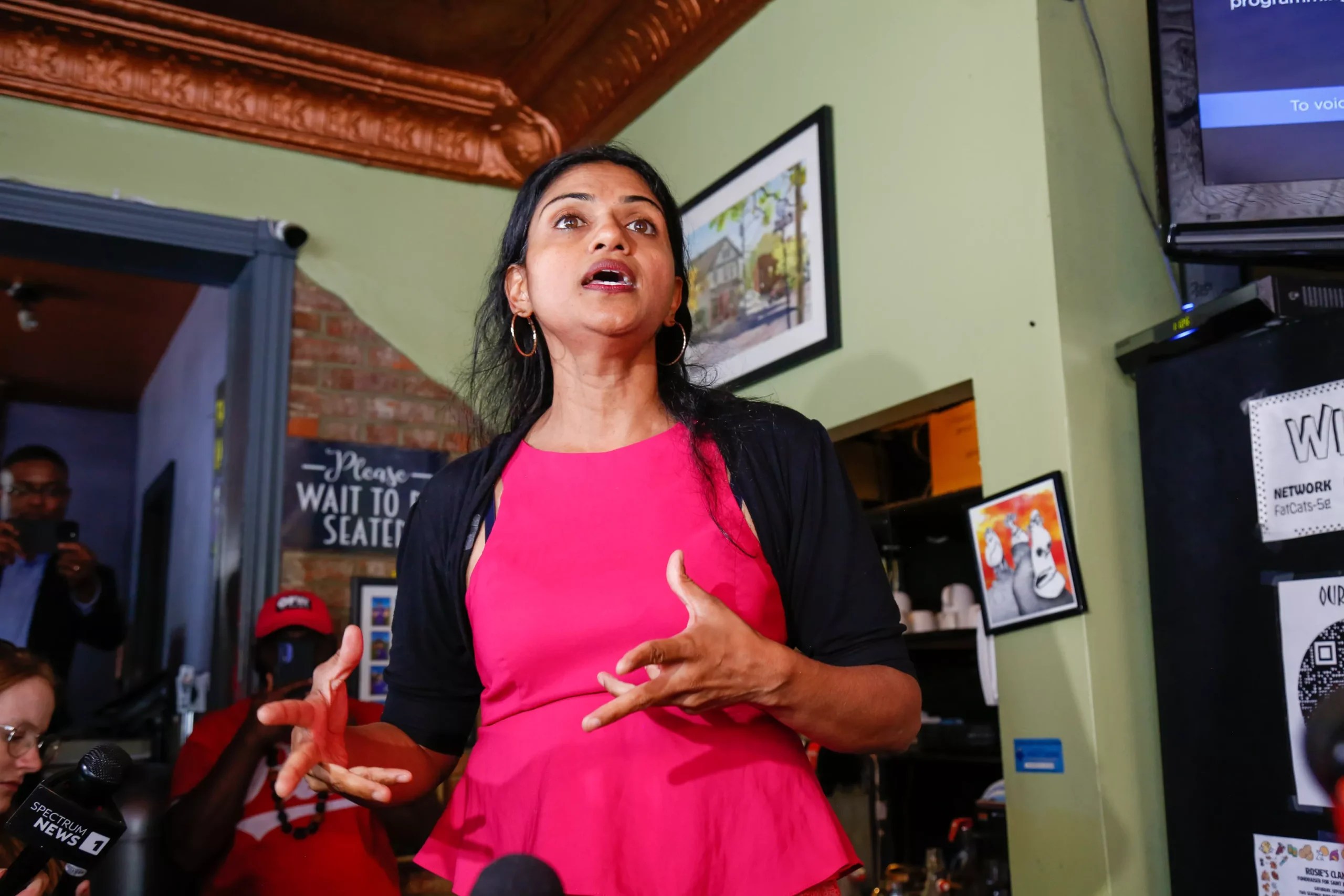
Jayaraman, a Los Angeles-based activist known for her book One Fair Wage, reminded the Fat Cats crowd that the modern tip-based wage industry has ugly roots that link back to American slavery and to pre-industrial England before it.
“Tipping originated in feudal Europe as something that aristocrats and nobles gave to serfs and vassals, but always on top of a wage,” Jayaraman said, standing atop a bar stool. “When it came to the states, Americans resoundingly rejected it, saying, this is a vestige of feudalism. We are a democracy.”
Political undertones filled Jayaraman’s five-minute speech, especially as she segued into the overarching purpose of her visit: to campaign for support for a state ballot initiative that would allow Ohio’s minimum to hit $15/hour in 2028.
But is upping servers’ wages to the ideal $15 fair for restaurant owners, especially those bothered still by costlier veggies and higher rents? After all, some studies show that raised wages might have a more lukewarm effect on worker retention than OFW paints it out to be.
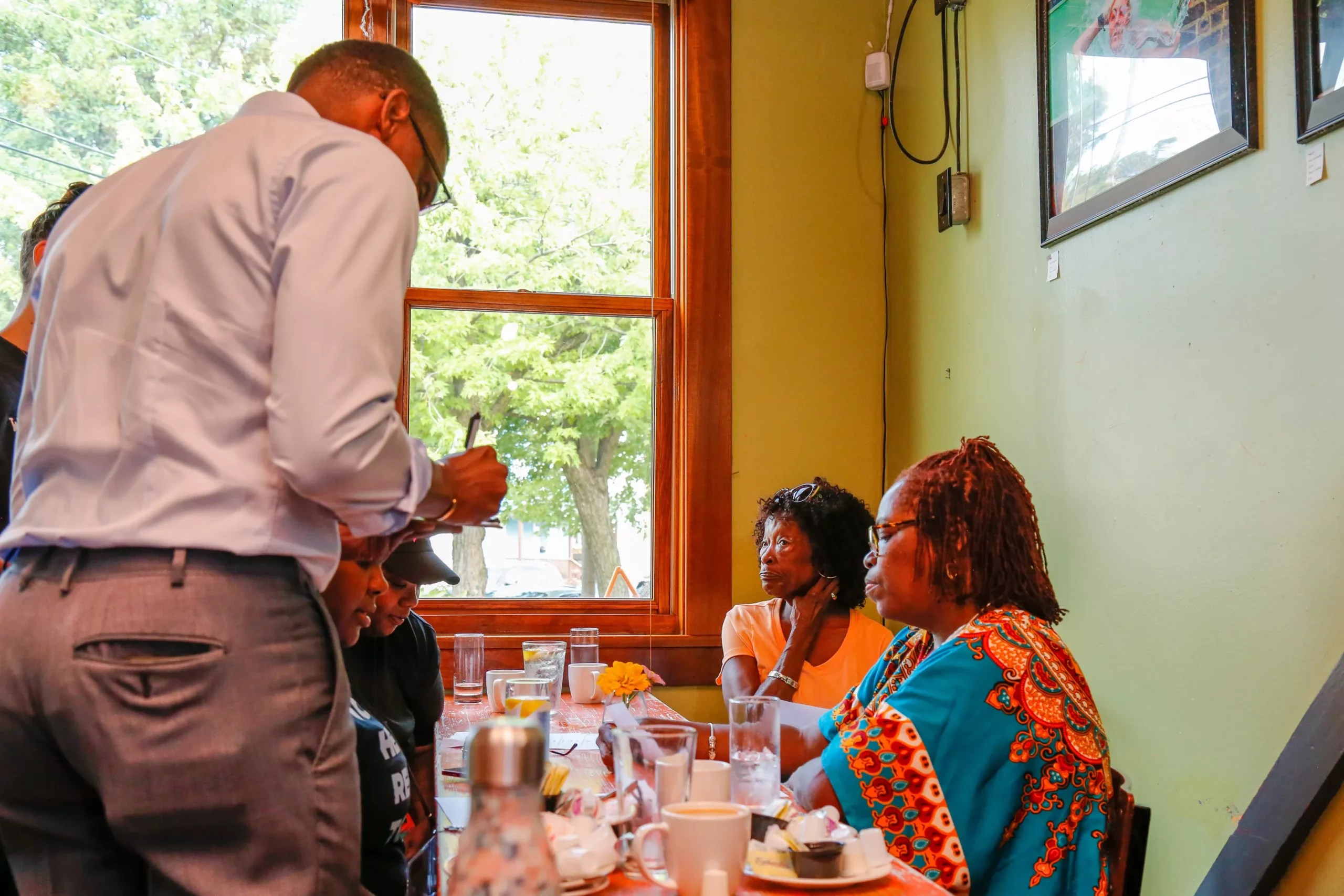
“A 10 percent menu increase completely covers the shift” to a fair wage, Knab told press. “Inflation is hard on business, hard on people,” he added. “That’s why it’s best to give the lowest end of the spectrum a raise.”
Come November 2024, voters will decide if OFW’s argument is sound. Meaning that, like Fat Cats and some 100 others across Ohio, restaurants will be required to raise their “subminimum” wages by law.
By the end of his hour training with server Amara Sandoval, Bibb seemed relatively quieted and humbled, and apparently ready to return to City Hall. How do you feel, one reporter asked Bibb, taking a break to wait tables?
“I feel good,” Bibb said. (He was a busboy at Toby’s Kitchen in high school.)
“It’s very hard work, especially with all these cameras,” Bibb said, garnering laughs. “So hopefully I get a good tip. Wink, wink.”
Subscribe to Cleveland Scene newsletters.
Follow us: Apple News | Google News | NewsBreak | Reddit | Instagram | Facebook | Twitter | Or sign up for our RSS Feed
Related Stories

Union Caregivers and Lutheran Hospital Avoid Strike, Reach Contract

Winking Lizard 86ing Its Live Iguanas

Study: Clevelanders Are the Best Tippers in America

Bibb Announces Ten Winners of $5,000 Restaurant Grants to Improve Worker Pay
This article appears in Sep 6-19, 2023.