


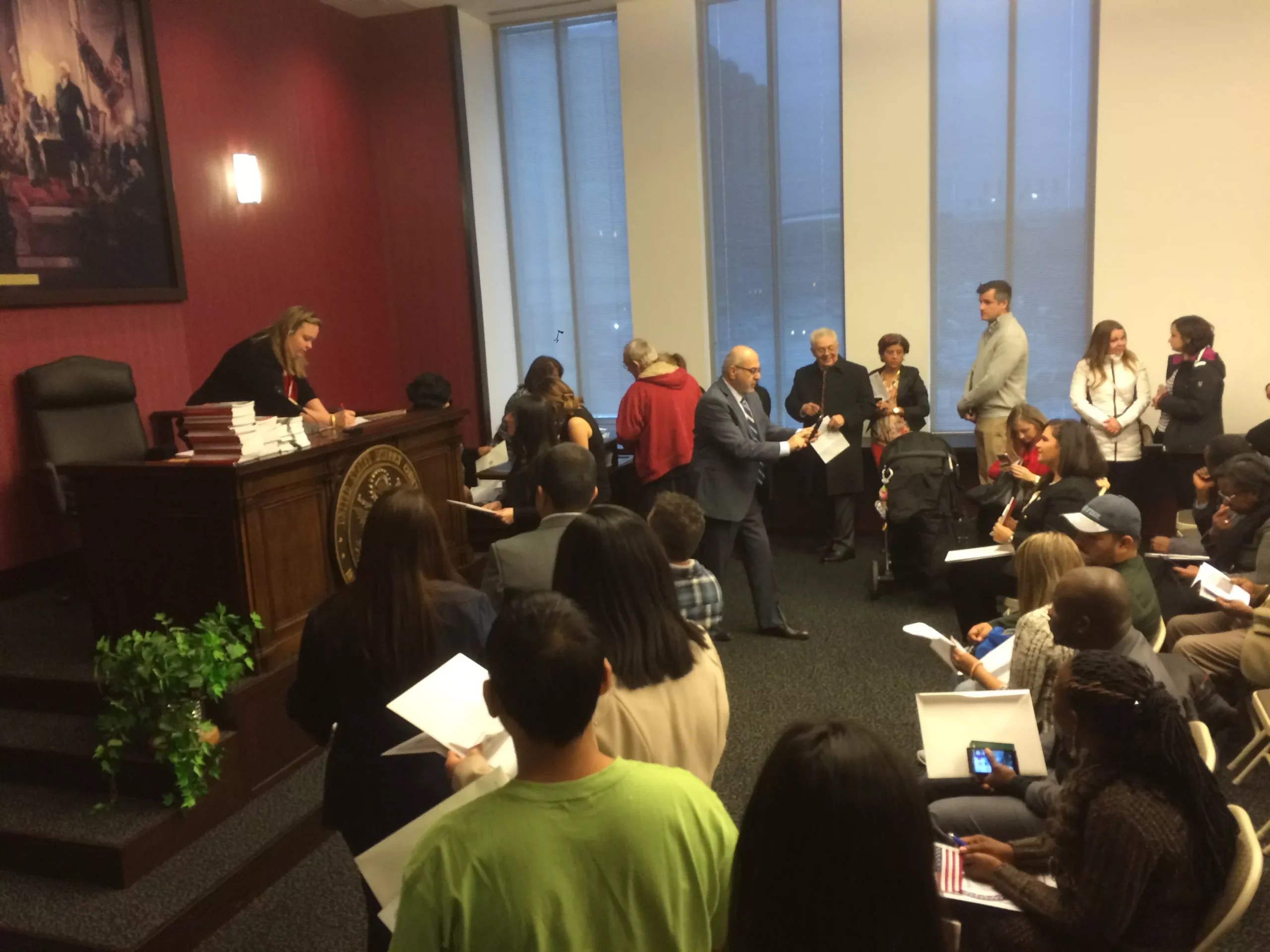
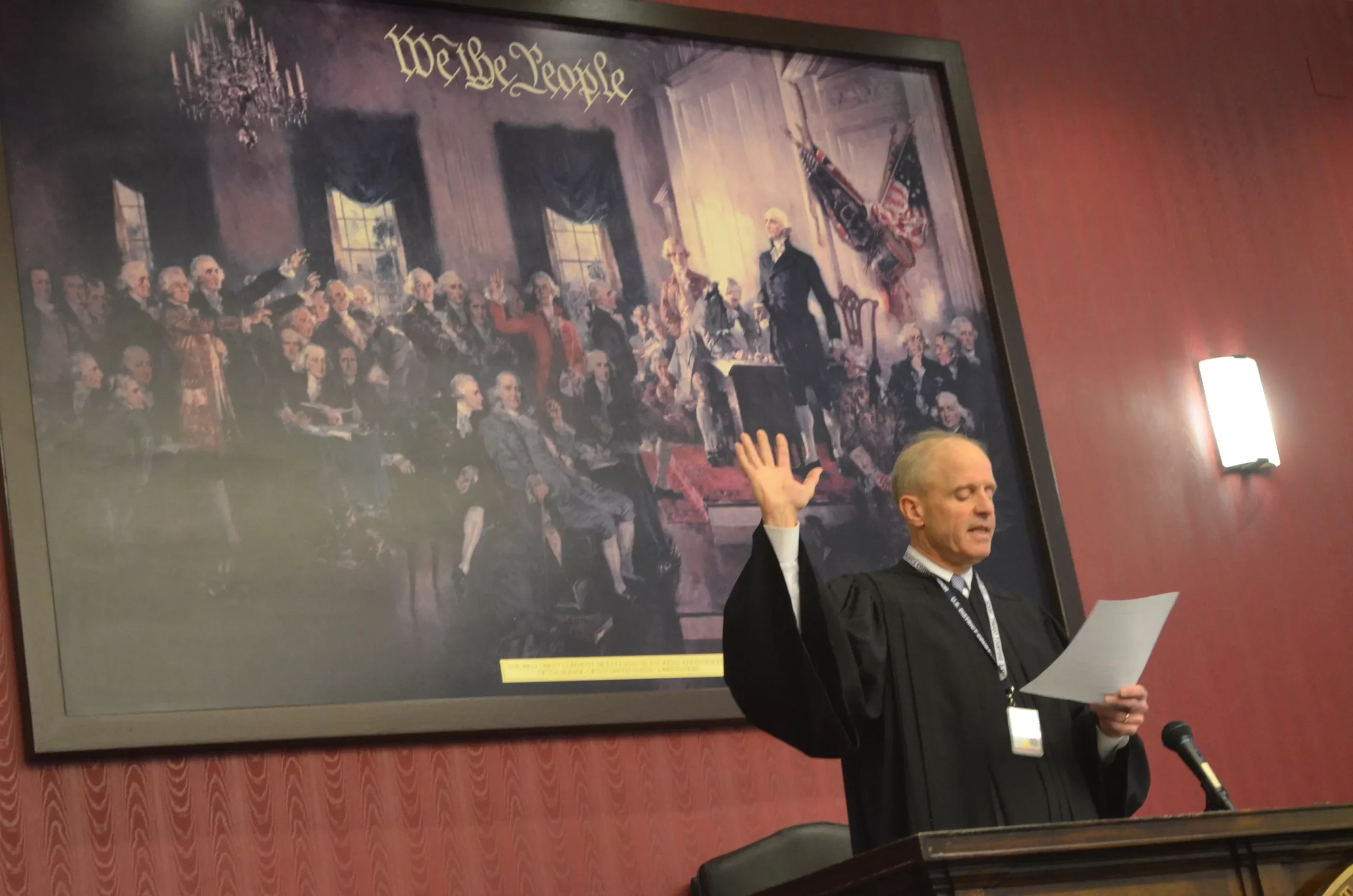
These naturalization ceremonies take place at Ohio’s Northern District federal courthouse every other week. Judge James Gwin, beaming over the virtues of citizenship, said that his court recently naturalized a 97-year-old Mexican immigrant. “I think that spoke very strongly about the importance that immigration has for our country,” he said this morning.
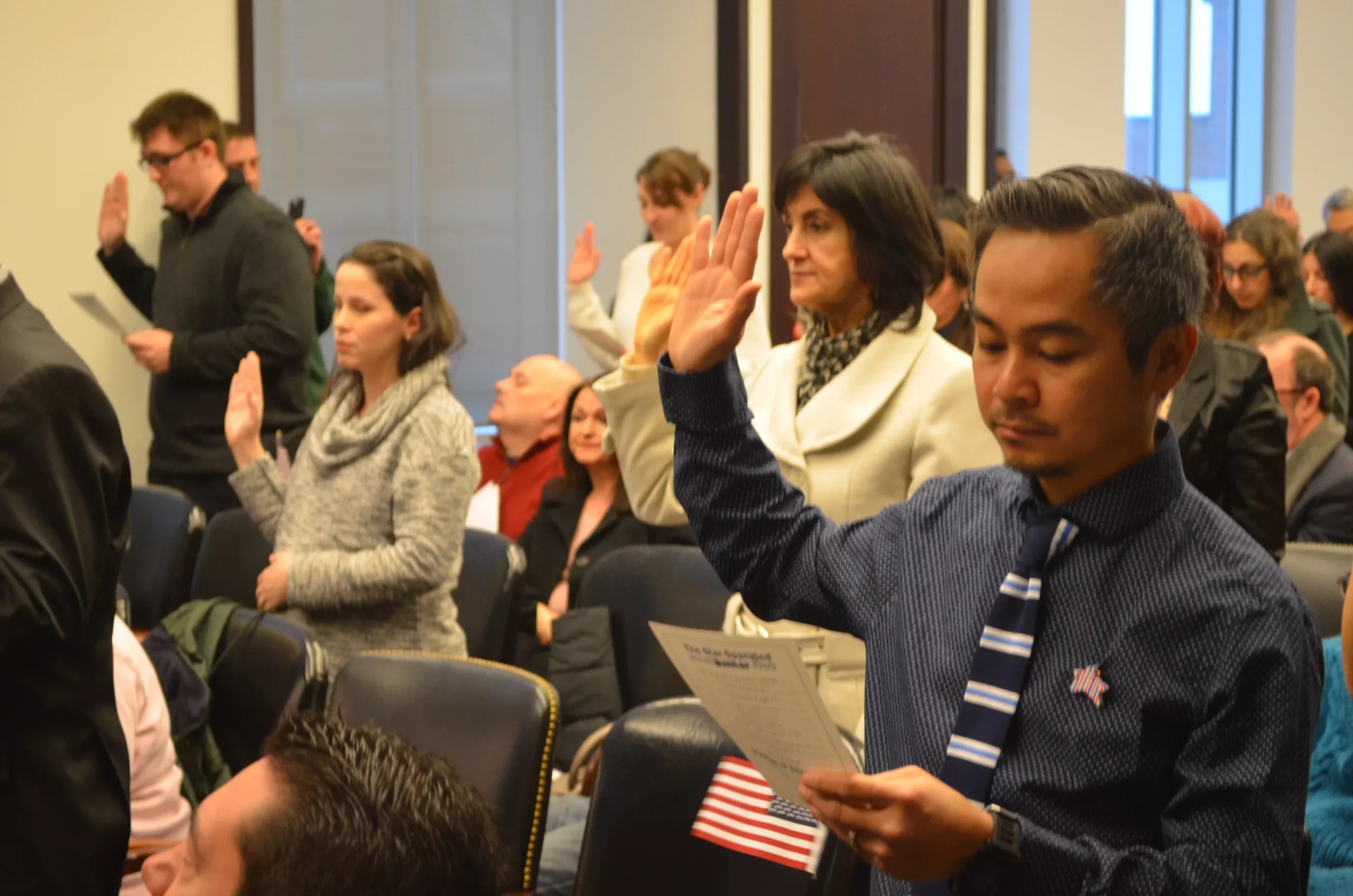
The whole event offered a fairly stirring scene. As courtroom officials read off the name of each new citizen, they also mentioned their country of origin. Gwin was quick to point out how that was often his favorite part of these ceremonies; people had immigrated to the U.S. from all over the world, including Ethiopia, Cameroon, Iraq, France, Canada, Colombia and Greece, to name just a few from today. Men and women and children waved small American flags and snapped photos of their family members receiving their certificates of citizenship. (One man raised his flag high as he left the courtroom and shouted, “Go Team America!”)
Elsewhere, representatives from Global Cleveland greeted new citizens and pointed them toward an array of resources, including voter registration sheets.
“That kind of made my day,” Reen said with a smile.
This article appears in Feb 1-7, 2017.

My grandfather Albert Joseph Bialek came to the United States from Poland {Galicia} in 1910. Per the Ellis Island website he boarded the ship Kaiser Wilhelm der Grosse in Bremen, Germany {formerly Prussia}. He had just completed his service in the Austrian Army. Poland at that time was divided into three spheres of influence by Austria, Prussia and Russia. Upon being
discharged he returned to his fathers farm. Officers from the Austrian Army made an attempt to reenlist him but tradition dictated that he could remain at home so long as he was sorely needed on the farm. Immediately after the officers departed Alberts father gave him his brothers travel documents and instructed him to immigrate to the United States. His father
knew that war was coming and he didnt want to lose his son to it. It took me longer to locate my grandfather on the passenger list because I had forgotten he was traveling under the name Jan and not Albert. Upon arriving at Ellis Island Albert was directed to meet with an Inspector who proceeded to ask him a series of questions. Looking at Alberts papers the Inspector pronounced his last name {phonetically} as BIE-AA-LE-K to which Albert earnestly objected by stating his last name as BEE-AA-W-E-K. In Polish the L is pronounced as a W. After several go rounds with Albert over the correct pronunciation of his last name the frustrated Inspector
finally demanded that the name be pronounced BIE-AA-LE-K {or youre getting back on that boat that brought you here} to which Albert fully complied with the new pronunciation of his last name. Given the fact that Albert entered the United States under the name Jan Bialek and later burned his immigration papers it is evident he was by definition a illegal immigrant. He went on to become a very hard-working brick mason and law-abiding citizen raising 12 children with the help of his Polish wife Mary {nee Mazan} and the rest {as they say} is history.
Just as Cleveland {Ohio} is a city of neighborhoods so is the United States a country of immigrants. In fact all the major cities of America {at one time} served as incubators for immigrants to not only become accustomed to the ways of this country but also to intermingle with each other {often prohibited in their native homeland}. It’s a shame that the inner cities were handed over
to the absentee landlords following World War ll. Just imagine how much stronger and united our country might have been had this unofficial tradition continued. Gentrification is not the answer. Preventing immigration is notthe solution. Intense vetting is acceptable during these challenging times but to unfairly deny one person access to the United States makes us all orphans again. As a popular song goes: “let me in immigration man.