

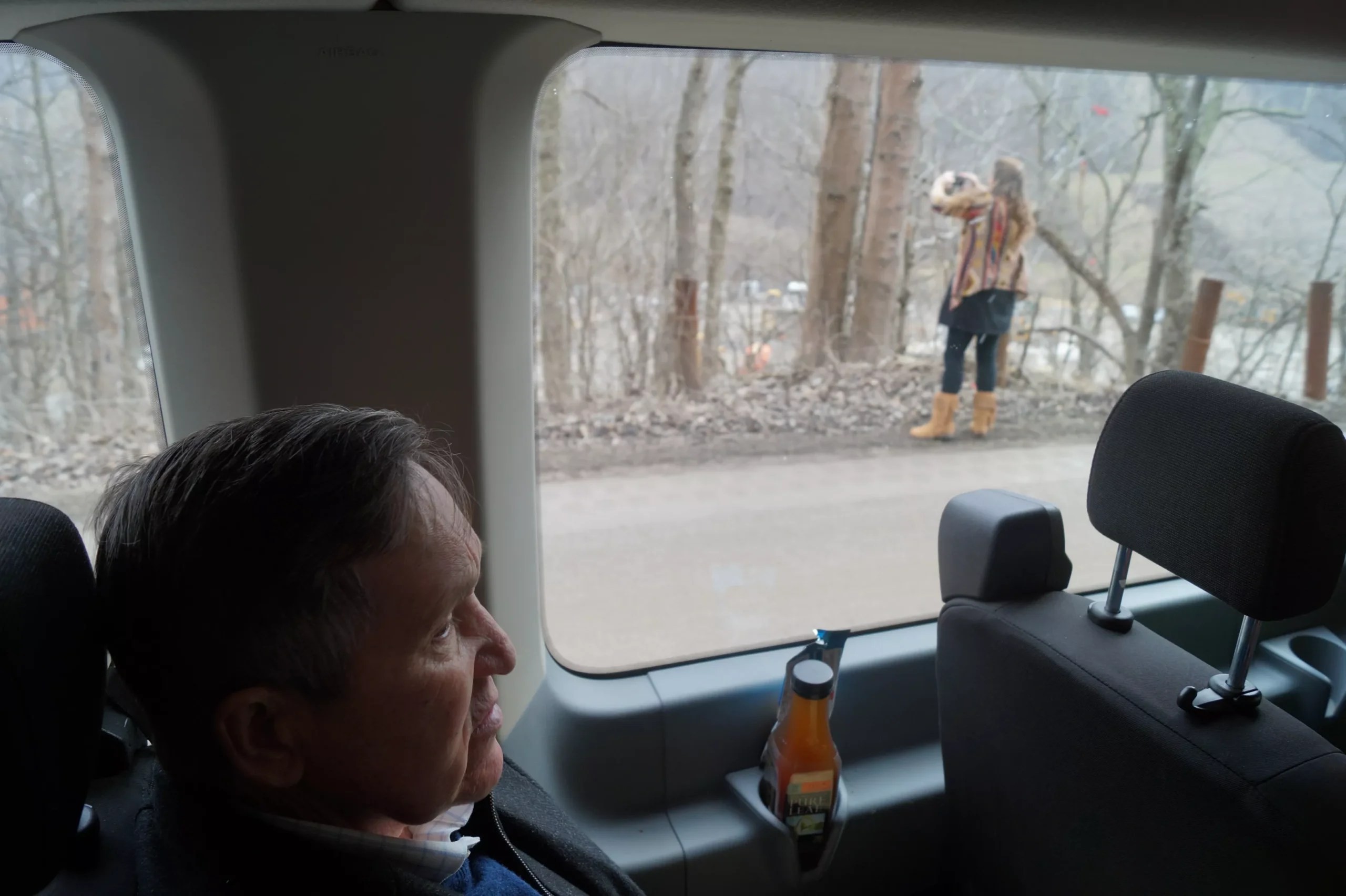
Such is the density of chemicals in the Southeastern Ohio air that you’ll experience these physical sensations inside your vehicle. At least I did, when I joined a handful of environmental and community activists, plus Dennis and Elizabeth Kucinich, a documentarian and a college professor on an “Environmental Devastation Tour” earlier this month.
Others in our tour van were likewise afflicted by the elements. In Noble County, where fracking pads dotted the hills like lesions, Elizabeth Kucinich asked if someone might open a window. The air in the van had become not only warm, but thick.
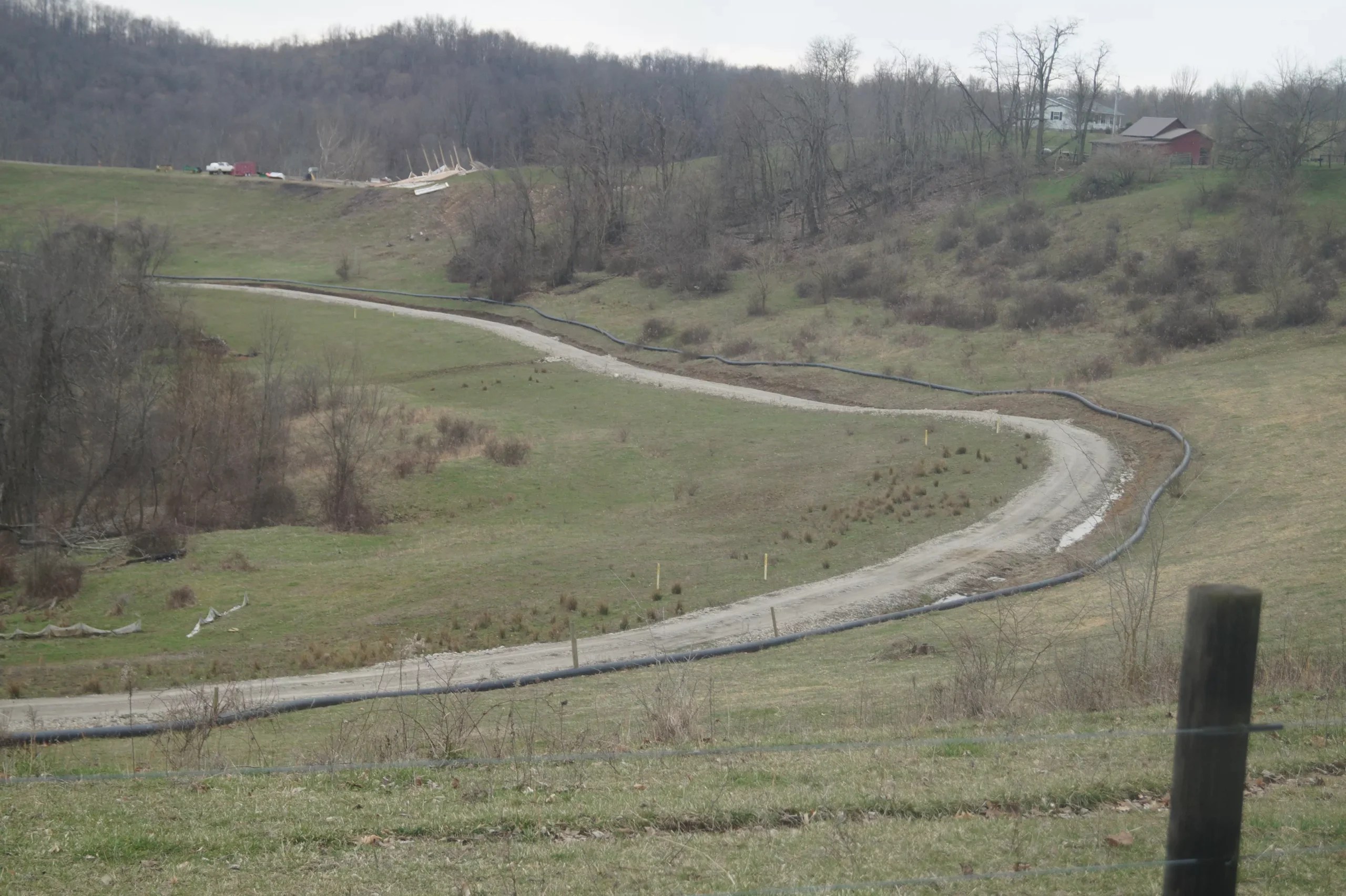
The air outside was colder, thankfully, but provided little relief. Near a country bar where we stopped for a bathroom break, it occurred to me there was no “fresh air” to be gotten for miles, an epiphany belied by the region’s forests, hills and streams in view. This sylvan quadrant of Ohio had once been among the state’s most naturally beautiful areas, one of its most “precious” areas, in the words of Kucinich. But the land — the atmosphere itself — had been poisoned.
“Look at the trees,” Kucinich remarked more than once, pointing at the gnarled and dead branches that lined the state routes as often as not. “The trees!”
Kucinich is the former Cleveland Mayor, U.S. Congressman and current Democratic gubernatorial candidate for Ohio. He has made “clean air and water” a campaign pillar. Along with a full ban on assault weapons and healthcare for all, the quest for clean air and water has been as central to his agenda and his talking points as anything.
But the quest is Quixotic. He has said that if elected, he would move to ban fracking, high-pressure drilling for natural gas in the shale formations deep below the earth’s surface. He told the Intercept that he would block all new drilling permits and would ban injection wells too.
“It’s non-negotiable,” he said.
But these bold energy proposals, these “radical” positions, may remind locals of Kucinich’s tumultuous mayoral term, during which he fought local business leaders and their elected attaches over a proposed sale of the municipal lighting system to the Cleveland Electric Illuminating Company. These days, Kucinich’s unwillingness to bend to corporate interests by refusing to sell Muny Light is regarded as heroic by many, even by those who are bothered or disgusted by his much more recent appearances on Fox News.
I asked Kucinich, as we traveled through the industrialized landscape of Belmont County, whether he thought Ohio voters would be on board with a protracted, costly legal battle with the oil and gas industry. Taking a stand against Cleveland’s corporate class in the 70s was one thing. But oil and gas in 2018? Vegas oddsmakers would give Dennis a better shot against God.
“This is something I believe in,” Kucinich said. “Clean air and clean water are rights. So I’m going to fight for them. Why am I doing this — why am I seeking election — if I’m not going to fight for what I believe in?”
Naive? Almost definitely. But one can’t drive through these blighted, sparsely populated Ohio counties without sadness and anger and an immediate desire to escape. For the politically motivated, it’d be nearly impossible (or so I suspected) to see these counties up close and not decide that something radical should be done. One shudders at studies like the recent one published by IHR Markit which found that Ohio petrochemical plants would be more profitable for oil and gas companies than those in the the gulf coast.
(It occurs: If winning were indeed what Ohio Democrats were interested in, you’d think they would consider more fully embracing an anti-fracking position. The debatable employment benefits seem secondary to the fact that the energy companies are reviled by most of the locals, at least the ones we spoke with. These were long-term residents who have had both their private property rights and the health of their communities trampled upon. These small-town folks might resemble Trump voters in the popular imagination — they are largely white and are presumably socially conservative (I did not verify) — but they nevertheless represent a demographic that could be won over with a committed environmental campaign. The campaign needn’t be about tree-hugging, (though I report in all sincerity that one of the activists on the tour did literally hug a tree when we stopped at a church, the first time I’d ever seen such a thing in person). But the campaign could, among other things, be about communities’ rights to their own safety, the right to banish dangerous oil and gas infrastructure from their backyards if they so choose, (which they invariably would)).
That seemed to be the point of the trip from the Kucinich camp’s perspective. Elizabeth K. — a hardcore proponent of something called “regenerative agriculture” and an intimate consultant on the nuts and bolts of her husband’s policy platform — knows and respects her husband’s stance on fracking. But she said that if he saw the devastation firsthand, his comments on the subject in future forums and debates would be inflected with personal outrage. (Note: Elizabeth calls Dennis “baby.” Dennis calls Elizabeth “darling.”)
Throughout the “fact-finding mission,” so dubbed by the campaign, Dennis could be seen literally finding facts, picking up tidbits of information and inserting them into his arsenal. With John Stolz, a Duquesne professor of biology and the Director of the university’s Center for Environmental Research and Education, he discussed the science of fracking. He referenced “the microbiome” — as in, “let’s talk about the microbiome,” — in the way Donald Trump referred to “the cyber” on the 2016 campaign trail. Kucinich would sort of rehearse a position and let Stolz guide him through the details or elaborate on a complicated idea: the way that toxins from fracking water make their way into the air, for example.
Kucinich took notes on a yellow legal pad all day long and was not above some napkin math to generate a dramatic talking point. When he heard that 11 million gallons of water are required for each fracking well and that the industry estimated it would take 7,000 wells to fully frack Belmont county, he did the multiplication.
“We’re talking, what, 77 billion gallons of water for this county alone?” He asked the van.
At times, it was striking to watch the maturation of a candidate’s political rhetoric in real-time. Mid-morning, Kucinich remarked quietly to Elizabeth that when he looked out the window, what he saw was corruption. Elizabeth nodded. That was good.
Then that afternoon, Kucinich approached me when the group stopped for lunch at a diner in Beallsville. “All this wouldn’t have been possible,” he said, now polished, “without an extraordinary amount of political corruption.”
When one community activist announced that this area had been labeled a “sacrifice zone,” by the industry, Kucinich latched on to it. He recognized the term’s political power. He used it multiple times later in the day, and continues to do so in his public remarks.

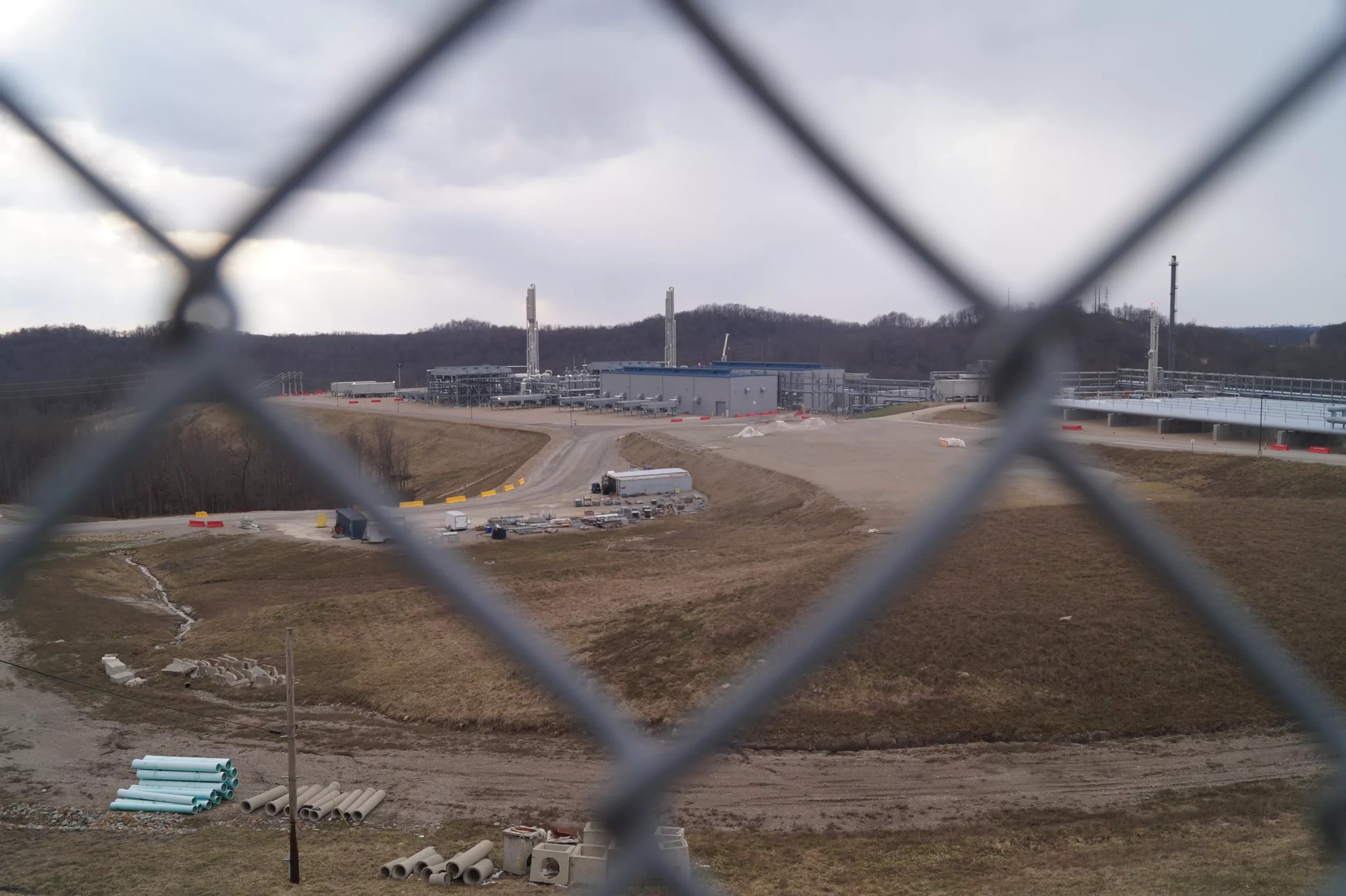

Indeed, one of the more notable features of southeastern Ohio these days is the preponderance of security personnel. The whole region has the flavor of a country under military occupation. Three times when our tour van parked near an industry site to take pictures or notes, a car or truck parked immediately behind us. The observant drivers tracked our movements and spoke into walkie talkies.
Then came the shocking stories, with accompanying images, of scuzzy and sometimes flammable water. There was the anecdote from a man near Cambridge who claimed he had to buy six new pairs of Carharrt boots in six months because the mud was chewing through the rubber soles.
That the farm animals could no longer be persuaded to drink the water was a given — much of this land would never be farm-able again. But what of the cow that had been born with two heads? What of the two men who’d mysteriously died baling hay outside a compressor station in Noble County? The cause of death in one case, according to our local guide: a toxic liver.
Then we were told of even nastier stuff. There’d been a 37-year-old woman who lived down the hill from the enormous Mark West compressor station. She’d been in good health, went the story, but died suddenly one day. After opening her up, the local doctor reportedly claimed that it looked like she’d been chugging anti-freeze.
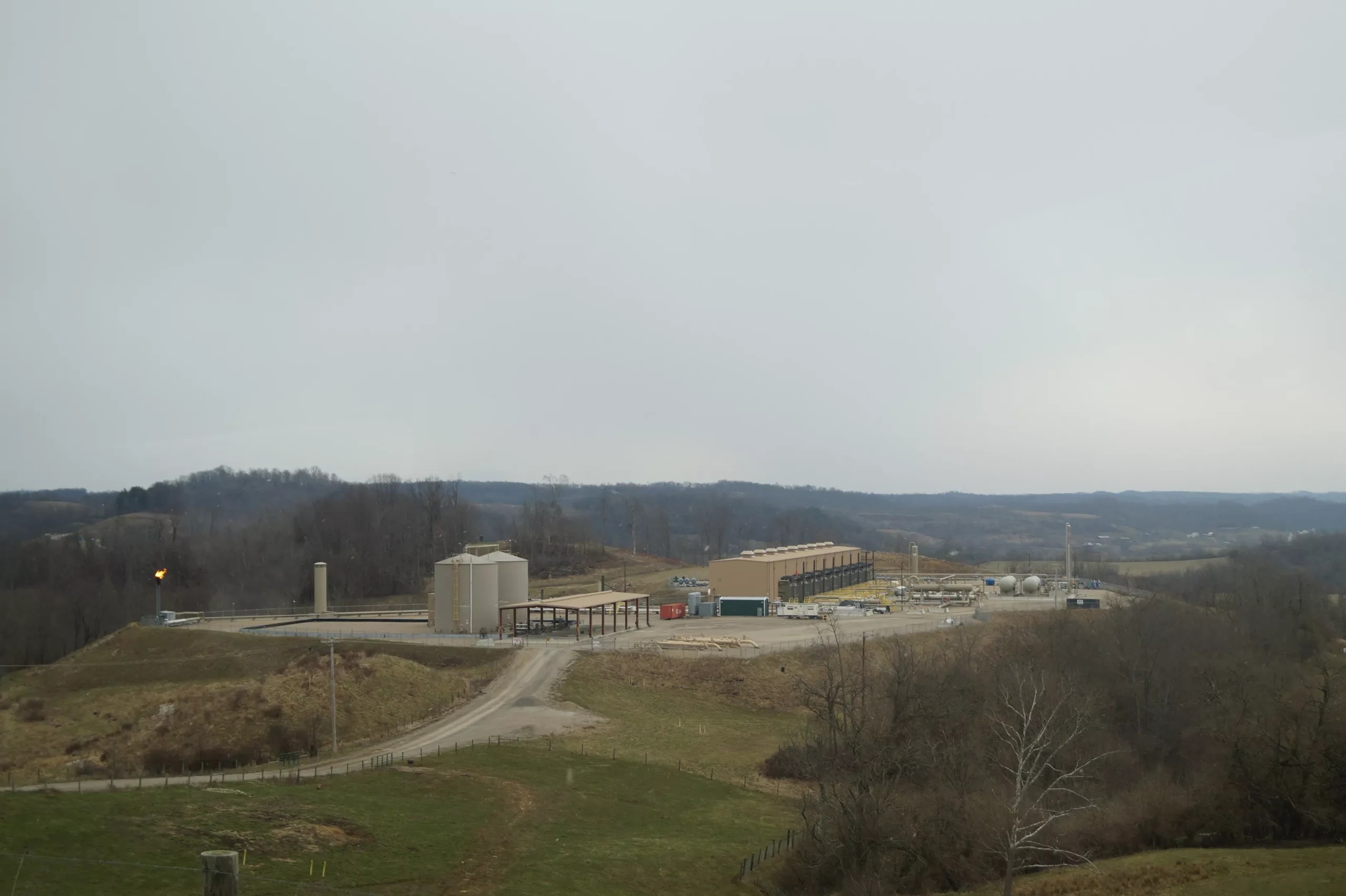
In Belmont County, we saw XTO Energy’s Schnegg Well site. The well had exploded in February and remained uncapped for 19 days. The U.S. Environmental Protection Agency released a preliminary report that estimated the well leaked about 100 million cubic feet of methane per day.
One local woman, on German Ridge Rd., near the well site, said that the bad things about the industry development should be looked at in context. She was sorry to lose some local families who’d sold their farms after their livestock had been halved by disease or dehydration, and she wasn’t thrilled with the noise from the truck traffic. But she said she thought the traffic was part and parcel of any economic development. She also said an energy company had rehabbed a local road, and for that, she was grateful. She had experienced no personal health problems.
But at the Schnegg site, while Dennis Kucinich was filming one of several videos he shot with Elizabeth that day, I chatted with a local woman in the back of the van.
“There are no songbirds anymore,” she said. “It’s just vultures and buzzards and birds that eat dead things.” Then she looked out the window at the Schnegg site. She had a connection to the security company and knew about the clean-up in the explosion’s immediate aftermath. She lowered her voice.
“That explosion was so hot,” she said, “it turned a rabbit to glass.”

This article appears in Mar 21-27, 2018.

Sam,
I grew up in rural Washington County, Ohio, and I still go home a few times a year. I can tell you lots of tales about acid rain spotting the paint of cars and poisoned livestock, but your lede:
“By the time you hit Cambridge, Ohio, driving south from Cleveland on interstate 77, your eyes will likely have begun to itch. Your insides will likely have been subject to a nettling discomfort, a weird, sourceless pressure. It will feel, inexplicably, as if your lungs are nauseous.
“Such is the density of chemicals in the Southeastern Ohio air that you’ll experience these physical sensations inside your vehicle. At least I did, when I joined a handful of environmental and community activists, plus Dennis and Elizabeth Kucinich, a documentarian and a college professor on an “Environmental Devastation Tour” earlier this month.,”
is over the top.
Yes, the problems are real, bu the hyperbole doesn’t help.
Cheers,
Jeff Hess
Have Coffee Will Write
I’m a resident of noble county and work in Cambridge. This article couldn’t be further from the truth. The trees aren’t dead, it’s called winter, you know, when the deciduous trees lose their leaves. It looks exactly the same here as it did a decade ago before the drilling began. You decided to travel the area on a gloomy day in March, I suggest you come back on a sunny day in May. I live on a farm that has been drilled, we have 70 head of cattle, all of which remain to have one head along with their offspring. This article is dangerous, it’s a total farce, it’s a downright lie to try to scare the public and aquire votes to serve a political agenda. Becareful what you read people, do your own research, educate yourself, and never believe a politician.
I spend a large amount of time down there in the summer riding my motorcycle. At least one Saturday ba month. I have not seen all this damage and there certainty isn’t this horrible smell that the article describes. The area is green and lush.
“Old soldiers never die. They just fade away……” (Douglas McArthur’s final address to Congress circa 1951)
Too bad old, worn out, say anything to get elected and then do nothing, politicians like Dennis can’t do the same.
This article IS the horror story and if Dennis Kucinich endorses this crap he should withdraw from the race. The authors writing is the poison people should worry about. There is nothing factual in the article except for the fact that the air in side the van was warm and thick…..thick with fake news!
I travel to Seneca Lake almost every weekend in the summer and NONE of this is true. There is a horse farm near us and a pasture with cattle and they are doing fine. I have never smelled anything referenced in this article. You should be ashamed of printing this garbage.
I have to say – I am left-leaning Democrat, but there was A LOT of crap in this.
“your eyes will likely have begun to itch”
“The air in the van had become not only warm, but thick.”
“But one can’t drive through these blighted, sparsely populated Ohio counties without sadness and anger and an immediate desire to escape.”
Statements like that make the writer look ridiculous.
This article could have been worthwhile, but the editorializing and imagination-as-fact statements were a little much.
Yes, theres a lot of fracking under (literally under) Seneca Lake for several years now, and the the thousands of people who swim in it each summer remain healthy. Though I did catch a carp once and it had 37 heads. I ate it anyhow.
Jeff — My eyes did indeed begin to itch and my insides were indeed subject to a weird nauseous feeling the entire day. I was not exaggerating. (Others in the van described similar symptoms.) Whether this was atypical, because of the recent explosion, or was standard I do not know. But it was gross.
For others: The tour was obviously designed to show us the worst of the worst. It’s not like every state route has fracking wells every 200 feet. But feel free to check out the ODNR map of active wells to get a sense of how prevalent the drilling is.
I can’t include links in these comments, but if you search for the ODNR Oil & Gas well locator, you’ll find it. It’s pretty striking.
Old career politicians never really retire — since there may be a pack of suckers to bankroll another campaign.
Have lived in Southeast Ohio for 10 years, I had to move away because of the fracking industry. I could no longer witness the industrialization of a once bucolic countryside. The last I drove through the area, near the Mark West Compressor station at Summerfield, I had a dull headache and nausea – that’s never happened. For those who have eyes and a nose, you cannot help but realize that what is being done to the region is not healthy. People want to believe that fracking won’t hurt them, but ask those who live there and don’t just drive through or spend a weekend. You may not catch it on a bad day, but when you do, you know it’s true. Plus it’s the things you don’t see and smell that could hurt the worst – the radioactive releases from the flaring with radon and water-soluble radium that is inherent in frack waste. When the industry LLC’s pack up and leave, people will pay with their taxes and their health. This has happened before in the region with acid mine drainage and mining remediation. Fracking will be much worse.
Sallard – Please do me a favor and tell more of these deaths in Noble County due to fracking. Surely you have reliable sources and details that you could share with all of us concerned citizens. Please be sure to share how these deaths tie directly to fracking/drilling. I live near the Mark West plant (within 5 miles) but I have not heard of any deaths tied directly to fracking? Please share these “facts”, it’s your jounalistic duty and I am deeply concerned, especially because I bale hay every summer and I am worried there may be some hidden danger that I am unaware of. Surely if you are so concerned with this issue and wrote this article based on facts as the title declares, you have all the appropriate backup readily available. Please share at your earliest convenience.
Cleveland Scene has become a total piece of shit agenda driven dishrag. Fuck this place.
Please please please expand on how this rabbit turned into glass.
That lady talking about magic rabbits turning into glass, needs to lay off the meth!
Cleveland Scene has always leaned left. If you don’t like it, don’t f’king read it.|
And don’t let the swinging door hit you in the nose on the way out.
But chill out, clown. Dennis is not going to win, even with stories about glass rabbits.
Folks,
What accounts for the diametrically opposed perceptions included in this comment stream, do you suppose? It mystifies me how reality continues to be seen so differently. Do any of the people who were actually on the trip think this article is sensationalized? What would be the point of that?
Dennis is nuts. I have property in SE Ohio and drilling has had a positive financial impact and the only necitive is the increase in heavy truck traffic. Most counties and townships have made drillers improve the roads they use and are generally better after the drilling is finished.
Dennis needs to stay in Cleveland, he deffinately dosen’t understand rural Ohio.
Ohio has had oil and gas development since 1814 so if southeast Ohio is the waste land you claim it to be how is it possible that people still live there and there is still oil and gas development?
I wonder if the industry is paying people to post the majority of these comments as they often do? Because if someone spends any amount of time in SE Ohio and talks with the people who have been affected (and I am not talking about the wealthy landowners who leased who received even more wealth from the industry – but those living next to fracking and its infrastructure who received none of the wealth but much of the pollution), they would soon find out that fracking (called unconventional drilling) is not at all like what was done in the past. The health impacts of fracking are being well documented as well as the psychosocial disintegration of families and communities and individual wellbeing because of the industry. Property values are plunging and people are sick of all the truck traffic and pollution. For those who are interested in the truth and research and not more industry propaganda by paid trolls – see here: psr.org/resources/fracking-compendium.html
There is a lot more hydraulic fracturing occurring within the Marcellus Shale in PA. WV. Most of Ohio is sitting on the Utica, which is a much deeper shale play, that your politicians continue to exploit with disposal. This is going to continue unfortunately; have you see Tappan Lake? Stark County? Tuscarawas? Its lined with injection wells catering the disposal and water withdrawals catering to the oil and gas industries. We live in a unique geological location, one which will be used up for the disposal and extraction of hydrocarbon related materials. Pipelines are being built; energy is being transferred to the Midwest. WE are extracting natural gas; and its very successful. Perhaps some more regulations need to be put in place for ex. banning storage ponds, ban on diesel idle, and fair mineral rights as well as usage of land post decommission. We can get this energy out of the ground with much less environmental impact, we just need the hammer to come down on waste disposal and well drilling procedures
You have to give the oil grubbers credit for bringing out their desperate paid shills in full force. When you gotta pay the doctor for treating your frack-poisoned kid, every little bit helps.
I think Dennis Kucinich gets better with age, & his sharp, observant eye is a welcome relief from the drone of the lying frack machine.
I grew up in Eastern Ohio and continue to live there. Everything in this article is bullshit.I live right across the street from fracked well pad.. I live in the country. I hear song birds everyday in all kinds of varieties. None of my very large family is sick. My grandparents are in there 80s and still farm the land with not problems.. we don’t live in military condition.. we have had alot of activists and protestors causing problems in the past causing people to be cautious of out of towners. Security at the sites are not ex military. They are normal people who needs jobs with no special training other then writing names of people who are on site to be accounted for in case of an emergency.. yes there has been in increase in traffic which is frustrating at times.. but overall this continues to be an awesome place to live.
this is absolute garbage. i both live and work in se ohio, and im in my 8th year in the natural gas industry. starting in North east pa, and being in the ohio river valley the last 5 yrs. i understand that im a bit biased, but nothing in this article is factual. “no fresh air anywhere?” “a country under military occupation”? “treat locals like insurgents”. all of these statements are false. the exhaust fumes emitted by the trucks, rigs, and other mechanized equipment does increase the pollution in the air, but not fracking, or drilling, flow back, completions or any aspect of the industry. i assure you the coal power plants, steel mills and chemical plants that line the river are wreaking far worse havoc on the environment than any of the aforementioned. “sacrifice zone”? are you kidding me? tell that governor hopeful to remove that ridiculous statement from his vocabulary. i sure hope his money men send him in this direction for some sort of rally…i assure you i will be there to blow holes in his lies.
Nothing good comes from fracking and the continued use of fossil fuels try understanding the consequences of global warming. We are experiencing it now; your children, grandchildren, and great grandchildren will bear the brunt of our inaction. But, the climate change deniers wont be around for the worst of this and how life on Earth as we know it will be threatened. This is not hyperbole this should be frightening to you!
We Can supply Aviation Kerosene,Jet fuel (JP 54-A1,5), Diesel (Gas Oil) and Fuel Oil D2, D6,ETC in FOB/Rotterdam only, if you want in rotterdam buyer must own tanks in Rotterdam serious buyer should contact or if you have serious buyers my seller is ready to close this deal fast contact us below:now base email us (neftegazagent@yandex.ru)
PRODUCT AVAILABLE IN ROTTERDAM/ CI DIP AND PAY IN SELLER EX-SHORE TANK.
Russia D2 50,000-150,000 Metric Tons FOB Rotterdam Port.
JP54 5000,000 Barrels per Month FOB Rotterdam.
JA1 Jet Fuel 10,000,000 Barrels FOB Rotterdam.
D6 Virgin Fuel Oil 800,000,000 Gallon FOB Rotterdam.
E-mail: neftegazagent@yandex.ru
E: neftegazagent@mail.ru
Skype: neftegazagent
Best Regards
(Mr.) Vladislav Yakov
Skype: neftegazagent
Thank You
Please get educated on all the evidence our EPA, USGS, and NOAA have collected. Money has always been valued more than human life in this country!
https://serc.carleton.edu/NAGTWorkshops/health/case_studies/hydrofracking_w.html
This should help you get started.
We are please to inform your esteem buying company the petroleum products you are looking for is available in our storage tanks and reservoir for immediate delivery. Such as:
1) D2 DIESEL GAS OIL L-0.2-62 GOST 305-82.
2) D6 VIRGIN FUEL OIL
3) JET FUEL JP54
4) JET FUEL JPA1
Provide your official email or contact us via email to enable us issue our official soft corporate offer (SCO).Thanks.
BELOW IS OUR CONTACT INFORMATION,
Please contact us via our official email address.
kuznetsovgavriil.mikhailovich@mail.ru
Whatsapp: +79153753185
Skype ID: live:63388f01d68be9ff
Thanks.
Kuznetsov GAVRIIL Mikhailovich