

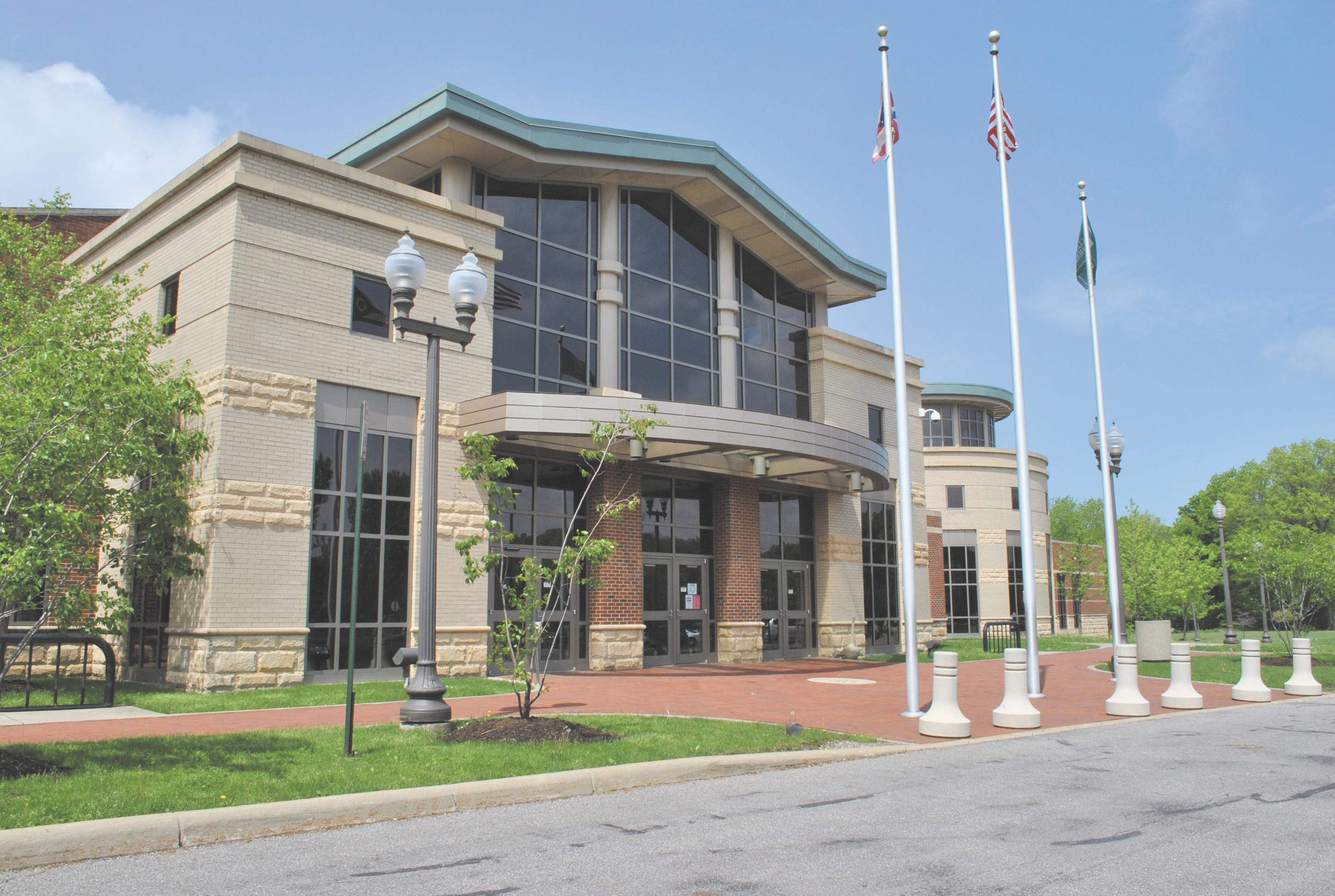
Good luck finding a parking space in the Cleveland Heights Community Center’s vast parking lot on some evenings. When armies of young hockey players from around the region schlep their gear through the center’s big glass doors, ready to go to war on the center’s two well-maintained ice rinks, cars are parked up Monticello Boulevard almost to the intersection with Lee Road. They join the regular contingent of after-work basketball players, Pilates class participants, workout buffs, and others attending community meetings.
Now imagine those big glass doors locked. That’s how the city’s finance director sees it.
“Last year it cost us $780,000 to run our community center,” says Tom Malone. In 2010, Cleveland Heights received $977,335 from the Ohio estate tax, which is paid to the city when a wealthy resident dies. It’s an unpredictable tariff that brings in an average of $1.2 million annually for the inner-ring suburb, whose budget — like that of most cities — is stretched thin in a time of unemployment, declining wages, sinking property value, and foreclosures.
But that revenue stream appears bound to dry up soon thanks to a push in Columbus, where efforts to balance the state books have left cities, townships, and counties across the state facing what seems to be a new budget crisis every day. Back here in Northeast Ohio, the threat of losing the estate tax has some communities in a panic.
“Absolutely Devastating”
It’s long been said that nothing is certain but death and taxes. How about when they’re combined? Strenuous debates have erupted across the country about the fairness and efficacy of the estate tax, which is levied by both the federal government and many states on estates over a certain value. Opponents, in an effort to make it all sound more toxic, have rebranded it the “death tax” and say it amounts to double taxation — that those who earned the money should be able to dispense with it as they please.
Estate tax advocates say it helps limit the concentration of wealth in the hands of a few — namely, heirs who didn’t earn it.
During his gubernatorial campaign, John Kasich promised to repeal Ohio’s estate tax. And he’s followed through, introducing it as a plank in his budget. That budget has passed the state House of Representatives and awaits consideration in the Senate.
If the tax is abolished, it will have been a long time coming. Ohio has had some form of death tax since the late 19th century. Under the current structure, established in 1968, estates valued at more than $338,333 are taxed at 6 percent and those over $500,000 at 7 percent. The tax brought in $333.8 million in 2009, with 80 percent of that — nearly $270 million — going back to the cities. The rest goes to the state.
The tax does not apply to estates that pass to a spouse, and there are complicated rules that exempt most family farms.
In 2009, Cuyahoga County collected more than $50 million, second in Ohio only to Hamilton County’s $62 million. That’s a nice chunk of change, though it’s distributed very unevenly. Upscale Pepper Pike, home to only about 6,000 people, averages $1.8 million annually, while sprawling, working-class Parma, with more than 80,000 residents, gets about $1.1 million.
In the last five years, the City of Cleveland’s cut has ranged from $2.7 million in 2006 to $6.2 million in 2008 — a great year for dying rich. In 2010, it collected $3.4 million.
Stacked up against those cities’ total budgets, it seems like a drop in the bucket — usually 2 or 3 percent. But that bucket has a lot of holes in it these days. Kasich has also slashed state funding to local government and schools in order to balance the state budget, in addition to phasing out a key tax on businesses.
“Coupled with the fact that we’re going to be losing so much money for local government funding under this governor’s regime, it’s going to be absolutely devastating for the entire community,” says Kenny Yuko, a state representative whose district includes Euclid, South Euclid, Richmond Heights, and Cleveland’s Collinwood neighborhood.
“I’ve heard several mayors say that if this goes through the Senate as it is, they don’t know what they’re going to do. It’s going to take longer than two years to come out of this economic tsunami we’re in. It’s a bad mistake with terrible timing.”
Another Threat to Safety Forces
Cleveland Heights, like most cities, doesn’t budget for the unpredictable amount the death tax brings in. And chances are it won’t be closing its community center. But with little to spare, the money fills significant gaps and allows cities to do things they otherwise might not have been able to do, whether it’s maintain safety force staffing levels or make infrastructure improvements.
Cleveland Heights’ neighbor, Shaker Heights, averages about $3 million a year from the tax. (In 2010, it took in $37.6 million in total revenue.) The death tax there roughly equals the compensation of 30 police officers — nearly half the city’s force, according to calculations by Shaker Heights resident Martin R. Kolb, who chaired the city’s financial task force and testified recently before the state Senate against repealing the tax.
But it’s the wealthiest — and, ironically, often the most conservative and anti-tax — communities that face the biggest quandary. They often collect the most from the tax and expect the highest level of services from their governments.
“Personally, I don’t believe in the estate tax,” says Westlake Mayor Dennis Clough, a Republican. But he recognizes that his city would be hurting without the $1.6 million the city averages from it annually. While Westlake doesn’t include the unpredictable amount in its budget — “we wait until it’s in hand,” Clough says — it’s aided the city in some very visible ways. In recent years, the death tax has helped build a new city hall, as well as a new service garage and improvements to Hilliard Boulevard.
Westlake’s finance director, Prashant Shah, says that the city’s average take amounts to 8 percent of its overall budget. Although Westlake has a cushion in its reserve fund, Shah worries it could dry up.
“We’re already looking to see where we can shave off 8 percent of our budget so we can prepare for the cutback,” he says. “We can probably hold out for a few years. If everything else remains the same, it adds up. This city’s going to hurt like everyone else.”
State Representative Nan Baker, a Republican whose district includes Westlake, Fairview Park, Bay Village, Rocky River, and North Olmsted, admits, “There will be an impact.”
“Certainly, it is a concern that [repealing the estate tax] will bring less funding to their cities,” she says. “But I think they all understand philosophically that we tax residents their entire life, and we tax them again on their death. I think they understand the importance of eliminating this tax. We’re hoping that difference of what they may lose will be made up by what they will gain in revenue if we can keep those people in the city they live in and keep investing and giving generous donations to different charities.”
Yuko, Baker’s Democratic colleague, also opposes the estate tax — in theory.
“It’s not that I’m against repealing the estate tax, but I’m definitely against repealing it right now,” he says. “It’s money that some people want to leave to families. It’s money they’ve earned for their lifetime of hard work. I realize we all pay taxes in life for a myriad of reasons, and this is another. If we were in a position where we could repeal it and be fiscally responsible, I would support it. But now we need to give local government every opportunity to survive — not thrive.”
Eliminating the tax now, he adds, “will be absolutely devastating on all four corners of my House district. The City of Euclid, my largest city, they’re facing a cut of about $1.2 million. Most of that money is being used for safety forces, such as police and fire.”
Buying Time
Legislators, recognizing that the governor’s budget was harder on local governments than expected, opted to postpone the impact: Originally slated to take effect immediately, the death tax repeal is now scheduled for two years down the road. Lawmakers clearly hope an economic turnaround will ameliorate the damage.
“That is why we postponed the repeal of the estate tax to begin in January 2013,” says Baker. “The way probate courts work, it would be another six to nine months before it would take effect. We wanted to be sure to give cities time to prepare for it.”
“I think it was the right thing to do, since people had already started working on their budgets for next year,” Westlake’s Clough says of the postponement. “Next year, we’re still going through the lag in the economic growth. I would say after 2013 would be the time to phase it out.”
Euclid Mayor Bill Cervenik points out that his city, like most, has already tightened its belt in recent years.
“We’ve made tremendous cuts in personnel,” he says. “If you take [estate tax revenue] from the city of Euclid, and you take away a million dollars in state funds, and we’re losing about $460,000 from the [phased-out business tax] — you add those up, that’s a lot of money. I submitted a budget to my city council that they approved for 2011 that was $700,000 less than our budget in 2008. That budget contained very few reductions in our safety forces. If these reductions are put into effect, I have nowhere to go but to reduce safety forces.”
And he says the demand for services — all services — has increased.
“When I started as a councilperson in 1989, I never fielded a call for basic help: food, clothing, toys at Christmas for my child,” he says. “Now it’s a daily occurrence. One of the arguments about the estate tax is that it’s chasing people out of Ohio. If all municipalities make cuts that ruin the quality of life in those communities, you’re going to be chasing out a lot more people.”
This article appears in May 25-31, 2011.
“Last year it cost us $780,000 to run our community center,” says Tom Malone. In 2010, Cleveland Heights received $977,335 from the Ohio estate tax, which is paid to the city when a wealthy resident dies.
This is the stupidest tax I have ever heard about. Does it charge to get in (membership, community discounts, etc)? It’s like saying we made $197,335 for free given to us by the state for someones loss because they where successful in life, while others still sit around with hands out (“No Work No Food” its my moto and needs brought back to life). It can run without this tax, it just means that management will not be making them $100k/year salaries which is what they don’t want to give up. There is no doubt that Tom Malone is making 100k a year and he just does not want to give up his rich lifestyle.
I don’t see why when someone dies you must pay the state again. The money they have made and own at death was already taxed by the federal, state, and city levels.
I think this issue needs resolved on a city level and not a State level. I suggest charging a bit more, or limiting/cutting back on resources used by the facility (its a community treause, not a state treasure! People don’t drive from Columbus or Dayton to go swimming). The biggest fix would be to remove all management and bring in new management at a lower salary, or keep the managers who are willing to take a pay cut to keep their job. If I made even $50k a year I would be wondering what to do with $20k of it at the end of the year after all my bills and living expenses.
USA has gone to crap and no one even cares to remember why the USA was formed in the first place. It’s already bad enough each level taxes based on total pay. Then after you get your money, your paying more taxes for anything you buy (which government increases taxes with rediculous laws which raise the price of everything else). And then at death the government wants even more. Our government officials should be doing their jobs for free, all we have in office are a bunch of greedy white collar crimminals. They care more for lining their pockets with money than the well being of the USA.
While cutting services and funding for education it is irresponsible to cut taxes in any form much less estate taxes.
I find it ironic that people who work get taxed, while those who receive unearned income, i.e. inheritances, get a free ride.
Although revenue will drop from estate taxes, the elimination of the tax will probably encourage many residents to remain in greater Cleveland, and in Ohio. Historically, many who face large state inheritance taxes move to Florida and other tax free states to escape the tax. The result could be more businesses moving to Ohio and fewer houses for sale. Lots of communities could reduce operating costs by reducing the number of non essential departments and non essential people; how about eliminating all the studies and consultants. It is possible to examine bloated staffs and cut back. In Shaker we have a number of retired individuals on full pensions from our public schools who have been rehired and then qualify for additional pensions – which is an example of worse than non essential – and this may be happening in lots of city halls. What about the duplication of services from one community to the next within one county. And of course our new county governing board with all the new salaries to protect us from self interested county commissioners. None of our new protectors have any self interest. Incidentally, I am a progressive liberal, just not into financial waste. E. Henry Schoenberger
Lets have this unneeded tax repealed as it seems that governments motto is if we can can tax it, we can spend it all and some with out any logical reason or controls to keep the spending waste in check. It would make more long range sense to keep the funds in the possession of its owners for them to invest in locally in jobs rather than another government sink hole.