

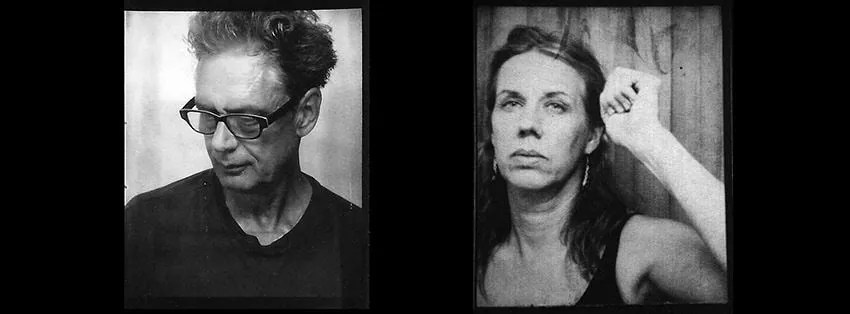
The exhibition showcases work by accomplished Cleveland-based painter John W. Carlson and CPR founder and director Shari Wilkins. For this show, both artists repurpose and recontextualize found vernacular photography. Vernacular photography includes imagery of everyday life, usually by amateur or unknown photographers.
Carlson deconstructs the imagery in his trademark style with accompanying expressive paintings; altering both the imagery’s forms and the photographer’s intentions. While both Wilkins and Carlson’s work in Destruction of Form is inspired by found vernacular photography, Carlson says he became fascinated with these images after seeing the Cleveland Print Room’s Lost & Found exhibition last summer.
“I was curious as to the motives behind the shots of the unknown, amateur photographers who took photographs of everyday life and common things as subjects,” reveals Carlson. “Initially, Shari showed me photos that had strange compositions and over the top gestures in which I sought clues to their meaning.”
Describing the re-/upcycling nature of this creative process, he adds, “We’ve altered the original photograph’s premise. It may be presumptuous of me to know the purpose of the photo, but when the premise of the photo is destroyed it becomes an entirely new piece of art. A lot of this is about perception.”
This exhibition takes this concept one step further by including the original photograph alongside Carlson’s interpretation.
Wilkins also alters imagery, but does so directly on the photographs’ surfaces. In this exhibition, She was inspired by the vernacular photography that she collects; along with detailed family documents, photographs, x-rays and ephemera she combines vernacular photography with new instant photography images creating Polaroid, large-scale photograms and photobooth work. In some instances, she then alters these images further by enlarging them many times their original size.
“My work is my attempt to grasp the significance of our existence,” she explains. “Last spring at the Hidden Mother exhibition at CPR, my piece for the show was a memorial to my mother by proving her existence through my photographs of her personal effects, which included shots of her actual ponytail, her false teeth and her wedding suit. The body and body parts are also important to my process. In this show the work also focuses on the body, inside and out, as I use x-rays in the photobooth as well.”
Both artists will discuss their work during a gallery talk on Saturday, July 25 at 1 p.m. DJ Sputnik will provide music for Friday’s reception. Destruction of Form runs through Friday, Aug. 28. The exhibition and reception are free and open to all.
(Cleveland Print Room) 2550 Superior Ave., 216-401-5981, clevelandprintroom.com
This article appears in Jul 15-21, 2015.
The described photographic endeavors here strike this citizen as parasitical.
Besides, an alternative explanation of the so-called found vernacular photography presents itself from experience: People take snapshots of various subjects while more or less testing the novelty of a given camera or lens, or both.
Or snapshooters take pictures randomly out of impulse, with scant forethought, much less a defined intention, if any.
Thus, the resulting photographs possess nominal, limited inherent interest — although, yes, the passage of time may impart a measure of value and interest to the snapshot for its context in a past era.
The project here involves a wasteful trek in the realm of triviality, worsened by the shallow intellectualizing of snapshots in hopes of elevating the project.
Finally, this citizen always finds suspect a report of a photographic activity that relies primarily on rationalizing text and scarcely if at all on shown photographs. After all, photography functions as a wordless medium of human expression.
A worthy photograph has a visual voice of its own which will directly reach a viewer minus words.
I guess internet trolling is *not* a parasitical pastime, eh?
JS: You weak sarcasm piddles away.
Who is JS, Pete? His name is Jeff Curtis. Also, you should probably learn the definition of sarcasm…
Please stick to what you know–because you clearly know little to nothing of found photography. Good try, though! 🙂
We hope to see you at the opening on Friday, if you can come out from behind your computer screen! All are welcome, even naysayers such as yourself.
Have a wonderful day, sir!
HH: My critique of the project went unanswered in your reply. Instead, your reply attacked me personally, a behavior qualifying as a logical fallacy.
As to my understanding of found photography, yes, it does remain circumscribed, and I largely took its mode as the news report described it, prompting me to classify it as snapshots, a category of photography.
Perhaps a technically qualified photographer can rework these snapshots for a curated exhibit. I leave this judgment to others.
Of course, showing representative examples of the work included in the exhibit as part of the online announcement would serve to introduce others to the exhibit concept; otherwise, an individual finds himself relying on a word-heavy presentation of the exhibit.