


It’s a dewy, fragrant, late summer morning in historic Willoughby, Ohio, 20 miles east of downtown Cleveland. And in the meeting room adjacent to Mayor David Anderson’s office on the second floor of City Hall, the mood has gotten tense. Maggie Rice, a 28-year-old activist, Willoughby resident, and recent contributor to the News-Herald’s “Another Viewpoint” section, is confronting Anderson about the Confederate flag.
She’s here on behalf of the activist network Organize Lake County. Much like Organize CLE, the Lake County collective picked up steam in the wake of Tamir Rice’s death and allied itself with the Black Lives Matter movement. In Willoughby, Rice and her cohort have been unpopular ever since they installed themselves across the street from a law enforcement appreciation rally in January.
As promised in her News-Herald editorial, Rice is now presenting the mayor a list of demands. At the August Last Stop Willoughby Parade, there was a float that flew a panoply of Confederate flags, and Organize Lake County would like one of two things, Rice says: that Willoughby issue an official apology and brand the party responsible for the float a “hate group,” and/or that Willoughby remove itself from future parades entirely, to communicate that it will not associate with hate groups or spend taxpayer dollars on public events that might be interpreted as supporting them.
Rice, wearing a hat with a Black Lives Matter pin, is methodical as she presents a packet of information to Anderson. She first highlights the history of the group in question — it’s the local camp of the national Sons of Confederate Veterans — and traces a media narrative of the national group’s affiliation with the League of the South, a known racist organization. She then chronicles an abbreviated history of the Confederate battle flag.
“The Confederate flag, we are told, represents heritage, not hate,” reads a quote from Southern historian Gordon Rhea, in Rice’s packet (a copy of which she provided Scene). “But why should we celebrate a heritage grounded in hate, a heritage whose self-avowed reason for existence was the exploitation and debasement of a sizable segment of its population?”
Mayor Anderson, blue-blazered and bespectacled, listens intently across the table, having granted Rice the courtesy of a private audience even after she and three other Organize Lake County reps met the previous week with law director John Wiles, your standard churlish suburban law director (i.e., partner at Wiles Richards, a firm specializing in suburban municipal law), and made no progress. But it’s clear this morning that though Anderson is happy to meet with Rice and hear her out, he has no interest in meeting her demands.
“I’m certainly willing to say the city’s never going to do anything to support a Confederate flag,” Anderson says, after stressing that though the flag may be offensive to people of color, First Amendment rights take precedence over municipal preference.

His rebuttal is essentially twofold. On one hand, he tells Rice, it’s the parade organizers, the downtown business owners who comprise “Heart of Willoughby,” who make the decisions about the floats. They typically only select groups who have been vital to the economic resurgence of Willoughby’s downtown. But they can’t legally censor anyone on a public street.
That’s not entirely accurate. Heart of Willoughby president Kathi Cannon, who owns a New York-style deli on Erie Street, says that “all registrations are accepted and welcome to march in the parade as long as they follow the rules and regulations” included in the registration materials (italics added for emphasis). Those rules stipulate that, although “the parade is not a forum for any particular political, religious or social point of view” (Rule #4), “The Heart of Willoughby Inc.’s decisions regarding parade entries, their eligibility, placement and judging is final” (Rule #5). So what they say goes.
But moreover, Anderson takes pains to explain, the City of Willoughby only has two opportunities to march in parades every year, at the Last Stop Willoughby event and on Memorial Day. Every politician who represents the people of Willoughby takes advantage of both, to greet and celebrate with constituents — to, in Anderson’s words, “throw candy.” The idea that the city wouldn’t participate, he suggests, is insane.
This summer, the Sons of Confederate Veterans took home first place honors in the “classic vehicle” category, marching alongside their parade partners, the United Daughters of the Confederacy. Floats were judged, according to Kathi Cannon, by the All-American Parade Judges Association, Inc.
As to the SCV’s contribution to Willoughby’s economic vitality, Scene won’t here speculate, but Anderson says the local camp, helmed by a Mr. Curtis and Mrs. Gloria Early of Willowick, is most definitely among the “historical” faction within the apparently bipolar national organization. Mayor Anderson hashed things out with Mr. Early over coffee, he tells Rice, and believes that he and his wife care much more about things like genealogies and gravestones than they do about politics.
“Would the city make a request …” says Rice, fishing for a consolation prize now that she and Anderson have reached an impasse.
“No, see, Maggie, no. We can’t. That’s like asking, that’s like me requesting …”
“You can’t do it? Okay, well then I guess, could the city make a statement …”
“… like requesting the gay and lesbian community carry … ”
“Right. Okay, okay, I get it.”
” … not carry the rainbow flag, which I mean, no, I never would.”
“Would the city make a statement …” Rice begins, then pauses, visibly irked. “To be fair, the rainbow flag has never been flown at any lynchings that I’m aware of. I think it’s a very separate issue and I don’t like the two being compared.”
“No no no. I’m just saying …” (Mayor Anderson contacted Scene the following day, apologizing for any possible misinterpretation. He said he never intended to compare the two flags and what they stood for. He said he was uneasy about the comment and that he thought Maggie was very gracious in her response.)
“These are not two special interest groups,” Rice says firmly. “We’re talking about racist violence and celebration of inclusion, two very different things. However, will the city of Willoughby say that they don’t want to march under a Confederate flag in a parade? That’s what it comes down to for me.”
“We’ve never marched under a Confederate flag,” Anderson says.
“I mean you did. You did this summer. I watched it happen.”
“We did not,” Anderson insists. “We did not.”
“You don’t see how the two, how putting ‘City of Willoughby’ and ‘Confederate flag’ next to each other — those two symbols — puts in the minds of the people watching the parade, including people of color, that one supports the other?”
“I think a couple of thousand people watched that parade, Maggie, and you’re the only person that’s asked me about it.”
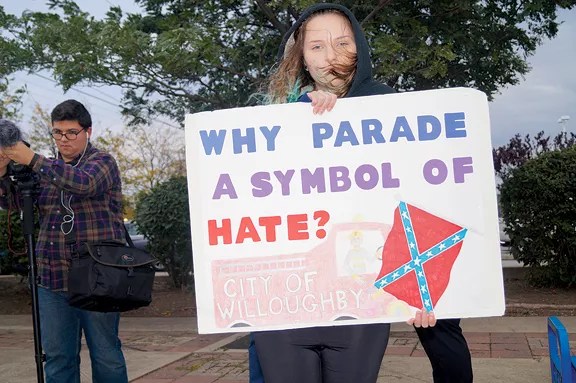
Indeed. The local reaction to Rice’s Aug. 26 editorial in the local paper, neutrally titled “Flags and symbols, which may be harmless to some, can be offensive,” was, with few exceptions, pretty hostile. Readers commented on both the News-Herald website and on Facebook, chastising the newspaper for only printing one side of a divisive issue and laying into Rice for the audacity to question the freedom of speech.
And though online commenters are hardly a representative sample, the sentiments of flag supporters in Willoughby echo a growing clangor of battle flag support all around the state.
To refresh, we live in the state of Ohio, which is a Union state.
But ever since Dylann Storm Roof murdered nine black people at the Emanuel African Methodist Episcopal church in South Carolina early this summer, the Confederate battle flag debate has been forcibly re-thrust into the national spotlight. Roof was seen in many published pictures brandishing or wearing the Confederate battle flag. His license plates bore the image of three of the flag’s iterations.
In the wake of the massacre, Confederate flag supporters have crawled out of the woodwork, in Ohio and elsewhere, to publicize their support for Southern heritage, and to assert that the flag had absolutely nothing to do with Dylann Roof and his actions.
South Carolina, for its part, removed the Confederate flag from its statehouse grounds in July, where it had flown since 1961. Similar actions were taken across the South: in Alabama, Florida, on the campus of the University of Mississippi. Equal and opposite protests mushroomed in response, and questions about the flag’s place in the American past and present have even trickled into the discourse of presidential candidacies. John Kasich, for one, said he supported South Carolina’s decision to remove the flag.
But these conversations, which tend to be heated, aren’t just happening in the South.
In Bucyrus, Ohio, in late August, a small group of local flag supporters held a parade that one organizer said wouldn’t have been possible without the momentum generated by South Carolina. Until this summer, they’d only ever been able to gather five or 10 vehicles for a demonstration.
In Norwalk, Ohio (just south of Sandusky), a group called the North Central Ohio Confederate Supporters now hosts a monthly rally outside the Huron County Courthouse. Organizer Ray Back told the Sandusky Register that his group is exercising its free speech rights, and that the members are eager to educate “ignorant” passersby.
In Port Clinton, the police chief got heat for wearing a gaudy Confederate flag vest, and then for refusing to apologize. The local NAACP chapter chimed in to say that the item was especially insensitive, given the rocky relations between the black community and law enforcement.
Out west of Cleveland, a Lorain County Confederate Support Group emerged after county Democrats withdrew from the fair when they heard Confederate flags would be displayed and sold. The group now solicits support on its Facebook page where its mission is described thusly: “Lorain County Confederate Support Group is here to educate people of the meaning of the Confederate flag and be the voice of souhthern herritage support [sic].”
Organizer Tom Maybaugh has continually maintained that his support for the flag is not about racism — “It’s not about racism. Not one little bit,” he told the Chronicle-Telegram — and insists that the flag is a sign of free speech and “people standing behind what they believe in.”
Which is one reason, perhaps, that the flag issue has caused special friction in Willoughby. There, the local high school’s mascot is the ‘Rebel,’ symbolized not by a James Dean-ish anti-authority figure, but by a grimacing Confederate soldier. And there, the Confederate battle flag has long been embraced as a symbol of school pride.
Lisa Stevens is an ’85 alum of Willoughby’s South High. She’s now the president of Rebel Families — “mostly a group of volunteer moms,” she says, “a pack of rule followers, not rebels” — and says that, in accordance with current school policy, the group doesn’t promote or sell any school apparel (what they call spirit wear) featuring the Confederate flag.
“I think it’s just known that it would not be appropriate,” Stevens tells Scene. “I received an inquiry from an ’81 alum this summer when the topic really heated up nationally, requesting some flag spirit wear. I let her know there was no longer any available.”
In 2010, the organization (which was known, at that time, as South Rebel Moms and was formed in light of the fact that women weren’t allowed in the Booster Club) was discouraged from selling a T-shirt in preparation for the Eastlake North game, the annual “Border Battle,” which depicted a Confederate flag. Then-principal Paul Lombardo intervened to say that the school district did not endorse or recognize the flag and that the school would subsidize a redesigned shirt. At that time, 250 had already been sold.
Though the flag was officially banned from school grounds in the ’90s, there have been scattered incidents of students wearing it to football games throughout the years. Even this year, Stevens says, a boy showed up to a game with a Confederate flag on his ballcap.
“He was asked by the assistant principal to remove the hat or else leave the stadium,” Stevens says.
At her class’ 30-year reunion this summer, Stevens says the flag topic came up regularly in conversation.
“I don’t think I have ever talked to an alum who doesn’t miss it, or at least the days when it wasn’t an issue in Willoughby,” Stevens says. “My memories from the ’80s include the beautiful flag, not even depicting Southern culture but our ‘glory days.'”
Current South High principal Patrick Ward concurs. “There is a Willoughby reality, and then another context that our kids don’t know,” he says in a phone call with Scene.
Asked facetiously if there are, for example, African-American students enrolled at South High, and whether or not Civil War and Civil Rights material is being taught in American History classes, and whether or not students are probably aware of the flag’s larger context, Ward says sure.
But still.
The two groups making the Confederate flag an issue out there are parents and alums who attended South High in the ’80s and ’90s, and the news media.
“On a day-to-day basis, it really never comes up.” he says.
This is only Ward’s second year as principal at South High, having spent the previous 14 as a teacher and assistant principal in the Mayfield City School District, but he says he can only recall one instance when a student wore Confederate flag imagery to school.
“We asked the kid to change his shirt and that was it,” he says. “Like anything, there’s a certain set of expectations around dress. Just like a drug symbol would not be appropriate in school, the Confederate flag wouldn’t be either.”
Specifically forbidden in the Willoughby-Eastlake code of conduct, along with pajama bottoms, spiked jewelry, crop tops, and “undergarments worn on the outside of clothing,” is any dress that causes or is likely to cause “a hostile, intimidating, degrading, offensive, harassing, or discriminatory environment.” Confederate flags fit squarely into that category.
But again, other than the occasional letterman jacket from a parent or cousin, it’s a rare occurrence on campus. The flag was removed from the gymnasium and school grounds in 1993 when a visiting basketball team wrote letters expressing dismay and discomfort at the racist symbol. Visiting parents were reportedly shocked. The Associated Press swooped in; they’d covered a similar debate at Toledo’s Bowsher High School, also “the Rebels,” in the ’80s.
Then-principal Glenn Caroff said that though the flag would be removed, the team’s name was not an issue — indeed, several other Ohio high schools have a Rebel mascot, including CMSD’s John Adams — and he wouldn’t forbid students from waving Confederate flags at games.
“That is an individual freedom-of-speech issue,” Caroff said at the time.
Not so much these days. Patrick Ward says that the district “really had a conversation” about the policy back in the early 2000s, and that most of his students were in the third and fourth grades at that time.
“They’re just so young that when they get here — unless attention is called to it, like in the past couple of months — they don’t understand the issue … . Look, in 1959, Union High School split into two and we ended up on the wrong side of Euclid Avenue, the south side, and that’s why we’re having this conversation. Flash forward to today, it’s really not a controversy.”
Don’t tell that to Mayor David Anderson. He graduated from South High in 1970, and says his whole yearbook is full of Confederate flags. Like most of his classmates, he remembers the flag fondly. But he says when the school district made the decision to ban it in ’93, he stood by them, even when residents begged him to intercede on their behalf.
“People stopped me in the grocery store and asked me why I wasn’t standing up for them,” Anderson tells Scene the day before his meeting with Rice. “And I said I’ve got to stand with the district on this. We’ve got students coming into our gym to play basketball, to play volleyball, and we don’t want them to feel uncomfortable.”
Anderson acknowledges that the flag has been used as a symbol of hate by groups like the Ku Klux Klan and the American Nazi Party — he says he watched a terrific HBO documentary on the subject — groups that South High ought not to be associated with.
But what about the city of Willoughby itself?
Maggie Rice and the activists of Organize Lake County feel very strongly that the Sons of Confederate Veterans’ float at the Last Stop Willoughby Parade in August cast Willoughby in a negative light, especially for the “newcomers” who the parade was billed as trying to attract.
Scene was not at the parade, but read about the float in Rice’s op-ed in the News-Herald:
“A mini-van pulled a small trailer, with a wooden silhouette of a kneeling soldier, and flying above, several flags: an American flag, a Confederate national flag (which consists of the familiar stars and bars, as well as a white rectangle and a red stripe), and confusingly, an Alabama state flag.
“This parade said to people visiting Willoughby, particularly people of color (including the young girls of the predominantly black dance team who performed), that Willoughby is not for them; that we don’t welcome them, and that our city is not a safe environment for them.”
Curtis and Gloria Early ardently disagree. They’ve been residents of Willowick for 40-plus years and have been marching in Willoughby for at least 15.
“And every year we get welcomed,” Curtis Early tells Scene. “They even call us. I was sick this year for the Mentor parade, and they called and said, ‘Where are you? We hope that you didn’t stop coming because of what happened down in South Carolina.’ We march in every parade around and we win trophies like mad.”
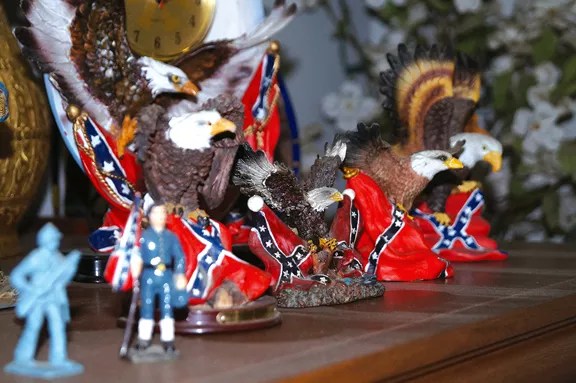
Scene can confirm. The Earlys have converted an addition on their home, built in 1984 for Mr. Early’s elderly parents, into a bona fide museum of revisionist history, celebrating Early’s own Confederate ancestors — Gen. Jubal A. Early among them — and black partisans who either fought for the South or who currently claim membership in the Sons of Confederate Veterans. Also included among the photos and battle-flag paraphernalia are trophies and medals the Earlys have acquired through the years.
The Earlys are nice people, by which we mean they welcome Scene into their home and engage in conversation without violent personal invective. Curtis Early’s easygoing voice is less a Southern twang than it is a backwoods Appalachian drawl: “Flowers” is flars. But they are also parrots for a host of Tea Party, Lost Cause Movement and battle flag-thumping sources that purport to explain the “true history” of the United States. Curtis Early is the treasurer of the Akron Camp of the Sons of Confederate Veterans — one of Ohio’s seven outposts — and he believes fervently, for example, that the Civil War was fought over taxation and states’ rights.
“But they wanna make it about Lincoln and the slaves,” he tells Scene, moments after we set foot in his home.
The “they” he continually references is unclear, but is most likely represented by the Yankee government and its agencies and attaches, not the least of which is the education system.
“Our public schools are being taught by our government,” Early later confides in Scene. “They’re allowed to teach the ‘politically correct history,’ that slavery was the cause of the war. You’ve gotta watch yourself.”
To right this grievous wrong, the Earlys travel around the region and give presentations on “what life was like” in the 1800s. This work is apart from Mr. Early’s involvement in the Sons of Confederate Veterans and, in fact, is much more about life in coal-mining towns such as the one from which he hails. “Poop pots and mine rats as big as dogs,” is the gist.
But during Scene’s trip to the Early museum, Mr. Early focuses much more on African Americans, and their involvement in Confederate causes.
“There’s a lot of black people who do know the true history,” Mr. Early says. “They don’t want you to know it, but there was between 60 and 100,000 blacks who fought for the South willingly, and that’s the false part of history. They want to take our flag down because they don’t know the true history. We got quite a few black members in Sons of Confederate Veterans. They don’t want you to know that either.”
For 30 minutes, Scene watches an online video at the Earlys’ invitation of a speech by one H.K. Edgerton, a black member of the Sons of Confederate Veterans and a theatric supporter of the Confederate flag. The video appears on a Tea Party website. On the wall behind Mr. Early’s computer are more than 50 numbered binders, which comprise the ongoing research for the Earlys’ next book. It will focus on “rich black slave owners,” he says.
Throughout our conversation, Mr. Early identifies both the NAACP and the ACLU as “hate groups.” He also calls Organize Lake County a hate group, and says, with respect to the News-Herald editorial, that Maggie Rice doesn’t know what she’s talking about.
“I know she’s about 23 years of age [sic],” he says. “What does she know about history at 23? Where’s she getting her information?”
The Earlys take exception to just about everything in the piece, but in particular to Rice’s misidentification of the flags on their float. Mr. Early says that he has been cutting back on the use of the Confederate battle flag and that the flags they flew were all “legal state flags.” He holds them up for Scene on his back porch in succession: the U.S. Civil War flag from 1865; the Mississippi state flag; the “Bonnie Blue Flag” which was used briefly by Mississippi during its secession; the North Carolina state flag; and the Alabama state flag.
“And the one that’s on my flagpole now is Irish,” Early says. “Because 40 percent of the Confederate Army was Irish and I’m 100 percent Irish.”
Even as we depart, Mr. Early, through his screen door, continues to loft factoids about the “War of Northern Aggression.”
Much less aggressive than the purported advance of the Union states into Dixieland is the toothless offensive scheming of the Eastlake North Rangers. Despite the best efforts of QB Zane Bunnell, they’re getting trounced by the South High Rebels in the annual “Border Battle” at Classic Park, home of the Lake County Captains, on Oct. 2. The score after one quarter is South 24, North 0.
South High has beaten their former Union classmates in this matchup every year since 2004. The dominance is so humdrum by now that the ‘rivalry’ talk is mostly ironic. Case in point: The theme of the Rebel Families spirit wear this evening is, “Let’s Make it a Dozen.” Emblazoned on the back of the T-shirts and sweatshirts is a Rebel soldier, arms akimbo, embossed over “04, 05, 06, 07, 08, 09, 10, 11, 12, 13, 14 …”
One assumes that the South High football fans appareled as such, who continue to swarm into the stadium in the biting Lake County winds, are nowhere near as ideologically entrenched as Curtis and Gloria Early. But they still don’t take kindly to the small group of Organize Lake County demonstrators, Maggie Rice among them, holding signs, beating a drum and passing out literature outside the gate.
“The City of Willoughby continues to endorse the display of Confederate imagery,” reads a handout, topped by an image of Dylan Roof.
Scene observes no altercations between the protesters and the fans. Many ignore the demonstration, though a few make a show of crumpling up their handouts and hurling them at nearby garbage cans. Organize Lake County, much like those on the issue’s opposing side, frames its presence as an effort to “educate the public.” But Rice says few people seem all that amenable to engagement.
“I had one guy who asked why I don’t like the flag, and I said because it’s been flown at lynchings,” she tells Scene; the anecdote is now posted on the Organize Lake County Facebook page. “As he walked away he said, ‘What if I like lynchings?'”
Inside the stadium, we spot the Confederate flag on a handful of letter jackets and on the baseball caps of a few grizzled dudes who look amenable to engagement indeed. But otherwise, the atmosphere is that of a very basic Friday night high school football game.
But when the Rebels score — when, for example, wide receiver Devannaire Conliffe catches a 40-yard touchdown pass from quarterback Mike Federico — and the crowds explode, so too does a cannon situated on the Classic Park warning track. A real cannon. It is a much-beloved school tradition and it’s one in which the student section delights repeatedly this evening.
For Scene, the frequent blasts and the attendant smoke italicize the football field-as-battlefield metaphor. But we suspect the students are content to interpret that metaphor in a general way. We suspect that after the removal of the Confederate flag as the official school flag in the ’90s, the tides’ turning would have been implicit, and the conflation of racist pride and school pride would thereafter have required a sin of commission.
We suspect, in fact, that on the Venn diagram of South High fans (students, alums, whomever) and Confederate flag diehards, only the overlapping few would relish this carnage of South over North as a kind of revenge.
This article appears in Oct 28 – Nov 3, 2015.

First sentence of the story needs some fact checking: Downtown Willoughby is only 19 miles from Downtown Cleveland. 30 miles would land you passed Painesville…
I don’t get what the big deal is about the Confederate flag either; yeah I get that it symbolizes a period or American history where a large portion of the country classified a group of people as subhumans only fit for forced labor, but on the whole, the US flag and our more collective history as the United States of America has been WAY worse to black people. The United States government before and after the Civil War has demonstrated a pretty consistent lack of concern for the welfare of black Americans, imprisoning them in way disproportionate numbers to the general population, using them as cannon fodder and lab animals in the military, and stacking the system against them in so many other ways. I don’t like what the Confederate flag symbolizes but I HATE what the American flag symbolizes.
For a lot of people the flag represented less government and less taxes one of the main reasons the war was fought. Slavery was not the only issue.
If it about “heritage” why would anyone be sporting a confederate flag up in the Northern state? Didn’t Ohio go to war against this flag?
Since when is the state of Mississippi flag known as the Confederate flag.
It’s the flag of traitors to the country and those who spin it any other way are just fooling themselves. Why would you celebrate a group of slave holders who went against basic human compassion and LOST.
Each state in their declarations of secession mentions the act of slavery.
Georgia- “For the last ten years we have had numerous and serious causes of complaint against our non-slave-holding confederate States with reference to the subject of African slavery.”
Mississippi-“It has grown until it denies the right of property in slaves, and refuses protection to that right on the high seas, in the Territories, and wherever the government of the United States had jurisdiction.”
South Carolina- “But an increasing hostility on the part of the non-slave holding States to the institution of slavery, has led to a disregard of their obligations, and the laws of the General Government have ceased to effect the objects of the Constitution.”
and I could go on. Regardless if their were reasons IN ADDITION to slavery is irrelevant. To stand beside the people who were on the wrong side of history, people who fought for the enslavement of their fellow man is wrong… plain and simple. This flag and all the other confederate flags are a symbol of hate and failure. You lost, good triumphed, let it go.
As the descendent of numerous men who fought on the UNION side in the Civil War, the side that WON, and that preserved the union we hold so dear, I am thoroughly offended by the sight of this flag in Ohio. It is the flag of TRAITORS. I have a 3X great uncle who fought at Bull Run II and Antietam in addition to many other battles before dying of TB in a military hospital far from home. Flying this flag in Ohio, or any other state in this country is grossly disrespectful to the thousands of men who fought for the Union and AGAINST slavery.
This insane removal of the Confederate Flag from every part of America is political correctness gone totally mad. I’m proud that sales of the flag have skyrocketed since this witch hunt began. I own one myself, though I’m a northerner. To quote a line from a favorite movie, “I chose my side out of conviction, not location of birth!” LONG MAY IT WAVE!
So Astro2005 holds the conviction that slavery is okay and that we should support hatred and racial bigotry. You should be so proud. Also the sales of flags have not “skyrocketed”… while I’m sure some racists are stocking up… your group of intolerance is shrinking. Confederate racists are not getting a big influx of recruits. Much like your beloved slave owners, you only face defeat and fading into obscurity. All too soon the flag will be a footnote and a relic in a museum. The flag of these united states which stands for freedom and democracy for EVERYONE will still wave.
Does Willoughby have a memorial for Civil War veterans? I bet it does. Ohio contributed a huge number of soldiers of the civil war effort. For people supporting the Confederacy in this part of Ohio to continue to commemorate treason is preposterous. It dishonors every single person that died under the Ohio flag in the Civil War. The mayor of Willoughby should be ashamed to not take a stance on this.
I am a Texan , and a Southern son , I don’t fly the battle flag of northern Virginia , none of my family fought under it . however , I have no less than 7 ancestors who did fight under the 1st , 2nd and 3rd flag of the Confederate states , and the Bonnie blue .I fly the 1st , to honor my family , most men did not own slaves , they fought for honor , and home , the battle flag gets a bad rap because of the klan and brotherhood , but if you look at those pictures , there is another flag flying also , the American flag . also you should read the emancipation proclamation , Lincoln didn’t free the slaves until like 1863 and then he only freed them in the South . the South gets the blame for that war , there is a lot more to it than that .
The south rightly gets the blame for that war. They drove the country to war and were called on one of the worst bluffs of all time.
As a teacher of United States history, I’m floored by the ahistorical view of Curtis Early and other apologists for the Confederacy regarding the cause of the War. I’d encourage Mr. Early to read South Carolina’s own Declaration of Secession (http://www.teachingushistory.org/pdfs/ImmCausesTranscription.pdf), which pretty clear lays out that a desire to preserve slavery was at the heart of their decision to secede.
A few key excerpts:
The “ends for which this Government was instituted have been defeated, and the Government itself has been made destructive of them by the action of the non-slaveholding States. Those States have assumed the right of deciding upon the propriety of our domestic institutions [i.e., slavery]; and have denied the rights of property [i.e., slaveholding] established in fifteen of the States…; they have denounced as sinful the institution of slavery; they have permitted open establishment among them of [abolitionist] societies, whose avowed object is to disturb the peace and to eloign the property [i.e., slaves] of the citizens of other States. They have encouraged and assisted thousands of our slaves to leave their homes; and those who remain, have been incited by emissaries, books and pictures to servile insurrection…”
“A geographical line has been drawn across the Union, and all the States north of that line have united in the election of a man to the high office of President of the United States, whose opinions and purposes are hostile to slavery. He is to be entrusted with the administration of the common Government, because he has declared that that “Government cannot endure permanently half slave, half free,” and that the
public mind must rest in the belief that slavery is in the course of ultimate extinction…”
“On the 4th day of March next, this party will take possession of the Government. It has announced that the South shall be excluded from the common territory, that the judicial tribunals shall be made sectional, and that a war must be waged against slavery until it shall cease throughout the United States. “
That’s not some PC version of history; it’s coming straight from the SC itself.
Anyone who flies the Confederate flag is a moron. The South lost. They LOST! What’s more, it was an Ohio General from Lancaster who made sure of it. Nevertheless, anyone who forbids the moronic activity of imbeciles, simply because it offends their sensibilities, behaves just like the ones they decry. People have a right to make their voices heard even if what they’re saying fails the tests of rationality, tranquility, and good manners. My advice to the people of Willoughby is to enter a Union float in the parade, perhaps with a larger than life statue of William T. Sherman. That should shut the fools up for a few minutes.
Yes, the Confederate flag is not only the banner of TRAITORS who LOST the Civil War, but ever since 1954 Supreme Court school desegregation decision, it has also become the flag of RACISTS.
Let’s cut out the bullshit, folks. The Stars and Bars is a flag that says: “WE HATE NIGRAS!”
Chew on that a while. And try not to choke on it.
The CSA flag should be treated as a historical artifact and placed exactly where such an artifact belongs…something that is folded away in the attic, next to that Nazi flag that Uncle Willie and GI Joe brought home from Europe.
But good luck with THAT noise.
Chuckles the Clown
I grew up in a lily-white exurb, and thought nothing of the Confederate flag. In childhood, when lLynyrd Skynyrd was on the charts, Confederate flag beach towels were all the rage at our private pool.
Well, you grow, and you grow up. I’ve heard the Confederate flag called “the American swastika,” and I have to concur. Morons come in all colors, ethnicities and races, but these Tea Party buffoons make me ashamed to be white.
Being partially of German lineage, there is no way I would ever fly a Nazi flag outside of my home. The Confederate flag should be regarded the same way in our society.
An answer may be found in an October 29 HuffPost commentary by Celia Buckman — “A Matter of Northern Pride”.
The protesters are delusions. The Sons of Confederate Veterans is not nor has it ever been “associated” with the League of the South. It has a policy of non-affiliation with any other group. The protesters need to do more research before they begin making demands.
The Flags of the Confederacy represent government based on the consent of the governed. Just as the US flag did in the Revolution. However, Lincoln changed that – he imposed government by force – just as the Nazis did 80 years later. Thus the US flag is closer to the Swastika than any Confederate flag could be. Lincoln committed treason with is unlawful invasion of the Confederacy / betrayal of the Principles of the Declaration of Independence. Time for a lesson in history for the haters of the flags of the CSA.