

The four buildings in the Quaker Square Complex have been in mixed use for many years, but historically were a part of the impressive Quaker Oats operation that helped build Akron to what it is today. Building #3 and #10 were two of the first buildings to be build in 1886 and were used as the “Cleaning House” and the “Dry House,” respectively. Building #1, which fronts Mill Street, was annexed in 1894 and was titled the “Cereal Mill.” This was adjacent to the Mill Race that ran down Mill Street that gave the street its name. Finally, Building #2 was added in 1912 and was titled the “Corn Puffs” building.
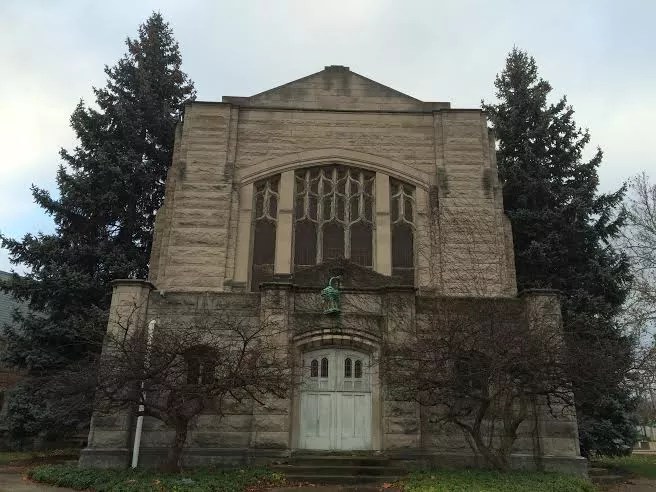
St. Paul’s Episcopal Church, sometimes called the “Firestone Church” due to H.S. Firestone’s close spiritual and philanthropic relationship with it, was built in 1884 as the Lewis Miller Sunday School. It was later acquired by St. Paul’s parish, and in 1907 the adjacent building was built that now fills the triangle-shaped block. Here’s the true irony behind this whole predicament that the building is in. In 1952, the University of Akron bought the buildings with funds from the Firestone Foundation. I can’t imagine that Harvey Sr. would be proud of the University’s current plans of razing a building, that he loved so dearly, that was able to be purchased by the University WITH FIRESTONE’S OWN ENDOWMENT!
But I digress.
All of these structures have served many Akronites over the years in many different ways, and are a link to Akron’s early days of growth. I understand that the needs of the university are diverse and far beyond my scope of knowledge. However, these buildings are an important link to Akron’s past and tell stories with each and every brick that is exposed. They give Akron residents and U.of A. students a respect for the past industries, people and lifestyles that made the city what it is today. In a time where we are actively trying to attract residents — and students — this connection to the past can be seen as an asset for Akron.
The university has an opportunity to serve as an example to its students, faculty and community by showing how respect for the past and its structural remnants can benefit future generations. Rather than razing these historic structures, I say that the university should showcase them and celebrate the rich history that they can tell.
This article appears in Dec 2-8, 2015.
Unfortunately, the bulldozing of history is the American Way.
“America has rolled by like an army of steamrollers. It has been erased like a blackboard, rebuilt and erased again.”
Art imitates Life imitates Art.
Chuckles the Clown
What about the remarkable Tiffany stained glass windows in the old Firestone CM, aka Ballet Center????????
UA has saved the following: West Hall – former church, Buchtel Hall – administration building destroyed by fire, Polsky Building – downtown department store, Quaker Square dormitories – once grain silos and hotel rooms, Ballet Center – former church, so far has been saved for the past 40 years, FolK Hall Art School – former Car dealership. I think there is some hysteria in this story.