

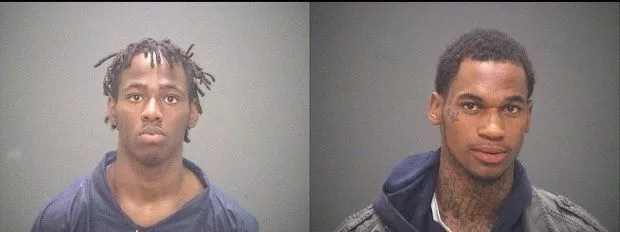
Sitting on the witness stand, shackled and wearing an orange prison jumper, 24-year-old Tervon’tae Taylor whispered to his attorney. The conversation dragged. The courtroom waited. A few strides across the carpet, Kenneth Jackson Jr, burned a hard look into his former friend. The 20-year-old defendant— dreadlocks pulled back, glasses resting on his nose, a strapped bow tie tilted on his dress-shirt collar — rubbed his hands together, ever-so-slightly shaking his head left to right in disapproval.
After a few more moments of discussion at the witness stand, the state asked for a brief recess. Suddenly there was a question if Taylor would go ahead with his testimony, bailing on plea deal he’d worked out with prosecutors stemming from his own involvement in the 2015 crime spree. As the defendants were led from the room, Jackson’s head had switched directions, nodding now up and down in agreement, still staring at the maybe-maybe-not-witness.
The Monday waffling would eventually have an impact on the case. Yesterday, Jackson and his co-defendant, Antowine Palmer, were convicted of their roles in a series of Tremont carjackings in 2015, as detailed by cleveland.com’s Eric Heisig.
But it would be a mistake to see what was unfolding in that courtroom as your typical pitstop in the larger arc of urban melodrama. It’s hard to think of another case putting floodlights on the very issue that’s teed-up to define the upcoming mayoral election: the narrative of the downtown-neighborhood conflict— which, when you strip off the tidy politicalspeak, breaks down to the growing tension between gentrified downtown areas filled largely with white young professionals, and the forgotten and isolated east side areas blacks and other minorities call home.
For all the whiz-bang panting about DOWNTOWN REVITALIZATION and BOUTIQUE HOTELS and ARENA UPGRADES, Cleveland remains completely shattered, broken along the lines of have and have-not. Studies have shown the city is hypersegregated, meaning its African American population is unevenly distributed into compact geographic areas, areas where the percentage of blacks is critically higher than their citywide population share.
These are the nerd-facts flowing beneath the barbs aimed at Mayor Frank Jackson and lobbed most vocally by his challengers from council, Zack Reed and Jeff Johnson. The narrative you’re going to hear on repeat for the rest of the summer is that Jackson has buddied up to downtown interests who’ve staked money on areas like the core, Tremont, Ohio City, and Gordon Square, while ignoring the economically bottomed-out inner city neighborhoods. (Watch how many times the three candidates say “neighborhoods” as their campaigns go on; Jackson used the word frequently in describing what he believes are benefits of the Q deal). The ugly truth is that when a city drives so much of its attention into one part of the city at the expense of the others, well, that’s, in part, how a Tremonter ends up with a .38 in his face and someone asking for his keys.
And that’s what Jackson, Palmer, and a handful of other Heartless Felons from the gang’s Broadway sect did. In July and August 2015, the men were tied to five carjackings in Tremont. At last week’s trial, victim testimony, DNA, and fingerprint evidence all were introduced to tie Jackson and Palmer to the crimes, according to coverage of the trail by Cleveland.com’s Heisig.
Tervon’tae Taylor, however, was supposed to be the state’s checkmate against the defendants. After pleading guilty to charges related to the carjacking last August, Taylor had agreed to testify against Jackson and Palmer.
And after returning from the recess Monday morning, it appeared the witness’s nerves were settled. At the prompting of an assistant U.S. Attorney, Taylor revealed how he, Jackson, Palmer, and a fourth man took a man’s car at gunpoint in Tremont.
“Why did you rob him?” the prosecutor asked.
Taylor shrugged. “We did it.”
But as the prosecutor began to question Taylor on the other carjackings, she hit a wall. The witness refused to name who he was with.
“Can’t say that name,” Taylor said.
“Why?”
“They not here.”
The prosecutor again tried to yank out the identity of another co-conspirator. But Taylor wasn’t playing along.
“I’m not going to say,” the witness said.
“Why?”
Shrug. “Next question, please.”
“Mr. Taylor, I noticed you looking to my right a lot?” the assistant U.S. Attorney asked the witness, indicating where Jackson sat at the defense table. She next asked Taylor if he was scared of Jackson or Palmer or their respective families.
“No,” the witness said. “Not afraid.”
In the end, Taylor’s testimony only tied Jackson and Palmer to one of the Tremont holdups. As a result, prosecutors were forced to drop some of the charges against the men. For Taylor, it couldn’t have gone worse: if he was afraid of going snitch, well, he testified against his friends . . . but still managed to possibly jeopardize any deal he had with the state.
On Wednesday, jurors returned guilty verdicts on both Jackson and Palmer, for three and one federal counts for the carjackings, respectively. Jackson is staring down at least 32 years in prison (since he was found guilty of using a gun in the crime). Sentencing by U.S. District Judge Patricia Gaughan is scheduled for Aug. 23.
This article appears in May 3-9, 2017.
What a bullshit article. Get a job, don’t rob people, and you won’t end up with your face plastered on the interwebs. Play stupid games, win stupid prizes.
Cleveland is getting better and worse at the same time, depending on who you are, where you are, and what skintone you are. Gentrification or thuggery…what a choice…like being asked if you want to hang or be shot. Is it any wonder that fifteen to twenty city residents (down from 22) still vote with their feet and leave EVERY DAY?
Amid all the hand-wringing and whining about “the growing tension between gentrified downtown areas filled largely with white young professionals, and the forgotten and isolated east side areas”, the writer has neglected to mention another demographic… the ” young white families and the middle-aged and elderly non-professionals and retired ethnics” who have lived in Far West Side neighborhoods and other areas for many years, often for their entire lives.
City residents living on the edges of suburbia are getting tired of platitudes and excuses. They feel, pissed-off, and disgusted, as well.
Crime is up, City services often suck. Streets are crumbling. People feel victimized and targeted by criminals who drive out to these “forgotten areas” to point their pieces, or just take the Rapid to do their law-breaking. Or they’ll even swarm out here in packs, on dirt bikes.
The clock is ticking. Wake the fuck up, Frank
Chuckles the Clown
LOCK ‘EM UP & THROW AWAY THE KEY!!
their momma says they are good boys
I wish I could connect the dots on this article but it’s solid rubbish.
I thought it might address some facts of substance but all I took away was about a guy who showed fear on the stand.
Point could have used some more reinforcement,
Author.
This is without question the stupidest insertion of “racial privilege” in any article from Scene yet. Yes, it is a real shame these thugs don’t have anything of value to steal in their own neighborhoods…that’s true. But I wonder why? Is it virulent racism the bubbles behind the eyes of every suburban white man showing its true colors? or is it the flight from continual crime and violence that has been formed through the destruction of the black family unit and the continued expansion of the welfare/nanny state?
Nope you’re right Scene. Were all racists.
What I get from this article is that the peace and security of the “haves” depends in large part on addressing the persistent poverty of the “have nots”.
the fallacy here is to presume that these thugs do what they do because they are poor. Just isn’t true. They don’t steal cars to feed their family. They don’t shoot each other to pay for their kids education. They do this because they have no grounding and no discipline, and because they are thugs. or teens. Put them in jail.
This article, other than the trial observation, is total garbage. The implied argument that somehow investing in a strong business community neglects the inner poverty areas is total BS. The city, under prior administrations has invested millions in Hough, Glenville, and other areas. CMHA has put in millions of dollars in new housing develpments. The jobs created by downtown and neighborhood businesses are available to those in these “urban decay areas”, but the welfare state has created an attitude that why work and get ahead if Uncle Sam pays my rent, food, and medical care. Instead they sell drugs and commit crime and drive the Hummer with $2500 rims. Until the politicians stop wasting money on projects that perpetuate the fallacy of throwing dollars at a problem that needs an attitude adjustment, nothing will change.