

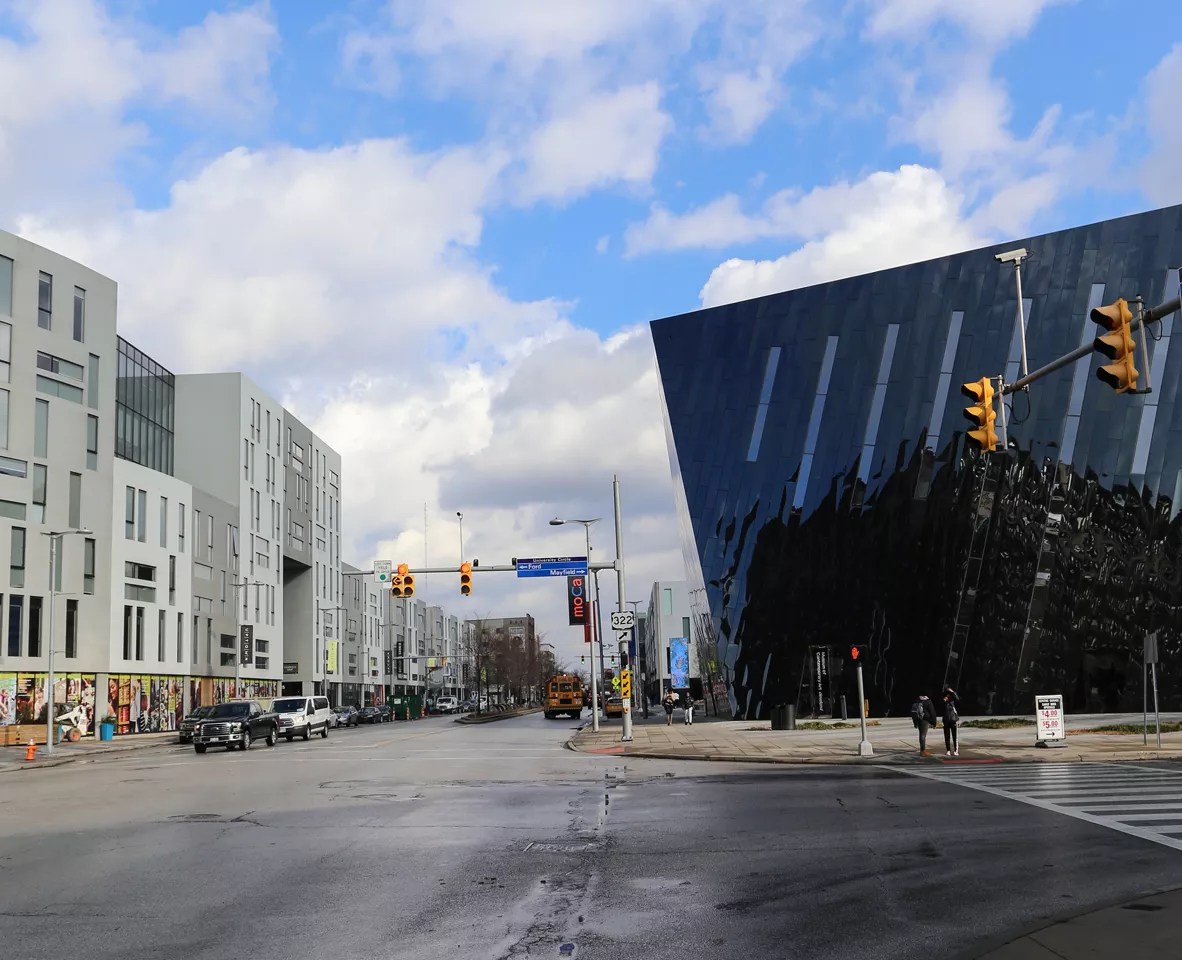
When the $200 million development of housing, shops, cultural institutions and public spaces along Euclid Ave. first opened in 2012, it was touted as the new main street for University Circle. “Just a short walk from the institutions on Wade Oval, and within campus borders of Case Western Reserve University and the Cleveland Institute of Art … it’s the place where residents, students, and visiting tourists converge to enjoy a diverse social scene and an array of entertainment – from art galleries and live music, to bowling and yoga,” touts the website for University Circle Incorporated (UCI), the nonprofit development corporation serving the area.
Yet six years after Phase I of Uptown was completed by MRN Ltd., which also developed East 4th Street, the Tudor Arms Hotel and West 25th St. south of Lorain, the bowling, yoga and live music venues have all closed. The Chipotle, Jimmy John’s and Panera are still there, but more than a dozen independent businesses have closed in and around Uptown, only to be replaced by a seemingly endless array of places serving rice bowls. In 2018, Coquette Patisserie, Corner Alley, the Happy Dog at the Euclid Tavern and Ninja City (which relocated to Gordon Square) have all been shuttered. The first few weeks of 2019 were no kinder, as Jonathon Sawyer announced the closing of Trentina.
To be fair, while all these businesses were located in the area, they weren’t all part of MRN’s project. Yet critics say that with the predominance of quick-service concepts throughout the area, Uptown has become a fast-casual food court that mostly serves students and University Circle employees. That’s a far cry from the original goals of the project, hailed as “a new downtown for the University Circle neighborhood” by the New York Times and a possible “new center of gravity for the city” by the Plain Dealer. To serve the area’s cultural institutions and residents, a more vibrant mix of businesses is needed.
“We would love for MOCA audience members to be able to attend the museum and then go on to have an equally interesting cultural experience in Uptown,” says Meghan Reich, deputy director of the Museum of Contemporary Art (MOCA) Cleveland, which has seen its visitation expand by over 100 percent since it opened its new, $26 million building in Uptown. “We want to send our audience to locally owned businesses and to experience Cleveland entrepreneurship at its best. It’s hard when those things close or can’t even open and the district is mostly franchises that are not unique or special.”
“I think it’s a great urban success story, but it isn’t what it was envisioned to be yet,” says Grafton Nunes, president of the Cleveland Institute of Art, whose $75 million campus reunification project at Uptown includes the Cinematheque, considered to be one of the country’s best repertory movie theaters.
Ari Maron of MRN counters that several of their tenants, including Constantino’s, Cleveland Clothing Company, the Case Western Reserve University bookstore, and a few of the fast-casual concepts are locally owned. “That was the plan from the beginning – to create a place that was both uniquely Cleveland and contains national businesses so that visitors to University Circle as well as students would feel comfortable there,” he says, arguing vehemently that the fact that the project is 95-percent leased shows that it’s serving the community and can be deemed a success. (Critics would add, beyond the general corporate-tinged homogeny of the tenants, that turnover has been brisk, and rents and leases are far higher than in comparable areas.)
“I think what we’ve responded to is what the market is demanding in University Circle,” Maron says. “At this point, it’s primarily quick-service fast-casual dining. That’s what the student population is looking for. That’s what the medical population is looking for. That’s not unique to Uptown; that’s a trend that’s happening nationally.”
UCI President Chris Ronayne agrees that Uptown needs to add destination retail, but says it is serving Case, CIA and CIM students and University Circle employees. Recently, improvements have been made to parking systems to make them easier to navigate (and, should you need reminding, Uptown is readily accessible by RTA). “We’ve moved from a vision of a mix of residents to more of a student community,” he says. “Although the project may have changed tack a little bit and become more student-oriented, it has revealed an untapped market and become a successful main street.”
Years in the Making
North of Mayfield Ave. where Uptown’s sleek, contemporary buildings now rise, there was once a sea of gray parking lots lining both sides of Euclid. Behind one parking lot was the Triangle apartment building, which boasted an atrociously ugly development with a McDonald’s, Mr. Hero and Federal Express. On the other side, there was an unpaved parking lot known as “Hessler Beach” where students on nearby Hessler Avenue sunned themselves and played volleyball.
Although talk of building on the parking lots goes back to at least the mid-’70s, in the booming economy of the mid-2000s, talk finally turned to action. Case and UCI saw an opportunity to turn these parking lots into an economic development project that would serve students and visitors to University Circle. “It was a university project but also a community project,” says Ronayne.
Over a period of years, Case spent $2 million acquiring 8.2 acres of parking lots (including a large parcel that they had once sold to a parking lot owner for $1, since they considered it to be a liability at the time). They also purchased the Triangle for $30 million, gaining a necessary site that was assessed at just $20-$23 million. When a request for proposals (RFP) seeking a developer was issued in 2005, it generated fierce competition for what was then considered to be a pretty plum project. MRN’s Ari Maron, who at the time was just in his mid-20s, having just graduated from Rice University, apparently impressed interviewers by playing a song on his violin.
“Ari won it on what people thought was heart and passion for the district,” recounts Ronayne, citing the Marons’ success in redeveloping East 4th Street and their promise to foster a similar vibe at Uptown.
Then just about everything that could go wrong did go wrong. MRN’s financial backers backed out in 2006. The housing crisis hit Cleveland in 2007. MRN’s development partner also withdrew. Then some of the tenant deals went up in smoke. Condominiums were a non-starter, so Uptown was converted into an apartment project. At the time, banks were also leery of lending to risky urban projects, so Phase I required 11 layers of financing. Many of these layers came from cultural institutions, the city, and area foundations. Case master-leased 40 percent of the commercial area, guaranteeing rents on the bookstore, café and grocery store; the city of Cleveland made a $5 million low-interest loan through its vacant property redevelopment initiative; the Cleveland and Gund Foundations kicked in $4 million and $2 million, respectively; and the Cleveland Institute of Art invested $1 million and master-leased 130 beds for their students.
When the project first opened in the tentative years after the recession, the apartments leased up at some of the highest rates in the city – nearly $2 per square foot – but the commercial spaces proved more difficult. MRN was asking $30-35 per square foot, more than twice what neighborhood spaces were getting, according to several sources. (Note that commercial rents are measured annually, not monthly as apartment rents are, hence the difference.) A few independents signed on, but the area wasn’t drawing enough traffic to sustain these businesses.
Accent, an Asian fusion restaurant, opened in 2012. It closed suddenly just one year later. It became Crop Kitchen, which also closed, and the space has sat vacant ever since. (It will soon be home to Falafel Cafe, which was booted from its previous home in the Commodore Building after 18 years by its landlord, UCI.) Cleveland Beer Cellars also lasted a year, eventually transitioned to Dynomite Burgers and then finally became an Orange Theory Fitness chain location.
At the time, Zach Bruell of Dynomite blamed the predominance of fast-casual restaurants in the area. “I believe in the concept and the neighborhood, but we just couldn’t make it work down there,” he told Cleveland.com. “There are just so many fast-casual restaurants.”
MRN Hospitality also tried opening a second location of Corner Alley. When the 25,000 square foot space closed, Maron told Cleveland.com that “smaller is better.” He announced plans to break up the space into a taco-and-tequila place from the owners of Tres Potrillos in Beachwood, a Verizon store, and another fast-casual restaurant, Burgerim, an Israeli chain similar to White Castle.
Shifting Retail Strategy
The sharp difference of opinion between Maron and some of the area’s businesses and cultural institutions boils down to this: MRN claims that Uptown is a vibrant neighborhood-based retail center, while critics say that by now it should be drawing more visitors and serving a wider audience.
“What Uptown is – and I think this is incredibly important – it’s the neighborhood fabric that makes cities work,” says Maron “I’m not sure it needs to be East 4th Street to be successful. I think it needs to provide the neighborhood amenities that University Circle needs to be successful.”
Business owners don’t agree. “By now, it should be fairly mature, but there’s not yet enough of a critical mass of people living here or walking around,” says Adrian Bota of Piccadilly Artisan Creamery. Piccadilly recently moved to the former Coquette Patisserie space across from MRN’s development and has begun selling pints of ice cream to grocery stores. They also recently formed a partnership with Vintage Coffee and Tea to sell pastries and beverages.
Sean Watterson, who recently closed the Happy Dog at the Euclid Tavern after a four-year run, says MRN’s student-focused strategy doesn’t serve independent businesses. “During our time we went from being a city destination to a student destination,” he says. “As businesses closed, there were less reasons for people to come down the hill. We survived based on events. We were doing events like crazy. When you don’t have places like Crop, Coquette and Corner Alley, there’s less ‘there’ there, and it’s harder to get people to come down.”
CIA president Grafton Nunes says that while his students are thrilled with the newly unified campus, he also hears complaints about the business mix. Although he believes Uptown is successful, there’s room for more diversity, he says. “Students do think there’s a predominance of Asian fusion restaurants,” he says. “I hear students say, ‘I wish there was a little more variety.'”
Reich points out that even the independent places that opened (and closed) at Uptown were concepts that already existed downtown or on the west side, making Uptown seem like a failed Best Of kind of pop-up constellation that didn’t present the district as offering distinctive experiences. “Crop, Dynomite, Corner Alley, Happy Dog — they exist (or existed) in a similar format somewhere else in Cleveland. What we need are businesses that are only here, that help make this a destination of its own,” she says.
Compounding Uptown’s problems is a lack of coordination among property owners. Bac Nguyen jumped on an opportunity to open in Gordon Square after watching Ninja City struggle a bit at Uptown. “When we first opened, we were the only Asian place besides Chopstix,” he says. “You go down there now, and there are a ton of fast-casual Asian places. That was a challenge. There are three different landlords, and whereas normally you’d have exclusivity agreements, you don’t have that here.”
Kevin Slesh, Director of Real Estate for Case Western Reserve University, also agrees that there needs to be more tenant diversity at Uptown. Case owns four retail spaces that front Uptown Alley, and they’re currently filled with independent businesses – ABC Tavern, Simply Greek and Mitchell’s Ice Cream.
“We recognize that there need to be more unique type tenants that would bring people from these surrounding communities to Uptown,” he says. However, Case only controls the spaces it leases, and Slesh reinforced that the project is almost fully leased. “If you look at Uptown today, there are only a few vacant spaces. That’s not something that can be changed overnight.”
Shane Culey, who operated Coquette Patisserie with his wife Britt-Marie Culey until it closed earlier this year, says that if area institutions want more independent, local businesses, they may have to put their money into helping them survive. That could come in the form of master-leasing spaces and subsidizing them, or owning properties outright and curating the tenant mix. “Right now, as far as I know, nobody is taking the lead on that,” he says.
Russell Berusch, who helped get Uptown started as Case’s vice president of real estate development from 2005-2010, and who also recently developed and sold the building where Coquette Patisserie was located, says it’s premature to worry and that, in the end, the developer may be justified. “In general, there’s a fair amount of attrition with mom and pop tenants,” he says. “They tend to be localized, thin on having cash reserves, and they don’t necessarily work with the same ground rules. The nationals, say what you will, they’re more predictable.”
Changes Coming?
Although Maron says that Uptown’s business mix is unlikely to change anytime soon, he defends the success of the project and says it has contributed to the growth of the area, which now has about 60,000 employees and over 10,000 residents.
“University Circle is an incredibly stable real estate market, because of the hospitals and because of the university,” he adds. “It’s the most stable real estate market in the region. We continue to be bullish on what the neighborhood can do from a real estate perspective.”
Even if the tenant mix doesn’t change right away, many people say that MRN hasn’t fulfilled its promises with Uptown Alley. The Maron family sold the project on the notion that it would be “East 4th Street picked up and moved over to Uptown,” says Alan Glazen of ABC the Tavern, and that clearly hasn’t happened. Chipotle, Jimmy John’s and Panera maintain their patios, but don’t do much to activate the alley, which is devoid of lighting and artwork.
Ronayne says the steering committee of stakeholders working to improve the area hopes to work with MRN to improve the alley. “We want to see animation of the alley with archway lighting, sculpture and landscaping,” he says. “Right now, some of the businesses with fronts on Euclid look at the alley as their back door.”
Maron defends the alley in this way: “It was designed to be a place that piggybacks on Toby’s Plaza in terms of event space. We wanted there to be outdoor dining, and there is outdoor dining there. We do have to retain right of way for safety vehicles, and that limits to some extent what we can do on the alley.”
He also says comparisons to downtown are unfair. “East 4th Street is a completely different animal than Uptown,” he says. “East 4th is located right next door to Gateway, where 4.5 million people a year are dropped off at your front door. It’s very event-driven, catering to huge amounts of people in a short period. Uptown is different – people are working, studying, but there’s a more consistent flow of traffic. It’s a completely different generation of business.”
Yet Nunes also argues that the alley is something of a missed opportunity. “Uptown Alley has yet to become the Uptown version of East 4th Street,” he says sanguinely. “There are things that could be done to turn it into the art promenade that we envisioned it to be.”
To bolster traffic to the area, stakeholders have ramped up programming on Toby’s Plaza outside of MOCA, which is now graced by the fantastic sculpture Judy’s Hand Pavilion that was installed during FRONT International. Last summer Case and other partners hired a consultant to program events such as pop-up putt putt, lunchtime concerts and after work programs.
The steering committee has also been working behind the scenes on a rebranding strategy, and new signs and parking machines were added this year to make parking easier to navigate.
The biggest gamechanger that will be coming to the area is more housing, Ronayne says. Residents are finally moving into Centric, a new 272-unit housing complex behind CIA on Mayfield Avenue, and One University Circle, a 270-unit luxury apartment building at Euclid and Stokes. Other non-student-oriented housing developments are in the works, too. Building critical mass will help sustain independent businesses, Ronayne says.
Business changes are afoot, as well. Ronayne says a new food concept will open in the Commodore building in March in the space that was home to Falafel Cafe, but it hasn’t been announced yet.
He hopes that Uptown begins to look different in a few years as successful independent businesses begin to fill in around the edges. “Uptown needs spaces to linger, unique draws and merchants and retailers that accentuate the personality of the place,” he says.
For Glazen, it can’t happen fast enough. “It had better change. Right now, it’s not in a good place,” he says. “On the other hand, there are a lot of good things here. We’re surrounded by the highest density cultural community anywhere. We have to marry ourselves to arts and culture.”
“The pain of being there early is assuaged by the density of the medical, cultural and arts community that’s around us,” he adds. “So, we’ll stay alive, make a little money, and wait it out. The future is looking good.”
This article appears in Jan 16-22, 2019.

Cleveland is a gritty, poor and undereducated city, that shrinks daily.
Why do planners seem to think we are anything else? Because the developers can easily flatter the local politicians, make them believe the hype, and then line their own pockets at taxpayer expense.
We wont be New York. Heck, we may not even be Columbus.
Start with teaching people how to go to work.
You had affluent east siders and U circle professionals looking for new places to eat. Then you brought in those west side resterfanteurs and their rude waiters to push w25th st fare. Didnt work. Too much focus on student taste. They needed to focus on the upscale theater and orchestra crowd and the more affluent graduate and medical students. Places like nightgown and lalbatross and most of little Italy have no problem drawing upscale diners. Stop trying to me what millenials think is cool and focus on what people with means actually eat. It doesnt have to be the obscure nouvelle weird aioli, remoullade and goat cheese tainted dishes. Something like cedar creek grille or a decent non-sushi Asian like Ho Wah or Asian Pearl. Clean places with good chefs. Even a place like pickwick would be ok. Not everyone wants to eat fast casual or super gourmet but overpriced and unidentifiable food. What ever happened to a corky and Lennys type place? But one that can make a real potato pancake like joes international restaurant used to make. Why not Italian. A decent old fashioned Italian place would work. Something like m Italian in chagrin falls. That would work perfectly.
Dont try to be so cutting edge and bring a decent restaurant or two. It will change things for the better.
And try changing the facades of those metal buildings on Euclid so they look more like townhouses instead of a huge railroad dining car. What were the architects thinking.
All I can say about the area is thank goodness its not just vacant buildings anymore. Time for some new thinkers in U Circle. The old ones have gone Stalins please, stop trying to infuse more of that subpar Ohio city, unsophisticated chic. Although it appeals to the pedestrian taste of Strongsville, Westlake and Rocky river, it wont cut it in university circle.
Youre forgetting to mention Jolly Scholar Brewery.
That place continues to expand production and is a destination.
As someone who lives in University Circle, I’m darned pleased with the changes, especially having a bank and a grocery store within walking distance of home. I bet the students who live here appreciate that as well.
I will say putting a bowling alley here was a bit weird. I don’t know any bowlers, much less in the UC area. Glad to see the space will soon be filled by a restaurant specializing in tacos. Now THAT’S something anyone living on a budget, especially college students. can appreciate!
Fast casual is the curse of the dining scene and its certainly not right for university circle except at a minimal level. No charm whatsoever. Whats the rush anyway? And why are they 90% taco places? Its just pathetic.
Uptown missed the charm and vibe of Coventry and the sophistication of cedar Fairmount. Of course Coventry has diversityed itself beyond reason and it impossible to get roast turkey or beef, chicken soup or even spaghetti and meatballs. And the Chinese restaurant needs to be cleaned, ckesned cleaned. And they need to clear out their sauce bottles and a risky wash them. Why are Asian restaurants always so sticky and grimy?
But Coventry lost what it used to have. The draw for not just the students and young people, but the draw for their parents. Uptown has the same problem. Stop catering only to the low budget student and the vegan and vegetarian tastes. And while youre trying to be so edgy and diverse, try introducing the diverse crowd to plain old fashion American food as well. It was pretty good too and you cant get it anywhere anymore. How many humus, taco snd sushi places do we need?
A Night Market or pop-up food and art stands in the summer would be a perfect fit for that Alley. I do agree that parking is a problem there. I live nearby and drive into one of the parking lots and grab and go so that I don’t overstay the free parking time slot. I have no incentive to sit and enjoy a meal. It’s impossible to find free parking in that area, but if I’m going to spend a fair amount of money on a sit-down meal I don’t want to have to pay even more for parking. Parking validation would go a long way to help that and encourage people to sit and dine.
And…thanks to the numerous, cheaply constructed, postage-stamp sized, way overpriced, tax-abated condos going up everywhere, guess who gets stuck paying the huge property tax bills????
Its time for Taxin Jackson and Budish to both be recalled from office, and sent to right to jail for their constant shenanigans and financial mismanagement of taxpayer funds!!!!
Cleveland urbanites (and suburbanites) find a neighborhood that doesn’t cater to them and they are up in arms about it. Why do the locally owned Asian and Indian restaurants (Indians Flame, Otani, Nu Joy, Chopsticks, Kenko, Phusion etc etc) not count as local independents? Seems like the market isn’t there to support these other “locals” – what’s wrong with that?
Imagine being a hard working Asian or Indian restaurant operator, catering to international clientele in the most diverse neighborhood of Cleveland, and Scene magazine says you’re nothing better than a food court because you don’t sell hipster hot dogs or a gourmet burger.
Two things:
1) The Leases at University Circle are too high. Businesses wont survive with that much overhead with a already decreasing population.
2) Nobody wanted Happy Dog, Zack Bruell, Corner Alley, or any other West Side Gentrified concept. This is the East Side. Cleveland always thinks catering to yuppie white millennials is the answer. Then people laugh when one of your Burger/Taco restaurants fail. Put some cool shit in University Circle. As of right now outside of a couple museums the place is lame as fuck. I don’t go over there at all anymore. Catch me Downtown.
I think you have to go back a few years to find Uptown’s problem. It’s the 60s when the area could have grown naturally but for the corporate interests that didn’t allow the area to be what it was – space for not wealthy occupants or visitors but a place for ordinary people. d. a. levy must be smiling at the latest dilemma caused by those who put profit over people. It should remain bland and unsuccessful.
Roldo Bartimole
To be clear, ABC Uptown is more popular than ever! As arts and culture become more and more exciting to the masses, we all prosper. It’s been a rough go but we believe in all the urban neighborhoods in cleveland. We wish there were more places like us, but that will come. PS I think it’s great that we have many Asian options. It’s just that none feel home grown, all too fast casual, none where you want to pass some time. Wish we had that!
In 1990 I worked for a company that helped build Triangle properties. I t was meant to be a mixed retail development and was funde by a low interest government loan. 30 years later they tore it down for my retail
From the very beginning of the redevelopment, Uptown has always felt like another Crocker Park or Legacy Village…I have always. since Day One, called it “Yuptown”…this is a “student neighborhood?” In whose bad dreams? If Euclid Avenue is the future of the “urban experience” and what Case Western graduates are going to remember about their college days in the years to come…it is enough to move an observing geezer to tears.
I have never understood the profusion of Asian fusion places…is that what Millennials and college students prefer these days? Or did entrepreneurial developers foolishly believe that they were catering to the masses of students from other countries who supposedly prefer such fare? Hence the overwhelming propensity toward “rice bowl” outlets. That is not meant to be a racist snark, and if it comes across as such, I sincerely apologize. But the demographics and the number of such places on Euclid can hardly be a coincidence.
The old Euclid Tavern felt like a student bar…and so did the Happy Dog. What will replace it? Probably nothing. “Jimmy Johns” is not a college hangout. “Barnes and Noble” cannot be considered to be a “college-town bookstore.” And “Uptown” will never be anything like a downtown Ann Arbor or a High Street in Columbus. Hell, it’ll never even be another downtown Kent…”Uptown” is not a “Downtown’ anything…and it’s nothing more than a “suburb in the city” for over-privileged college kids and wealthy foreign students…and something of a sick joke.
I would gladly forego all their fusion joints for one good deli serving comfort food. But those on the academic and medical campuses don’t want one…or a home-style place like a Sokolowski’s. That’s too Old Cleveland. Uptown is the New Cleveland they want. And they can have it. I go to Severance and the CMA and CIM fairly regularly. But not Yuptown. No reason to bother doing so.
It starts with the name, what kind of ridiculous name is UPTOWN, with the exception of Moca the architecture is boring and plain, it reminds me to the new east flats, looks like cardboard boxes stacked.
Uptown, Crocker, legacy, pinecrest. All the same. All taxpayer funded lowest common denominator mass junk. Not a unique place among them and surely forgettable for any student passing through.
The worst part is that nobody asked for these suburban nightmares, they were developed with tax money, in the back room with developers and politicians. Nothing organic. Nothing authentic. Maybe ABC… but its the only cheap drink bar around.
Boardwalk? Isabellas? Euclid tavern? These memorable places are gone, and cant be replaced.
Just to chime in one last time—–I don’t think anyone “planned” the present tenant mix…..it just was what was available.
Any restaurant other than fast casual is doomed to fail in Uptown. The residents are literally all broke college students with a little bit of section 8 spillover from the Commodore Apartments. Little Italy and Albatros already serve the market of people willing to spend decent money, and there was zero parking available around Accent during the few months it was open. Even Dynomite was overpriced for the student market and there was far better sushi available in Coventry. I dont quite get why its a problem that fast causal food is the main focus of the area, Im sure the restaurants there are doing pretty well with that business model. Even Indian Flame is packed every day at lunch and its at least a 25 minute walk from the quad and the hospital.
As for the bowling alley, it was a clever idea but it was WAY too expensive for student customers. Most people I know in the area went there once when it opened, then never again.
The biggest problem in uptown is the Commodore, the place is a sketchy dump that hasnt been properly maintained over the years. Also I would like to add that Rascal House has terrible pizza and its really hard to figure out how they are still in business.
Too bad you didn’t have the opportunity to attend a REAL college in a REAL college town. My sympathies.
Case isn’t a “real” college? I guess my paychecks from google aren’t real either. All that computer architecture and compilers homework I did must have been a massive conspiratorial fraud.
I don’t care whether you work for Google or Gionino’s Pizza. Doesn’t matter to me what you earn and who signs your paycheck doesn’t impress me in the least.. Urban campuses lack the rah-rah and the boola-boola that large state institutions have, and to miss out on all that is to miss out on a huge part of the college experience.
I spent time in four college towns in four populous states, all with large state schools. Midwest, Case is a good school and my wife got her MA there, but it lacks the atmosphere of a Florida or a Colorado.. It’s set in an urban environment in the middle of a gray and gritty city. This is immediately obvious when a visitor encounters Uptown and says “This is IT? Is that all there is?” Sadly, the answer is yes.
A few more fotos would be helpful. The few times I have visited (MOCA) I scoped out parking ahead of time, as parking anywhere in UC area always an issue.
Placing moca at the corner instead of in the midst of businesses was a huge mistake. By setting it off from the overall development, and then adding even more non tax paying land use between it and the businesses, there is little economic synergy
Here’s the good news—–ABC The Tavern is doing really well, and it was a challenging journey, but evolution is doing its job. There is much true urban real estate nearby, and sooner or later, the limits will be stretched to incoprorate then, particularly toward the east, and yes, in to East Cleveland. I’m optimisitic.
Keep tooting that horn of yours, bro…nobody’s listening to it…
When it was built, I thought Uptown would clobber Little Italy. Apparently it hasn’t.
Parking
That’s the only reason I can see
There is nowhere to park
So I never consider it
The problem is rent is too high. Youre never going to get REAL diversity to take a chance on the east side for the prices being charged. Im a transplant from Arkansas. Everyone has told me to avoid living on the east side. Youre not going to attract real heavy hitters until you lose that reputation. The easiest way to get people to ignore the reputation, is to get them to shop with their dollars, and not with their ideas.
The author totally slammed BurgerIM, it is not White Castle, I repeat it is not White Castle in any way shape or form. It is a very good burger place, and one of my go to spots. Secondly, Cleveland Heights wants to jump in as well and add the same style monstrosity known as the Top of the Hill project to be located at the corner of Euclid Heights Boulevard and Cedar Road. To compete with Uptown. Unfortunately our city government officials will be too stupid to pick up Scene magazine and read this article, and figure out that it is a waste of money. We will have sacrificed our children’s scholastic futures and will put generations deep in debt if the project actually develops.
Thirdly, with that aside, what truly deters people from visiting the are is parking. We are not New York, we are not Chicago, and there is no reason for the exorbitant amount charged for parking, parking has always been the issue. Lack of, being in proximity to where one wants to patronize, safety and the likes. My mother worked for the Cleveland Orchestra for nearly 40 years, it was of her biggest complaints in attracting future concertgoers. It is hard to sell a subscription when one cannot guarantee that one will be able to park with getting gouged.
And lastly, the critique that there are not enough avant-garde style restaurants within the district is a nonclometure for the already established businesses that are there. There is absolutely nothing wrong with a McDonald’s in the district. While the majority of the outside world may visit once in a blue moon, we forget that the foundation of the area is Case Western Reserve University and that the majority of people living in the area are students, most indebted to their eyeballs by year two, and most who can only afford good ole’ MickyD’s. Want avant-garde serve beer in them like their European counterparts do. Quit bitching.
Alan Glazen is a cheerleader, shill, and patsy for any bar owner, club owner, or foodie restaurant entremanure in town. Regardless of whether or not they’re jerks or what shenanigans they pull off or how much their place sucks. All he needs is a letter sweater and a megaphone. Give it a rest!