

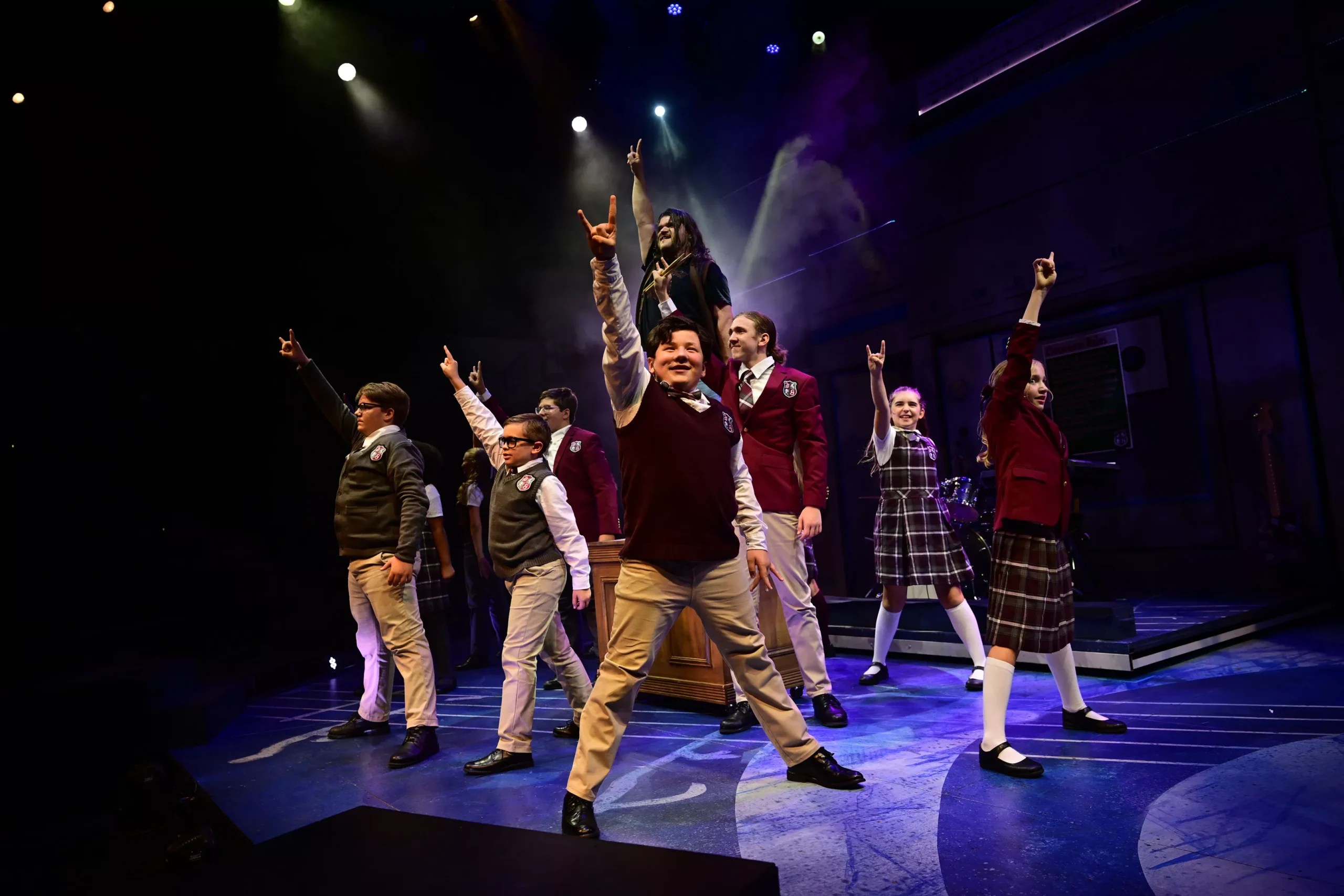
While the “School of Rock” musical follows the same story as the hit 2003 film upon which it was based, the musical delves deeper than the film’s source material. In addition to the inclusion of a slew of new songs, the musical version with music by Andrew Lloyd Webber, lyrics by Glenn Slater and a book by Julian Fellowes, gives us a better picture of some of the most important, yet overlooked, characters of “School of Rock”: the children.
Put into the simplest terms, “School of Rock” follows a down-on-his-luck musician as he tries to convert a class of stuffy fifth graders into rock stars. The film, written by Mike White and starring Jack Black, centers on Dewey, the aforementioned musician. While the children were always central to the story, the musical version gives them depth.
Under the direction of Terri J. Kent, Porthouse Theatre’s production taps into the heart of the show. Porthouse recognizes that the real stars of “School of Rock” are the kids, and it gives talented, young, up-and-coming actors plenty of room to embrace the spotlight.
Dewey Finn is a lead guitarist who has just been kicked out of his own band and is on the verge of being kicked out of his room for failing to pay the rent. When Dewey intercepts a phone call intended for his roommate, who is offered a lucrative teaching position as a substitute teacher for a private school, he wastes no time assuming his friend’s identity. Stuffy uniforms and strict rules grate against everything that Dewey stands for, but when he learns that his students are gifted musicians, he decides that he can secretly turn them into his bandmates, and together, they can win the upcoming Battle of the Bands competition.
Douglas F. Bailey II plays Dewey, the character originated by Jack Black, and he dons the role like a second skin. Having recently taken up the same role in Cain Park and Cassidy Theatre’s production of the show, it’s obvious that he’s had plenty of practice perfecting the vocal fluctuations and spasmodic movements quintessential to Black’s character. Bailey II feels at home performing and seems to be having a great time while doing so.
Riffing well with Bailey II is Morgan Thomas-Mills, who plays Dewey’s passive roommate and best friend, Ned Schneebly. His domineering girlfriend, Patty Di Marco, is well-played by a commanding Kiara Sylvie Durbin. Audra Casebier lends impressive, operatic vocals to the production in her role as the school’s uptight headmaster, Rosalie Mullins.
The ensemble of children on stage are both talented and passionate. They infuse a great energy into the show, which is best on display during the song “Stick It to the Man,” where they stomp and spin to Martín Céspedes’ choreography while singing about rebellion and breaking rules.
Some of the young actors playing instruments, and doing so pretty damn well, include Elliott Wancata as guitarist Zack Mooneyham, Liv Hoffman as bassist Katie, Axel Schmidt as drummer Freddie Hamilton and Josh DiSantis as keyboardist Lawrence.
Leading the group of student musicians, as well as a six-piece band off-stage, is music director Jennifer Korecki. While there were a few synchronization issues between the band on-stage and off during their first joint number, by the time of the penultimate song, the production had found its rhythm.
Embodying the achievement-driven, stickler-for-the-rules student Summer Hathaway is Parker Towns. In addition to having a great voice, Towns is an especially talented young actress who never lapses in her steadfast portrayal of the uptight, overly proper character. Also vocally strong are Ava Kimble, who plays Tomika, the shy and sweet transfer student who turns out to have a killer voice, and Mason Cooper Brosch, who plays Billy Sandford, the band’s enthusiastic, flamboyant stylist.
In addition to all of the plaid, uniform-clad students–dressed appropriately by costume designer Abbie Hagen–the “School of Rock” cast also includes an ensemble of actors depicting various parents and teachers. Some of the portrayals by the adults were a touch too dramatic and were played too large. By making the parents of the show into caricatures, the positive changes that develop within those characters by the end of the show have far less weight than if they were to be played with more gravity.
One thing the adult ensemble was not, however, was loud. If lowering the audio levels for the adults was an intentional design choice by sound designer Jeff Polunas as a statement about how the children finally have a chance to command the narrative, then it’s brilliant. But, even if it was intentional, a small bump to those levels certainly wouldn’t hurt.
The large cast of “School of Rock” could place a demand on Porthouse’s stage, but director Kent and stage manager Tom Humes ensure that everything, and everyone, knows their marks and moves about smoothly.
This also applies to Jonathon Taylor’s many set pieces, including Dewey’s bedroom, apartment and classroom, which all roll into view from the set’s backdrop: a giant DK cassette player. The cassette player is an inventive, fantastical backing to the action that is as fitting to the show as it is visually intriguing. It certainly pairs well with Jakyung C. Seo’s lighting design, which often emulates a rock concert.
Porthouse’s “School of Rock” is sure to entertain young and old audiences alike, but behind the story is something pretty beautiful: a handful of talented, young artists embracing music and performing their hearts out. And isn’t that the whole point?
“School of Rock” runs through August 3 at Porthouse Theatre, 3143 O’Neil Rd., Cuyahoga Falls. Visit kent.edu/porthouse or call (330) 672-3884 for tickets, $18-50.
Subscribe to Cleveland Scene newsletters.
Follow us: Apple News | Google News | NewsBreak | Reddit | Instagram | Facebook | Twitter | Or sign up for our RSS Feed
This article appears in Cleveland SCENE 7/16/25.