

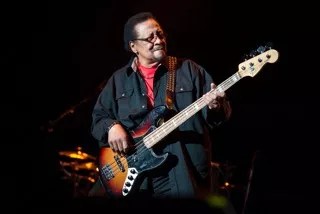
Featuring guitarists such as Zakk Wylde, Buddy Guy, Eric Johnson and Dweezil Zappa, the current tour features 27 dates in more than two dozen cities; at 7:30 p.m. on Tuesday, March 15, the tour comes to the Hard Rock Rocksino Northfield Park’s Hard Rock Live. Fans can expect to hear the all-star ensemble perform Hendrix favorites as “Purple Haze” and “Voodoo Child (Slight Return)” as Cox anchors a rhythm section that includes Stevie Ray Vaughan and Double Trouble drummer Chris Layton.
“Jimi was an icon and a genius,” he says via phone from a San Antonio tour stop. “He gave us his music and his music was so great. He wrote ‘in the now’ like Gershwin and Bach and Mozart and Handel. I knew that eventually one day — and I made this statement in the ’80s — the resurrection of Jimi and his music would come in 100, 200 or 300 years. I thought it would be years before it was rediscovered. Here, it’s come around 30 years later. Here we are. I’m blessed to still be around and be part of this.”
In 2004, the first Experience Hendrix Tour came to fruition with a three-date string of shows on the west coast, starting in Hendrix’s hometown of Seattle. Over time, it has blossomed into a successful tour that gives some of the world’s greatest guitar heroes the chance to pay homage to one of the first guitar heroes.
“Experience Hendrix has done an excellent job of putting the musicians together,” says Cox. “They all leave their egos at home and the idea is to make good music from the songs that Jimi Hendrix wrote. We have some of the greatest guitar players in the world. We have Zakk Wylde and Eric Johnson and Kenny Wayne Shepherd. I don’t want to mention them because I’ll leave a few out. In the past, we’ve had guys like Joe Satriani and Slash.”
Cox first met Hendrix when the two of them were both stationed in the army at Fort Campbell, Kentucky.
“I went to a movie and the movie let out, and I wound up at the doorstep of our apartments,” he recalls when asked about his first encounter with Hendrix. “It was raining. The window was up a couple of inches. Inside was this practice room. I heard this guitar player. I heard the uniqueness and I realized he was not that proficient. This friend of mine was with me and he said it sounded like a bunch of noise, but I knew better.”
Cox and Hendrix moved to Nashville and formed the King Kasuals. Hendrix would move to England, where he’d become a superstar; he’d eventually recruit Cox to join him in his Band of Gypsys, and Cox was at his side as he performed at Woodstock.
“Back then, people enjoyed even the small concerts,” says Cox. “There weren’t that many guitar players in the world. There weren’t that many bass players in the world. We had no trouble playing or becoming the house band. There weren’t enough musicians to go around. Today, it’s a different ballgame. There was a lot more freedom than there is today.”
Hendrix’s music continues to be played by new generations, and the Experience Hendrix tour draws from a diverse fanbase.
“Everyone comes out to these shows,” says Cox. “Jimi Hendrix’s music is unique because he wrote ‘in the now.’ In writing in the now, it gets passed down to different generations and transcends cultural boundaries. I’m waiting right now to go to Australia and New Zealand. So much of the fan mail comes from there and from Bangkok and Russia and Brazil and South America—all over the world. The music transcends boundaries. It’s drawn world-wide interest.”
While Hendrix was known for experimenting with drugs, Cox, 74, says he “takes care of his health.”
“I don’t drink anything,” he says. “I don’t smoke anything. I don’t shoot anything. I don’t live like that. When you’re aware of just how fragile the body is that the creator has given us, you have to take care of it. I do the best I can. I’m not a fanatic, but I try to do the things that are healthy and consequently I’m still here.”
This article appears in Mar 9-15, 2016.

Buddy Holly was the template for music executives to follow once a popular artist passed away; “new” albums and singles were released for a decade….until there was nothing left in the vault. It took the disappointing album sales of “Soundtrack Recordings from the Film Jimi Hendrix” – coupled with Eddie Kramer and Mitch Mitchell being pushed out of the gatekeeper’s role – for John Jansen (“Alex Trevor”) and then Alan Douglas to muddle the Hendrix legacy.
The later unofficial releases from tapes sold at auction by the estate of Michael Jeffery and leased through former Yameta Co. Ltd. attorney John Hillman were superior to the official studio work by Jansen and Douglas. But it was Jimi’s family finally gaining control of his estate that was the biggest victory for fans past. present and future to truly Experience Hendrix.