

One in four Cleveland households will see no benefit from the proposed new Innerbelt bridge because they don’t have cars. And, as research from some transportation advocates has found, the situation is even worse in the neighborhoods on either side of the proposed span.
On the Tremont side, according to NEO CANDO (a census database maintained by Case Western Reserve University), nearly 30 percent of households don’t have cars, as Green City Blue Lake’s Brad Chase discovered. And on the other side — the Central neighborhood, one of Cleveland’s poorest — nearly two-thirds (65 percent) of households lack access to a car, and therefore will see no benefit from the half-billion dollar bridge for which ODOT currently seeks approval.
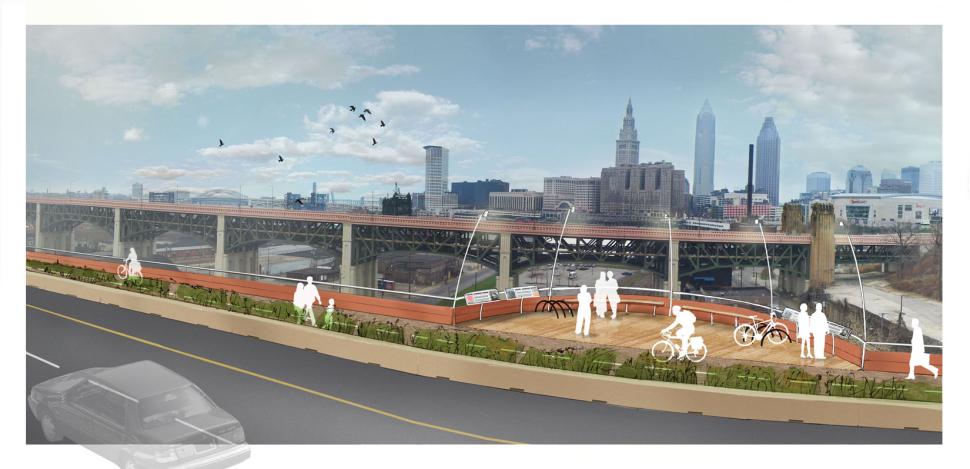
Advocates are hoping to get equitable treatment for those residents as the state transportation agency presents its proposals to NOACA, the regional planning agency which must approve ODOT’s plans. What they want is a lane for pedestrians and cyclists alongside the vehicular lanes, creating a safe, straight line that brings Tremont much closer to downtown.
They’ve got a rendering (right) of what such a lane might look like, thanks to the Cleveland Urban Design Cooperative. And thanks to ODOT, they’ve got a price tag. By ODOT’s own estimate of $20 million, it represents approximately four percent of the total project cost. Federal guidelines say the agency must consider pedestrian and bicycle access if it will be less than 20 percent of the overall cost, a standard this projection easily meets.
Activist groups Cleveland Bikes, the Ohio City Bicycle Co-Op and others hope to rally support for bike and pedestrian access at 2 p.m. Sunday, December 6, at Tremont’s Lincoln Park. They plan to ride ODOT’s recommended routes from Cleveland to downtown, which are as much as half a mile longer than the path of the proposed bridge, and to strategize about next steps.
“If you live in Tremont and want to walk downtown, or if you’re a tourist downtown and want to walk to Tremont restaurants — it’s not just a bike thing,” says Ohio City Bicycle Co-Op director Jim Sheehan.
One critical step is to get supporters to take time away from work from 10-10:30 a.m. Friday, December 11, when NOACA will hear public comments on ODOT’s proposal. The meeting is at NOACA’s offices at 1299 Superior Avenue. — Michael Gill
This article appears in Dec 2-8, 2009.
Well then hopefully they listen up and consider pedestrians and bike riders. Sounds like a relatively useless bridge, otherwise.
I completely disagree with spending at least $20 million to put pedestrian and bike lanes on the new innerbelt bridges for many reasons. First, to say people that don’t own cars on either side of the bridge won’t benefit from them is narrow-minded thinking. These people benefit in direct and indirect ways other than driving on it themselves. Riding RTA buses, taxis, and in cars driven by family and friends quickly move these people from one side to the other. Also do these people not benefit from safety forces (police, fire, ambulance) that are able to respond to their emergencies quicker because of the bridge? Second, it’s a safety issue. Isn’t the innerbelt bridge technically part of the Interstate highway system as I-90 & I-71 where speeds are at least 50mph? I don’t believe it’s legal for pedestrians and bicyclists to travel on any of the nation’s interstates. Plus, putting pedestrians and bicyclists on a bridge hundreds of feet in the air next to vehicles and trucks traveling at high rates of speed is asking for fatalities. Last, is the convenience factor. Cleveland Bikes and Ohio City Bicycle Co-Op say the current paths to downtown are “as much as a half mile longer” than the current bridge path. So, at the most one has to go is a half mile further. For someone who likes to bike and walk, is a half-mile really that much further. And, I had to laugh when I read Ohio City Bicycle Co-Op Director Jim Sheehan’s quote that tourists are wanting to walk from downtown Cleveland to Tremont. Who are you kidding? These people (if they actually exist) would rather walk in unsafe conditions on the bridge rather than through the city’s streets and bridges already in place (Lorain-Carnegie and Detroit-Superior bridges come to mind)? I don’t think so. Let’s not bloat this project with more money and potentially put people in harm’s way.
Nope, sorry, it’s not a safety issue. Obviously you didn’t see the success of the new bike/pedestrian lane on the Woodrow Wilson Bridge this summer – over the Potomac along I-95/495, an interstate highway (gasp!) – hundreds of feet in the air (gasp!). The design was just awarded an “Outstanding Achievement Award’ from the American Society of Civil Engineers. Oops.
Your thinking is narrow-minded. It’s the kind of thinking that’s kept Cleveland in the pits. Neat, let’s build another bridge similar to the original built in 1959! We could immediately put a historical plaque on it during bridge dedication. While we’re at it, maybe make a celebration fire on the river underneath to remember those good times.
I’d suggest you take a look around the world. Check out how modern bridges are designed for multi-modal capacity.
Dear “Double A” —
Bicycle (and pedestrian) safety is foremost in my mind (teaching that is one of the main things we do at the Ohio City Bicycle Co-Op). “Blitzen” addressed that red herring well, but I’ll add that putting more bikes on the Hope (Lorain-Carnegie) bridge has safety consequences far more serious than even the most basic treatment of space on the new bridge would be legally able to get (let alone the very extensive treatment pictured in the artists’ concept that illustrated this article). Here’s why:
New bridge facility:
1. Wide, dedicated space, with separate designated spaces for cyclists and walkers
2. Separated from motor traffic by a concrete barrier and a 17ft. wide breakdown lane
3. Motor traffic usually traveling at ~ 60mph (despite legal speed limit of 50mph).
4. Intersections at both ends designed according to modern best practices.
Bike facility on Hope (Lorain-Carnegie) bridge:
1. Many cyclists use the ~8 ft sidewalks, as the 5ft bike lane is often full of broken glass.
2. The bike lane is separated from motor traffic by a faint 5 inch wide line of white paint.
3. Motor traffic usually traveling at ~ 45mph (despite legal speed limit of 35mph).
4. Cyclists (and pedestrians) facilities at both ends are shoehorned in with minimal consideration.
Finally, I’m glad you got a laugh from reading my quote, but walking an extra mile to get to work and back while you watch motorist zip across a shorter, brand new, $450,000,000 bridge that you could be arrested for using is not that funny. I know what you found funny was the idea of tourists using this bridge, not folks who need it to get around; and, evidently the fact that it would cost money to accomplish: first, look at the pictures of bridges elsewhere that are posted at gcbl.org/innerbelt and then think about who laughed at what we spent to lure tourists here to see the Indians, Cavs, Browns, Rock and Roll memorabilia, etc.
I invite you to join us this Sunday to continue this discussion of the fine points of this issue — that is a large part of why we’ll be out there walking and riding that extra distance; to see what it really feels like.
Jim Sheehan,
Ohio City Bicycle Co-op
The I-90/71 Bridge is a chance to get bike access right, right from the start. Designing access now will provide a dramatic, beautiful, healthy and practical connection to downtown Cleveland. Whether they bike, walk or drive, the Innerbelt Bridge should be available for all, not just those driving to or through downtown Cleveland. At least 30 communities already benefit from cycling and pedestrian access to an interstate highway bridge. In many cases, these are dramatic and beautiful shared spaces that enhance the city’s life.
Investing in cycling infrastructure, by providing access to the innerbelt bridge, would improve safety. Bicycles account for 10% of trips, 13% of fatalities, but only 1% of federal funding. The more we provide for cycling and pedestrians, the safer these modes of transportation become. By saying no, ODOT is sacrificing pedestrian and cyclist safety and health for the benefit of motorized vehicular traffic.
For most Americans, transportation is an expense second only to housing (higher than health care, education and food). Even before runaway gas prices, the average American spends 19% of their income on transportation, with households that heavily rely on cars for transportation spending 50% or more. Based on AAA reports of typical transportation costs 56.1cents/ mile and $5 daily parking, typical car commuter costs are more than $11,500/year. Providing more biking and walking opportunities is a practical, healthy, financially sensible investment for the region.
I am in support of the Bridge for both the automotive reasons and the Bicycle Pedestrian reasons. From being located just south of Downtown my activities there are limited by;
By car: Lack of parking, Costs of parking, costs of gas, traffic congestion, delay times damages to my vehicle.
By bicycle, foot, or other mobility device: No direct access to downtown, steep inclines in and out of the valley, canal, and river areas, competing with the flow of traffic (whats shared and what isn’t)
I like like to bicycle downtown for enjoyment, and have a neighbor that does out of necessity, and another out of the idealism of it, and another for… . Lets face it, if its not easy (or practical to do)… we’re not apt to do it. Lets open the area up for everyone.
Being a “transplant” to CLE, it would be great to invite my friends from Akron and Summit Co. to “Bike-Aboard” the CVSR for 2 bucks, meet me here____, ride downtown to take in a show, game, concert, event, and catch a meal at Bistro _____. Or freinds from the southern suburbs could catch the Big Valley Parkway to the Brookside reservation and meet me here____, and have the same kind of day. Lets have fun downtown, encourage others to do the same, every little bit helps rejuvenates the environment, economy, health, and relations. It just has to be safe, practical, reasonable, and appealing to do so.
So who’s with me… Is a dollar spent in the infrastructure of CLE well spent?, but a vast improvement to the quality of life here, not to mention the vast improvements of employment opportunities, environmental, financial and health impacts? You decide and please voice your YA of NAY opinion at the rally this Sunday.
Both the Lorain Carnegie and Detroit Superior Bridges are scary routes to get to Downtown from the Near West Side.
The Carnegie Bridge bike lane also serves as a break down lane and is always filled with glass. Cars go about 20 miles over the speed limit.
The Detroit Superior Bridge so-called bike lanes disappear in the middle of busy intersections at both ends and the westbound bike line disappears and then reappears IN THE MIDDLE OF THE BRIDGE!
I don’t like cutting through the Flats because of terribly rutted roads, fast industrial truck traffic and the prospect of being a female and getting a flat in the Flats.
Yes, please add a dedicated, safe bike lane to the new bridge!