

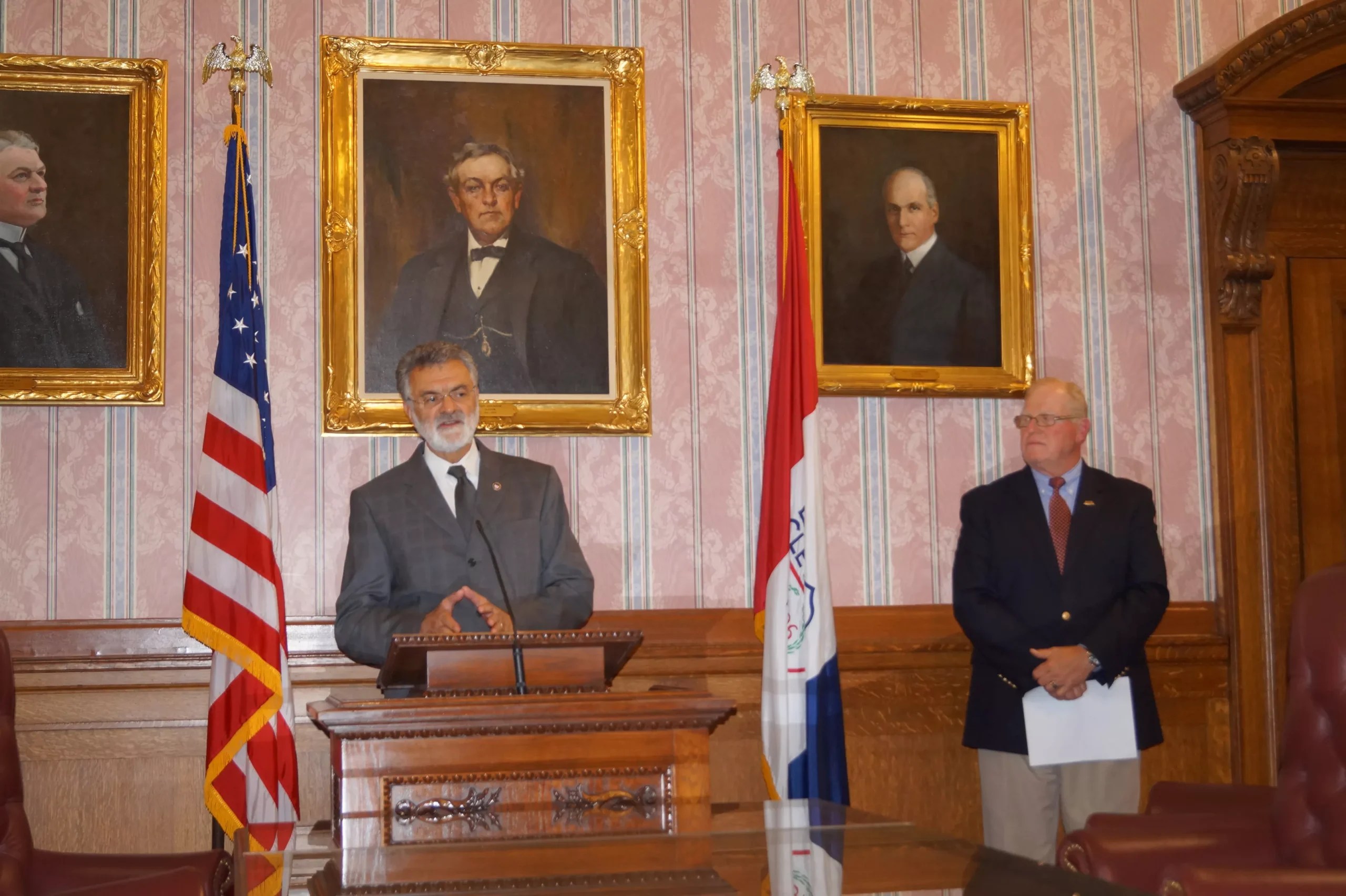
The Public Square stretch of Superior Avenue was supposed to have opened to buses on August 1 but has been barricaded ever since the RNC. Jackson said there would be capital costs involved in “removing the street portion” to create the “unified Square” he’s always preferred. But that won’t happen until the city gets the go-ahead from the Federal Transit Administration (FTA).
Jackson and Calabrese spoke to a small battery of reporters who’d managed to make it to City Hall in time, having been assembled on short notice — a 5:39 p.m. email announcing a 5:45 p.m. press conference.
In opening remarks, Jackson said the decision had been made in the “best interest” of the general public.
“This became more of a conversation — more intense — after the ribbon cutting,” he said. “We are going to be engaging with our operations people, our traffic engineering, our police commission, to look at ways to mitigate the impact that this closure has on the transit zone.”
Jackson said that, working with RTA, the city will come up with a comprehensive plan within 10-14 days and seek concurrence with the FTA, after which time the 600-foot strip of Superior Avenue can be removed.
“The concerns that we’ve heard are the impact of going around the square as opposed to through it,” Joe Calabrese said, taking the Red Room mic to elaborate. “But we’re going to look at the whole transit zone and use some strategies that have been successful to more than make up for the delays at Public Square.” (Italics added.)
Calabrese referenced dedicated traffic lanes and/or traffic signal prioritization on St. Clair and Superior Avenues between W. 3rd and E. 18th / E. 12th, respectively.
“We hope to show the FTA that this will be an even better program for greater Cleveland,” Calabrese said
The announcement came as a surprise, especially after public transit advocates have so strenuously campaigned for Public Square to re-open. Just last week, a web developer and transparent-government enthusiast named Melanie Mazanec, who lives in Chicago, created PublicSquander.com, a site where you can track the dollars lost due to bus re-routing in real time.
Calabrese said he wasn’t sure if that figure (about $1.5 million annually) was accurate. Jackson questioned whether there were even any delays due to re-routing at all.
“The advocates were more concerned about whether or not they would be prohibited from using buses in an efficient way, whether their life was going to be more difficult with the buses going around the Square,” Jackson said.
“Some would argue that the six or seven-minute delay around the Square does present a challenge,” a reporter responded.
“That’s an assumption that may not be a fact, about a six or seven minute delay,” Jackson said. “That may not be a fact.”
“Well I’ve seen people time it,” the reporter pressed.
“We have professionals here, not only with our police, but with our traffic engineers and RTA people that would give you another [number].”
Calabrese chimed in: “If we lose a little time going through 600 feet, we can gain time going through the other several blocks, so there’s a net benefit, not a net loss.”
Throughout the tense Q&A, Jackson denied that the Square had been designed specifically for bus traffic — “It was designed specifically for people,” he clarified — and that this had been his master plan all along.
“Everybody knows the conspiracy, don’t they?” Jackson responded to a reporter. “People can believe what they want to believe, and it was not that. In our initial conversations with RTA, I said to them, ‘You know what my preference is, but if you can demonstrate to us that there’s an operational and financial harm to RTA, then I will accept that.'”
Evidently (and miraculously, given the preponderance of evidence), no operational or financial harm was sufficiently demonstrated.
Moreover, Jackson continually cited “people” who had agitated for a unified Public Square. He admitted, though, that there had been no polling or data gathering to determine the public’s opinions on the issue.
“Best interest of the general public,” then, rings deafeningly off-key. And with with this much time invested in, one would assume, studying the effects and costs of the closure, the lack of answers proves dishearteningly sad yet predictable.
*Correction: The FTA is the Federal Transit Administration, not Authority.
This article appears in Nov 9-15, 2016.

Why not treat public square as a roundabout? It’s basically already set up that way. Leave the traffic lights for pedestrian traffic, but have them default to green when there aren’t pedestrians using the crosswalks.
This article presents the matter as a one-sided issue, and as anyone who frequents the new Public Square can tell you, it is not. The Square has become the vibrant hub of pedestrian activity that it was always supposed to be, and it would be disingenuous to suggest that this massive public benefit would be unaffected by having any traffic, let alone busses, cutting right through the middle of it. I understand people feeling misled by the way this was handled, but to write this article without even acknowledging the significant upside of the Mayor’s decision seems unfair.
Mayor Jackson did the right thing. There are other streets buses can use. Keep them out of Cleveland’s Central Park. Keep rising Cleveland!
While I fully understand the bus congestion relieved by the shortcut on Superior, I have to say that as a human, I’m going to feel much more at peace in a square without buses. Maybe it was silly not to design it that way to begin with, but I have to believe that prioritizing buses elsewhere downtown and prioritizing pedestrians on Public Square will make Cleveland more of a real city. It’s a crying shame the Red Line wasn’t built as a subway as proposed almost 100 years ago…there would be far less need for buses on Public Square, seeing as subway cars have much higher capacitybuses from far-flung areas would only need to get to a subway or el station to transfer…but our Red Line today only goes to Tower City. Having more than one station downtown would have really helped for the Cavs parade!
I’m one of the people that rides a bus. There are times when the bus is sitting there for close to 10 minutes trying to get around the Square. In the meantime, people are just crossing the street whenever and wherever they like. Cars go into whatever lanes they feel like, even when the lane is marked as a bus lane. If they are going to keep the Square closed, then during morning and evening rush hour it should be buses only going around it. There are plenty of other streets that cars can go down.
I think it would have been better for all if Superior and Ontario streets run under the square and a bus terminal there for people to wait for buses out of the weather .