


Cardale Jones took off on another Twitter spree two weeks ago. He does that. But this time, the guy once best known for famously tweeting that he didn’t come to Ohio State to “play school” was taking on social issues and incisively beating back condescending replies.
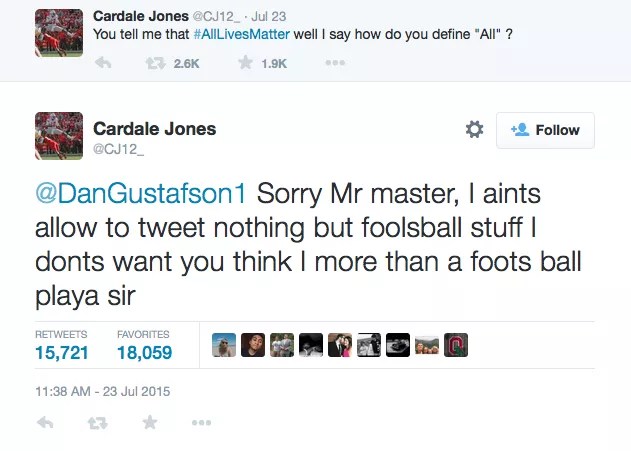
This particular late July day’s thoughts started with Jones sharing the #BlackLivesMatter hashtag. Then discussing the #AllLivesMatter responses he received. Then making national headlines with his retort to someone who told Jones to “worry about getting us fans another national championship…stay out of this bullshit.””Sorry Mr. master,” Jones replied. “I aints allow to tweet nothing but foolsball stuff I donts want you to think I more than a foots ball playa sir.”
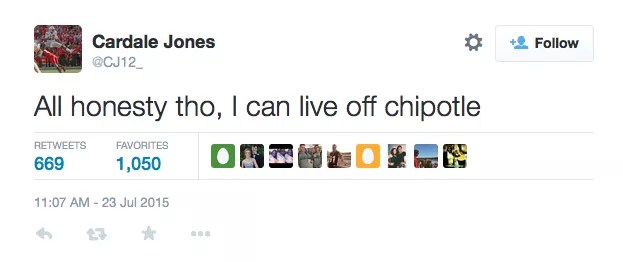
Even Buckeye haters had to love it; many of them tweeted as much. The territorial lines are drawn hard and fast in college football, and in recent years many have looked at the Big Ten with a mix of hatred and pity. They found bogeymen in Terrelle Pryor and Jim Tressel, for different reasons. In Jones, champion of college football and Twitter and eating at Chipotle, even parochially inclined SEC diehards have found someone worth enjoying — and maybe even rooting for.
The Year of Cardale rolls on. Like he did with a first-drive touchdown pass in the Big Ten Championship, and later when Alabama’s Landon Collins tried to take him down in the open field in the Sugar Bowl, he’s crushed it.
From afterthought on the cusp of having to transfer to winning three trophy games and having to turn down the NFL, Jones has turned six weeks to savor into a seven-month run of success and fame. Since last Nov. 29, when he went from never having played a significant down to being thrust onto the national stage after J.T. Barrett broke his ankle against Michigan, the 22-year-old Cleveland native has grown up fast and in front of a growing audience and has shown no signs of slowing down or even needing a breather.
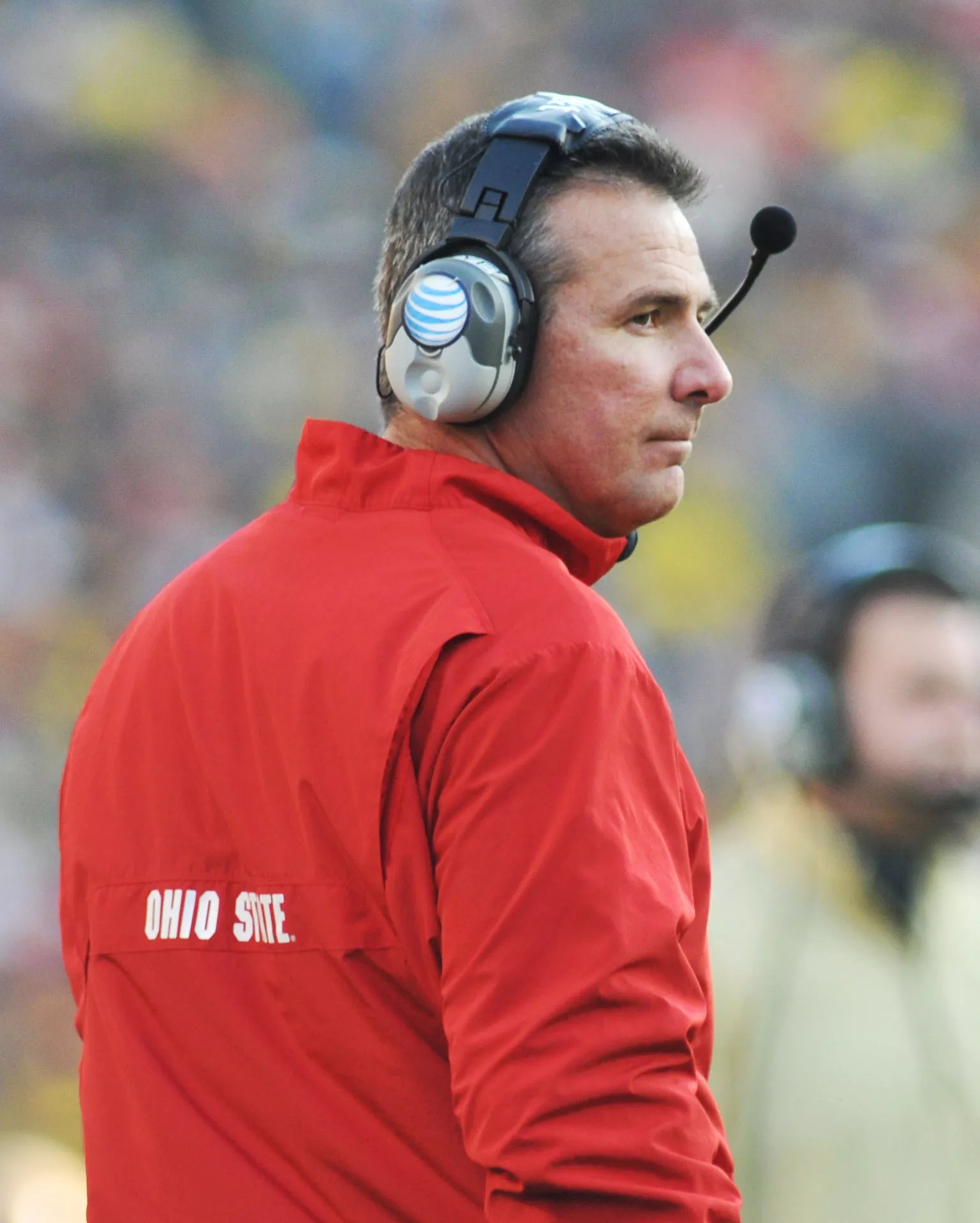
Once a frequent visitor to the office of Ohio State coach Urban Meyer to discuss questions of maturity and focus, Jones and his coach raised the national championship trophy together in Dallas last January, then huddled together in Cleveland 48 hours later to discuss whether Jones would immediately ride his momentum to the NFL. Those meetings were initially private but not much else has been for Jones, who’s become one of America’s most talked-about athletes while still convincing people that he’s actually a student-athlete, not a bored jock whose strongly worded, ill-timed tweets landed him a long-lasting place in Meyer’s doghouse his first year in Columbus.
For those keeping tabs: Jones went from an inner-city high school, to one year of military school, to one year as a redshirt, to two years mostly watching and then, finally, one of the most improbable, out-of-nowhere success stories anyone can remember — three starts, three trophies, three of the biggest wins in Buckeye history — to not even being guaranteed the starting spot when Ohio State begins its title defense on Sept. 7. Barrett is healthy again, and the pressure is high with a camp competition for the starting job looming.
In what might be the most talented and complicated quarterback room in college football history, Jones is the only one in the room with prototype NFL size and skills, and the only one who’s undefeated, on the field and on Twitter, where he shows a humor, a charm, a personality, and gives off a feeling his 15 minutes isn’t going to expire anytime soon.
The question is this: Now that so much has changed, does he need to change too?
Ask Jones for the best story about being recognized or the best part about being suddenly famous, as I did last month, and that smile that can light up a stadium lights up the room.
“I got a lot of Twitter followers,” Jones says.
The best guess of a couple people close to the Ohio State program is that Jones had around 17,000 Twitter followers when he entered that Michigan game in the fourth quarter. He had almost triple that the following week, more than 150,000 by March and at last count had 232,000.
Jones, lighthearted as always, was back to his normal dispatches by the weekend after the “Mr. Master” tweet, posting videos of himself performing pro wrestling-like maneuvers on a child at a swimming pool. He’ll post an occasional Bible verse, words of wisdom passed along by some coach or a book or even an Internet meme, or his banal thoughts on what he plans to do — or not do — on a particular day. Jones ran the fella who told the QB to “stay out of this bullshit” right off Twitter altogether, and it wasn’t the first time the superstar engaged in a debate on social issues. He can be a Twitter activist. But mostly, he tweets about burritos.
What we most know about the Cardale Jones Experience is that it’s fueled by Chipotle, which conveniently has two locations on or adjacent to Ohio State’s campus.
He’s still at least seven months away from being able to officially endorse Chipotle or anything else for money; for now, he can’t even accept a free burrito for fear of the NCAA’s highly anal and hypocritical eligibility police finding out. He’s famous without being rich, a social designation held mainly by college athletes.
And that fame has come quickly. It’s all very new to Jones.
“Just being in airports and people are just clapping and freaking out …that’s pretty sweet,” he says. “But it’s pretty weird too.”
Not that long ago, he was a third-stringer sitting in his apartment playing Call of Duty. Now he’s flying with Meyer to Los Angeles for the ESPY Awards and tweeting to UFC champion Ronda Rousey and famous-for-something Kylie Jenner about meeting up.
There’s a newfound sense of responsibility that comes with that territory, to sign every autograph, to smile for every selfie, to try and oblige every reasonable request. (On that last front, Jones has plenty of his own. One example: He asked the Cleveland Indians — via Twitter, of course — to let him throw out a ceremonial first pitch; the team obliged.)
But there’s also a struggle to act responsibly in very real and basic ways.
An example:
Before Jones spent 45 minutes in early July posing for pictures and shaking hands at a fundraising event at Sandusky’s Kalahari Resort and Waterpark, he was calling two of the most important men in his life to tell them he had just finished a workout and was running a little late.
Jones swears he called Meyer and Ted Ginn Sr., the event’s namesake, to let them know his situation. And, truth be told, there was construction on the Ohio turnpike and a small-town funeral procession had clogged some of the back roads. Either way, upon arrival, Jones tried to casually blend in near the entrance until he was waved to the stage.
Jones, of course, blends in nowhere these days, at least not in Ohio. He eventually received a prolonged standing ovation that was followed by Meyer taking the microphone.
“He’s either late because he was stuck in traffic,” Meyer said, “or he’s late because he’s Cardale.”
Chronic tardiness, as the stories go, was a staple for Jones in Meyer’s first two-plus seasons as Ohio State’s coach. That went for football meetings and activities. When it came to class, he sometimes wouldn’t go at all. Though he was actually a better than 3.0 student at the time of his “classes are POINTLESS” and “we came to play football” tweets in 2012, they’re now characterized as the kind of lapse in judgment and lack of awareness that held Jones back — and almost pushed him out of Ohio State altogether.
“Coach Meyer never asked me to change who I am,” Jones said. “He just wanted me to take things more seriously. I’ll say it. I wasn’t living up to the standards.”
On the banquet circuit last spring, Meyer told the story of those first viral tweets — remember, kids, that the delete button is largely worthless — and how he wasn’t even sure at first what Twitter was and how they’d been so largely disseminated.
“I was just thinking I was going to jump his ass when I got ahold of him,” Meyer said.
Fast forward 30 months and Jones decided to play a Twitter prank that might have had Meyer wanting to jump his ass again. It was May 1. He grabbed his phone and fired off a series of tweets saying he was transferring to the University of Akron. He thanked Buckeye Nation for everything and said he was ready for a new challenge. The immediate responses varied from calling him a liar, to disbelief, to Akron students telling him he’d love the new Chipotle that recently opened on the west end of campus.
Eventually, Jones came clean, calling it a “May Fool’s” joke. It was a Friday afternoon at a light football time of the year, so maybe his timing was good; Meyer didn’t find out about the Akron tweets until much later. Jones got plenty of response from inside the Ohio State football building though — “Cardale, quit being a dumbass,” basically — and it quickly faded away.
Asked this summer about those Akron tweets, Jones says he was pretty sure that Meyer didn’t know about them and firm that “it will never happen again. The real, honest, true story is I really thought it was April 1. April Fool’s Day. Honestly.”
That’s his story, and he’s sticking to it.
Meyer wants it to be known that he never said Jones was a bad kid. He’s been coaching — and winning — for a long time, and he’s seen lots of kids who need a push, who respond to different motivations, who initially think classes are pointless.
Some last. Some don’t.
“[Cardale is] a very good person,” Meyer says. “His stuff is just stuff, he’s late for this … it’s stuff. It’s not the headline news. He’s got incredible leadership skills, but they’ve been hidden. We keep trying to pull them out.”
It’s probably not coincidence that Meyer has reinforced in recent public comments that leadership ability and “the whole package” will weigh heavily in the ultimate decision as to who starts at quarterback for the Buckeyes this season. It’s no coincidence either that he’s mentioned the impressive leadership skills Jones has shown, even if they need some dusting.
He knows, after all, that Jones spends a lot of time on Twitter, where all things Buckeyes are discussed freely and openly. The two have had their own free and open discussions too, back when Meyer’s concerns ran deeper than what kind of salsa Jones prefers on his burritos.
At points in both 2012 and 2013, Meyer was unsure Jones would even remain at Ohio State. When the coaching staff pushed its priorities on Jones, he sometimes pushed back. Sometimes, he didn’t respond at all. Meyer didn’t recruit Jones, and in the college football world that’s often an easy way out for both parties. But Jones wasn’t making anything easy.
So well after the first round of tweets and a handful of other incidents, there was a meeting. It was in Meyer’s office, and it was about Jones, and his antics, and his decisions, and his future. His high school coach, Ted Ginn Sr., and his non-legal guardian, Michelle Nash, were there too.
Meyer has a policy for such meetings. Essentially, all who are close to and care about the player are welcome. They’re also welcome to bring their opinions, just not any excuses.
Both sides present their cases and when the meeting ends, it’s either Meyer’s way or Interstate 71.
And though Meyer admitted last spring that it was mostly “nonsense” that had left Jones “with one foot out the door” before the air was cleared, that meeting took place and no excuses were made.
Ginn, the former school security guard turned Ginn Academy namesake, is the longtime football coach at Cleveland’s Glenville High School. Ginn is in the business of changing and saving lives — winning football games is secondary, he’s long said. The Glenville program had produced 2006 Heisman Trophy winner Troy Smith, eventual first-round NFL picks Ted Ginn Jr. and Donte Whitner, and has sent as many as a dozen players to Division I college programs in a single year. That’s a credit to Ginn, who knew Cardale Jones before Jones was even in middle school, because Jones would hang around Glenville football practices.
Florence Jones raised six children, working multiple jobs while trying to make ends meet. Cardale, her youngest, has said he never knew his father. With Cardale struggling early in high school and in danger of falling in with the wrong crowd, Ginn contacted Nash, a longtime friend, and asked her to serve as a mentor of sorts to Jones, to provide meals and an ear and things his mother could not. Jones eventually moved in with Nash, who has no children of her own, and has referred to her as his guardian and surrogate mother.
Asked what he remembers about that meeting in Meyer’s office, Jones said: “Just the simple fact that Coach Meyer talks about how those meetings usually go, how the parents or what he calls ‘a third uncle’ ask why they kid is getting treated a certain way. [He says] they point the finger and play the blame game. My mom wasn’t like that at all. Coach Ginn wasn’t like that at all.
“My mom came away from that meeting knowing Coach Meyer had my best interest in mind, not just as a football player but as a person and a student at Ohio State.”
Said Meyer of the meeting: “It was real. There were hugs, tears, confessions — the whole deal. We came out okay.”
There was an understanding, and also conditions, and also some more bumps on the road. Tom Herman, Ohio State’s quarterbacks coach and offensive coordinator for the past three seasons, made Jones sign a contract stating he could miss only a certain number of classes and maintain a certain grade-point average or he would lose his scholarship. At one point last year, Herman made Jones wear a dunce cap in a quarterback meeting when he wasn’t meeting his responsibilities.
As recently as the week of that famous Michigan game last November, Jones was back in Meyer’s doghouse. Ohio State safety Tyvis Powell, a longtime friend and roommate of Jones, told reporters that Jones “got into it with the coaches about some [academic issue]. I think he didn’t go to tutoring or something like that and they were going to take his tickets. And Cardale was like, ‘I don’t care because I’m not playing anyway, so I don’t care what you do. He said, ‘I think they forgot that I don’t play.’
“But after that day, I think that’s when I saw him change and be more focused and watch more film and throw the ball more to receivers. All the way up to [that] game, Cardale was like, ‘For what? What am I going to do that for?’ And then, boom, he ended up playing.”
In the week leading up to his first start in the Big Ten Championship game vs. Wisconsin, Ginn told everyone who asked that “people will be surprised” and said that Jones was ready not only for Wisconsin and a week of preparation as a starter, but for everything that would come with success.
And now?
“A lot has changed, but the goals are the same,” Ginn says. “He was confident before. He was prepared before. People just didn’t know it. Some of that was Cardale’s fault. He made some mistakes, sure. Those are in the past. Now that he really sees what’s in front of him, it’s all about going forward.”
Does Ginn have any doubts?
“He’s a grown man,” Ginn says. “He’s blessed and ready for all of this.”
There was another meeting involving Jones, Urban Meyer, coach Ginn and his guardian Michelle Nash.
There were a few of them, actually.
Ohio State won the national title on a Monday night and flew home on Tuesday afternoon. Thursday at 4 p.m. was the NFL’s deadline for eligible underclassmen to announce their intentions to enter the 2015 NFL draft, and Jones had played well enough in those three magically improbable games that he had a decision to make.
He knew it. Meyer knew it. Ginn knew it.
None of them slept.
Jones drove from Columbus to Cleveland, to Nash’s house, to his old Glenville neighborhood, to his young daughter, Chloe, born last November. He tried to process everything — not just the pending decision, but all that had happened in the prior six weeks — and stayed in contact with Ginn and Meyer, who worked the phones with their NFL contacts to get the most accurate information on how teams regarded Jones, a new and previously unknown commodity.
Their basic quest was to find out how much money Jones would be starting at — or pushing off. He’s listed at 6-foot-5, 250 pounds, and anybody standing next to him might question if that’s undershooting it a bit. In those three games he showed an NFL-type arm and athleticism most 250-pounders don’t have, and it’s not a leap to think that in the quarterback-needy NFL, raw talent would outweigh relative inexperience and the occasional bout of immaturity.
Meyer had put off previously planned recruiting trips to work with Jones and Ginn on the decision. On that Thursday morning, they met, again, and Jones told Meyer that he planned to return to school. Meyer then flew out of Cleveland but nobody else knew a decision had been made. The planned announcement for that afternoon in the gymnasium at Ginn Academy would still go on and be carried live across Ohio and also on ESPN and NFL Network. This was the rarified air Cardale Jones had climbed to in the course of two months.
Generally, players hold formal, and fancy, press conferences only if they’re announcing that they’re headed to the NFL. That’s what the Twitter prognosticators believed, and an announcement that the press conference had been pushed back 45 minutes only built the drama.
When the time came for Jones to make his announcement, Ginn retreated to a corner of the stage, clicked a few buttons and cued up Drake’s “Started from the Bottom.” At the podium, Cleveland Municipal School District director of athletics and master of ceremonies Leonard Jackson bellowed, “Oh, he started from the bottom, he did, he did.”
Escorted by uniformed security guards like he was headed to the ring for a prize fight, Jones emerged from an adjacent hallway to a standing ovation. He took the podium, quickly took stock of the dozen or so TV cameras, the faces of every age and color scattered across the gym, then asked for a moment to thank everyone for coming and to thank everyone who’d helped him prepare for the five weeks and three games that had changed his life. Jones then said he had an announcement to make, and that his “decision was very simple.”
He was coming back to school.
Jones talked about having time to chase his football dreams, the importance of education, how difficult it was to make such an important decision in such a short amount of time and how “it’s my life,” and it wouldn’t be affected by outside perceptions.
He was, quite frankly, the adult in the room.
He started at the bottom — he did, he did — and now he’s here. Being atop the football world usually means there’s only one way to go thereafter, but the way things have gone for Jones to this point leads you to believe that he’ll be able to remain his fun-loving self. Imperfect but perfectly happy.
He scoffed at the notion (in person and later on Twitter) that he’s been a class clown in the past, but he very well knows his track record. And he now knows more about the spotlight and standing ovations and expectations than he ever could have dreamed before too.
“I think I can still be myself and have major accomplishments,” Jones said.
With nothing won and everything on the table in a competition that will take place mostly behind locked gates, Jones in a sense will be starting from the bottom again. The coaches picked Barrett in a pinch last August after Braxton Miller’s shoulder injury, and Barrett led Ohio State to nine straight wins after a slow start.
Meyer has said the shock of Barrett’s injury wore off quickly because the Buckeyes were peaking and needed to beat Wisconsin the following week in Indianapolis to keep their quest for a berth in the first College Football Playoff alive. The way Meyer tells it now, coaches and players alike believed in Jones, and the game plan was in no way watered down or made more conservative based on his inexperience or any lack of trust.
There was one rule though, and that rule was drilled into Jones starting that Monday afternoon. He was free to use that big right arm and rip the ball down the sidelines, as he eventually did, but he was told not to make any throws between the hashes to the middle of the field, where the defense is often waiting and novice quarterbacks often go in a panic.
Ohio State scored less than two minutes into the game when Jones threw a 39-yard touchdown pass to the speedy Devin Smith down the right sideline, well outside the hashmark and the imaginary boundary the coaching staff had given him.
On the next possession though, Jones either didn’t like or didn’t see his initial read. He moved around, scanned the field and eventually whizzed a fastball into the middle, where a group of defenders were waiting and another couple were closing fast. It fell incomplete but could have been intercepted, and Meyer was livid.
As the coach approached the new quarterback on the sideline, his face as red as the jersey Jones was wearing, Jones managed to get the first word in.
“I’m sorry, Coach,” Jones said. “I know I’m not supposed to throw it there. It won’t happen again.”
Somewhere between then and the 52 other points Ohio State scored that night, that one mistake was forgiven.
But not forgotten.
Maybe it was just a brain freeze, a nervous guy in a new spot either caught in the moment or too confident in his arm. Or maybe it was just Jones testing Meyer, testing their level of trust and pushing back against a guy who almost always does the pushing. It wasn’t the first time.
A big kid who clearly relishes the big stage, Jones is on quite a run. Meyer has been watching, is still evaluating and holds the keys. Whether or not he’s willing to hand them over on a full-time basis will be decided sometime between now and Labor Day.
Buckle up, Buckeye fans. He might not always hop in the car on time, but neither a detour nor a posted speed limit has slowed Jones thus far.
This article appears in Aug 5-11, 2015.
Jesus. You could have just…not written this. “these college players need to be more perfectish” is such a boring trope. especially because they’re almost always written about Black players. think of how much worse White players have to act to warrant similar pieces. yuck.
Huh? What was the problem with this piece exactly? I enjoyed the write-up on Cardale, and thought this was well worth my time. It’s always nice to learn a little bit more about the behind the scenes stuff that you don’t always hear about, and I heard new things in this article that I previously hadn’t been aware of before.
Good luck to Cardale, and good luck to the Bucks. Here’s to this year!
Growing up in public has unfortunately become a major industry in the 24/7/365 Reality TV of sports-entertainment pop culture.