

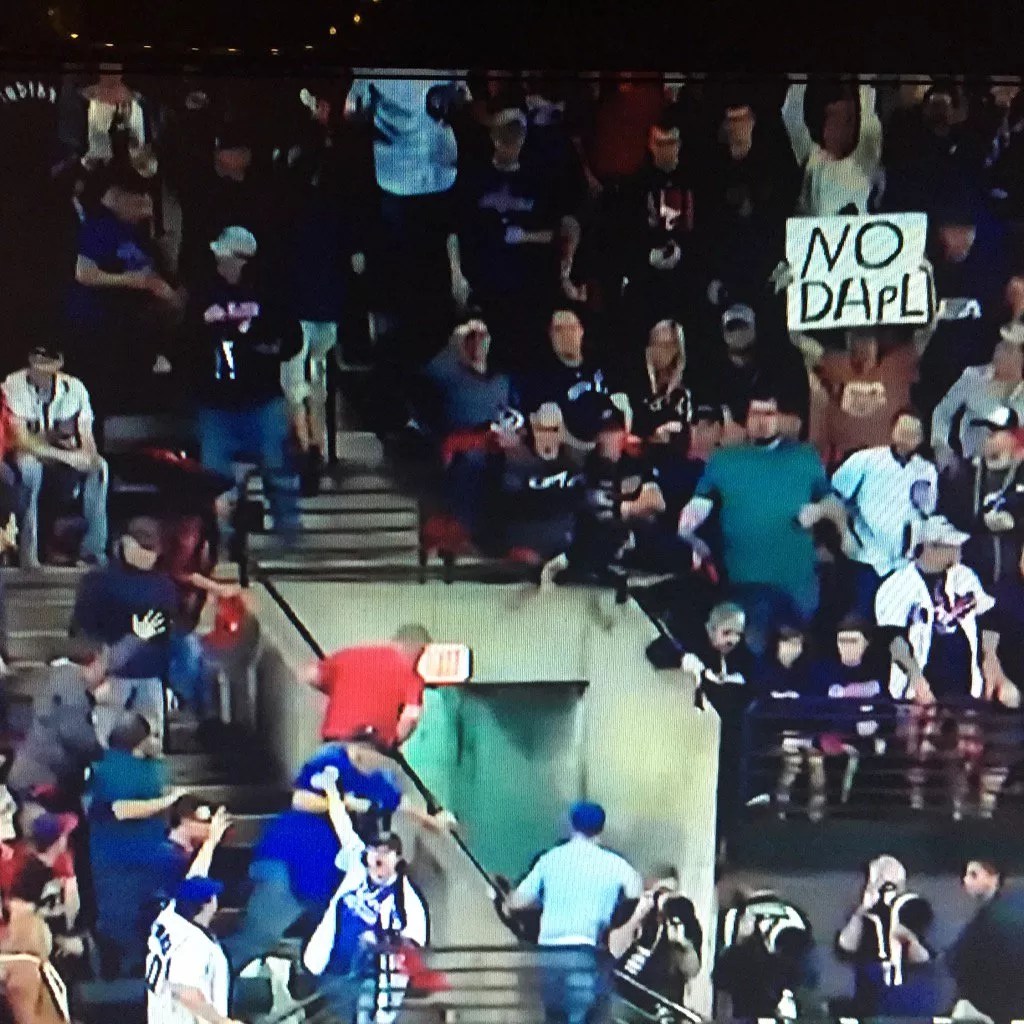
That’s the hashtag in protest of the Dakota Access Pipeline, the $3.8 billion construction of which has inspired the most significant protest by Native Americans in decades. Cleveland Chiricahua Apache Robert Roche, who went to North Dakota’s Standing Rock Reservation last month and intends to return, told Scene that people out there were calling it “the new Wounded Knee.”
Recent clashes between militarized security forces, (some from local police agencies; some furnished by states like Ohio; and some, with shady international ties, hired by the pipeline’s owner Energy Transfer Partners) and the protesters, largely Native Americans who refer to themselves as Water Protectors, have galvanized a corps of celebrity supporters and social media activists and pushed long-overdue conversations into the national spotlight: conversations about the environment, about the value of human beings vs. corporate profits, and about the United States’ appalling track record with indigenous peoples.
That the track record is appalling is beyond dispute. It continues to this day in the systematic disregard and circumvention of land treaties, treaties that have been systematically disregarded and circumvented for centuries, usually at the behest of American business interests. See, e.g. the Black Hills Gold Rush.
What is still disputed — and hotly, these days — is how native mascotry fits in to the copious fabric of American abuse toward native peoples. During the World Series, this has been a hot-button topic, and it’s one that MLB commissioner Rob Manfred signaled he would deal with (at least as it pertained to Chief Wahoo, professional baseball’s most flagrant case) in a private conversation with Indians’ ownership after the World Series.
In some ways, it can be regarded as fortuitous that the Cleveland Indians advanced as far as they have, so that the discrepancy between what’s happening in Cleveland and Chicago vs. what’s happening in North Dakota can be more clearly witnessed and analyzed — “an absurdly grotesque twist,” said Sam Laird, in an opinion piece on Mashable.
The convergence might mean very little to many Cleveland Indians fans, but it’s an instantly recognizable relationship to many of the Native Americans protesting the pipeline.
“The link…is straightforward and simple,” wrote Ray Halbritter and Jacqueline Pata in a September editorial for The Hill. “A society that appropriates our culture without regard for the damage it does is one that will inevitably allow a powerful corporation to appropriate our lands without regard for our people.”
Chief Wahoo is an image that continues to have its ardent local defenders, and why not, one might reasonably ask, with the enticement of the team shop and every Dick’s Sporting Goods in the region. The Indians are likely not to wear the Block C, their “primary logo,” once in the postseason.
Defenders argue that Wahoo is merely a cartoon intended to produce feelings of joy and enthusiasm. When they see it, they say, they don’t think of Native Americans at all; they think of baseball. (This is, one suspects, an inadvertent case for Wahoo’s dehumanization of Native Americans, but it’s a striking case nonetheless).
Much less ardently defended are banners like these. McClain High School in Greenfield, Ohio, (south of Columbus) played its opponent Hillsboro Friday night. Hillsboro’s mascot is the Indians.
“Hey Indians,” McClain’s on-field banner teased, “Get Ready for a Trail of Tears.”
This article appears in Nov 2-8, 2016.

Great reporting, Sam Allard. Thank you for being the BEST of journalism in Cleveland in this era.
The North Dakota Access Pipeline is a huge issue. The Chief wahoo debate (regardless of whether you are for or against) pales in comparison.
Not to say Chief Wahoo shouldn’t be a topic of conversation, but if you have any concern for Native Americans it is inexcusable to waste your time on Chief Wahoo at the expense of focusing your attention on the Pipeline protest.
If the sign-holder was on the staff of News 5 Cleveland……he would have been identified by the station GM and fired by certified letter before he left the ballpark.
Aleks Klax–these two issues are inextricably linked. That’s the entire point.
It could be argued (by an ignoramus) that Wahoo itself doesn’t directly, immediately harm Native peoples. But it is clear that the acceptance of this type of dehumanization is what leads to greater, more immediately harmful situations such as what’s going on at Standing Rock. Again, that’s the whole point.
Alex,
I feel like you missed my point (I’ll admit, I probably didn’t provide enough explanation).
I agree with the notion that America’s legacy of cultural insensitively has played a part in contributing to the situation as it is today. Chief Wahoo certainly being an example of that.
At PRESENT changing Chief Wahoo will in no way help the Native protest in Dakota Pipeline.
Now my point specifically directed at you Alex (and honestly my apologies if I am misunderstanding you) : if you are suggesting that getting rid of Chief Wahoo is “inextricably linked” or is in anyway of equal priority to the Dakota protest then frankly you really don’t give a damn about Native Americans, it is just a justification for internet bullying.
Lame attempts to internet shame someone over PC missives such as Chief Wahoo only proves my original point.
Actually, the banner said “Hey Indians Get Ready for A TRAIL of TEARS Part 2”
Anything to get Chief Wahoo into the conversation…right, boys?
As usual Sam, you made the rants too long… [joke…which I’m sure you won’t get…not old enough…]
Chuckles the Clown